
Abstract
High-speed protective devices in modern datacenters, such as low-voltage circuit breakers with electronic trip units (ETUs) offering instantaneous or short-time protection, are documented to operate in cases where standard Power Quality (PQ) records show no corresponding voltage sag, swell, or sustained waveform distortion. Post-event analysis often indicates nominal RMS voltage and current at the time of operation, leading such events to be characterized as “nuisance” or “mysterious” trips despite confirmed protective operation.
These events are neither imaginary nor indicative of malfunctioning protection. Rather, they reflect a mismatch between the time domain in which modern protective devices operate and the time domain captured by conventional PQ monitoring. Most installed PQ instrumentation is optimized for RMS-based metrics and longer-duration disturbances. Electrical phenomena occurring on microsecond time scales can therefore exceed instantaneous protective thresholds without materially affecting the averaged quantities used for standard logging.
This measurement blind spot has operational consequences at the utility–facility interface. Utilities reviewing PQ data may find no actionable disturbance, while facility engineers are left with unexplained breaker operations and service interruptions. Investigations often stall with “no fault found” conclusions, resulting in repeated truck rolls, strained coordination, and unresolved reliability risk for mission-critical loads.
This paper examines the physical mechanisms that produce apparent “ghost” trips, explains why they evade conventional monitoring, and outlines a structured, evidence-based approach for distinguishing grid-side from facility-side contributors using time-domain reasoning and forensic waveform analysis.
Anatomy of a “Ghost” Trip
A “ghost” trip is not a failure of protective equipment, nor is it an electrical event without physical cause. It is a protective operation triggered by real electrical stress that occurs outside the time window typically observed by conventional monitoring. Understanding these events requires separating the response characteristics of modern protection from the limitations of standard PQ measurement.
Modern datacenters increasingly rely on fast-acting protection and highly sensitive loads. ETUs, solid-state power supplies, and silicon-based rectification stages respond on time scales measured in microseconds. These devices are designed to detect rapid current rise, instantaneous overcurrent, or steep voltage gradients that could damage downstream electronics or compromise coordination.
Legacy electromechanical systems, by contrast, integrated energy over longer intervals through thermal or magnetic effects. The transition to faster protection has improved fault isolation and reduced equipment damage, but it has also shifted the relevant time domain for protective operation far below one electrical cycle.
Standard PQ monitoring is centered on RMS voltage and current, typically calculated over a half-cycle, full cycle, or longer window. Events that do not persist long enough to materially affect these averages may leave no trace in recorded data, even if their instantaneous magnitude is significant. From the perspective of the protection system, a legitimate limit has been exceeded. From the perspective of the monitoring system, nothing abnormal has occurred. Observability depends on sampling rate and capture methodology. At higher sampling rates, fast transients that would be invisible in lower-resolution systems become at least partially observable. The figures in this paper all show the same 1MHz transient over a 60Hz sine wave.
Protective devices and PQ monitors are therefore not contradictory; they are optimized for different purposes. When these design intents are conflated, unexplained trips are often mischaracterized as nuisance operations. In reality, both systems are functioning as designed—they are simply observing different slices of the same electrical event.
Time Resolution and Sub-Cycle Events
To understand why ghost trips evade conventional monitoring, it is necessary to examine how electrical events are measured and represented in time. The limitation is not a lack of sensors or data acquisition, but a fundamental consequence of sampling rate, averaging, and signal reconstruction.
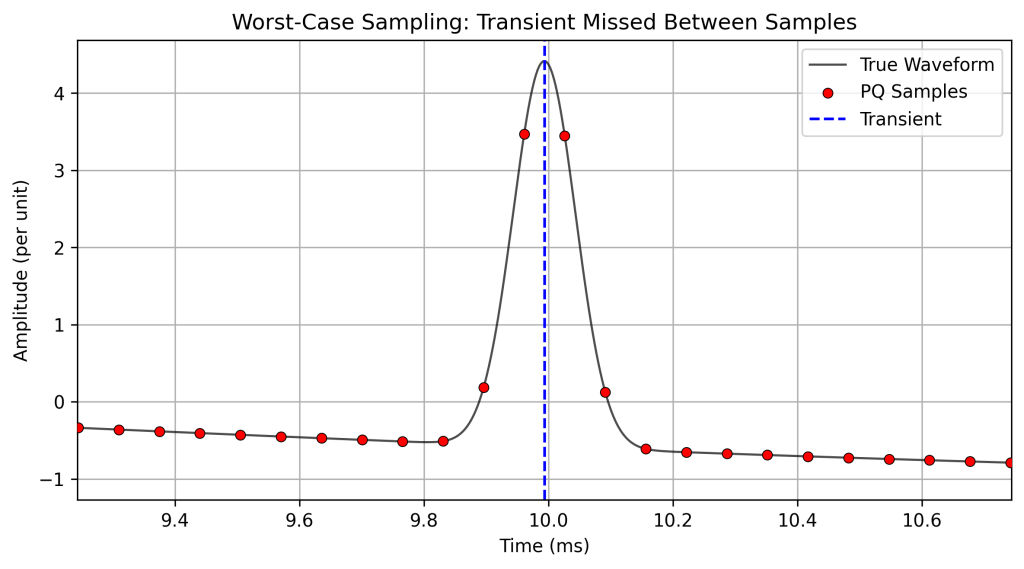
Electrical waveforms are continuous, but digital monitoring systems observe them at discrete points in time. At commonly deployed PQ sampling rates—on the order of a few hundred samples per cycle—each data point represents tens of microseconds of real time. Any electrical phenomenon that begins and ends between those sample points may not be directly captured. Instead, its contribution is averaged into neighboring samples or omitted entirely. Figure 1 shows a transient versus an RMS average, demonstrating the need for fast sampling and waveform capture, like those available on the Seeker or Bolt instead of simple rolling average.
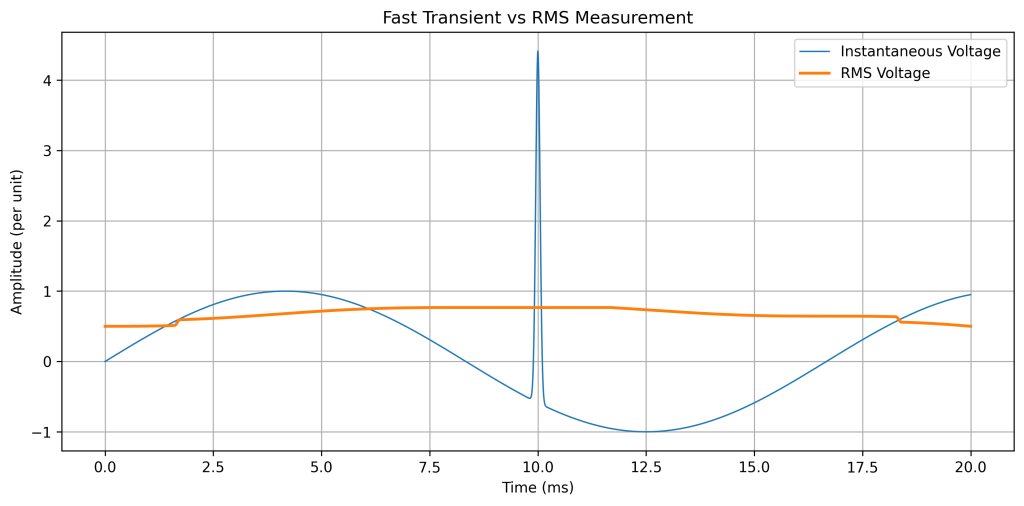
RMS voltage and current are energy-based measures intended to characterize sustained conditions. They are effective for identifying sags, swells, overloads, and harmonic distortion that persist over multiple cycles. They are not designed to represent short-lived peaks or steep rate-of-change phenomena. A brief impulse with high instantaneous current may contribute negligibly to an RMS calculation, even though it is capable of exceeding a protective threshold based on peak magnitude or accumulated .
Sampling below the dominant frequency content of a transient introduces an additional complication: aliasing. High-frequency components can be misrepresented as lower-frequency artifacts or absorbed into noise-like distortion. Ringing, commutation effects, or impulsive behavior may therefore appear as vague waveform roughness rather than discrete events. Figure 2 shows a worst-case transient whose peak occurs between samples. Note that while the peak isn’t fully captured, the 256 sample/cycle rate does partially capture the transient instead of masking it like the rolling average shown in figure 1. A high-resolution waveform capture platform like the Revolution would capture the entire 1MHz transient, including the peak.
A commonly used analogy is hydraulic water hammer. A pressure spike lasting only milliseconds can rupture a valve even if a pressure gauge averaged over a minute shows normal operating pressure. The system response is correct; the measurement simply failed to observe the relevant time scale. Electrical ghost trips follow the same logic.
The Utility–Facility Blind Spot
Many ghost tripping investigations converge at the interface between the utility distribution system and facility-owned infrastructure, where measurement responsibility and time resolution often differ. This boundary is not defined solely by ownership, but by changes in impedance, protection philosophy, and operational visibility. It is also where short-duration electrical phenomena are most likely to be generated, reflected, or amplified.
From the utility perspective, several sources of fast electrical disturbance are part of normal operation. Capacitor bank switching introduces abrupt changes in system reactance that can excite high-frequency oscillations. Insulator tracking, contamination-related leakage, or momentary micro-arcing can inject brief bursts of energy that self-extinguish without developing into sustained faults. Lightning protection systems are designed to conduct sharply and briefly, diverting impulse energy while leaving little trace in RMS-based monitoring.
Within the facility, modern electrical loads can produce similar fast behavior. Variable frequency drives, switch-mode power supplies, and large-scale server farms rely on rapid semiconductor switching. Inrush events during coordinated restarts or transfer operations can momentarily exceed instantaneous protection thresholds without developing into sustained overloads. Long cable runs and bus structures introduce impedance mismatches that can produce reflected waves, locally amplifying voltage or current.
What unites these grid-side and facility-side contributors is speed. The events occur quickly, decay rapidly, and may never register as abnormal when viewed through RMS-centric instrumentation. Yet they are fully real from the perspective of fast-acting protection. At the utility–facility boundary, this shared blind spot can obscure root cause and stall resolution.
Forensic Comparison Across Time Scales
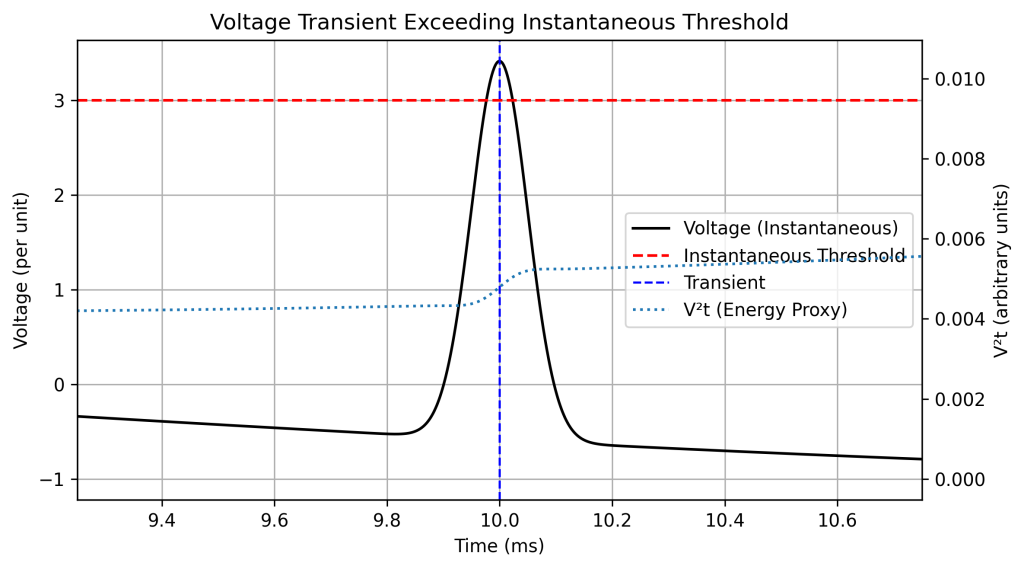
When investigating a ghost trip, the critical question is not whether a disturbance occurred, but how the same event appears when viewed at different time resolutions. Many electrical phenomena that trigger fast protection do not disappear entirely in conventional data—they are transformed, diluted, or misrepresented.
Investigative Protocol
Once a ghost trip is recognized as a time-domain visibility problem rather than a protection anomaly, investigation can shift from speculative fault-finding to structured, repeatable analysis.
First, the event must be anchored in time. Protective devices such as breakers, PDUs, and UPS systems maintain internal event logs that record the moment of operation. These timestamps provide the reference point for all subsequent correlation.
Second, the protective operation should be correlated with independent records, including PQ monitors, utility switching logs, facility control systems, and environmental data. The objective is coincidence, not magnitude; a minor irregularity aligned in time is more meaningful than a larger disturbance elsewhere.
Third, trip characteristics should be evaluated. Phase selectivity, instantaneous versus delayed operation, and repeatability under similar conditions often provide more insight than waveform magnitude alone.
Finally, investigators should assess likely directionality. Coincidence with known grid operations or weather activity suggests an upstream origin, while alignment with facility load changes or equipment transitions points downstream. This distinction narrows the investigative field and prevents unfocused mitigation.
Premature corrective action is a common and well-documented failure mode in complex electrical investigations. Adjusting settings or adding suppression without understanding the triggering mechanism may reduce symptoms while obscuring root cause. At this stage, explanation—not correction—is the objective.
Mitigation and Hardening
Once the nature and likely origin of a ghost trip are established, mitigation can proceed with purpose. The goal is not to eliminate all fast electrical behavior, but to ensure that legitimate transients do not produce disproportionate operational impact.
Operational adjustments may include coordinated review of instantaneous and short-time trip settings, performed in the context of system protection studies to preserve safety and selectivity. Procedural changes—such as staged load restoration or controlled transfer sequencing—can significantly reduce coincident inrush stress.
Physical hardening may be appropriate where repetitive or externally driven transients are identified. Surge protective devices can clamp impulse energy when correctly rated and bonded. Filtering may reduce high-frequency noise associated with power electronics. Grounding and bonding systems should be evaluated with high-frequency behavior in mind; paths adequate at 60 Hz may be ineffective at higher frequencies.
Over-hardening carries its own risks, including reduced sensitivity to legitimate faults and degraded coordination. Effective mitigation aligns protection behavior, system impedance, and corrective measures with the actual stresses present.
When mitigation is guided by time-domain understanding rather than assumption, both utilities and facilities benefit from reduced uncertainty and improved coordination. Protective systems continue to operate as designed, while mission-critical loads experience fewer unexplained interruptions.