
Abstract
Transformer energization events occur frequently in electrical distribution systems and often appear in power quality recordings. These events can produce large transient currents and waveform distortions that may initially resemble faults or abnormal system conditions. Without proper interpretation, energization events may trigger unnecessary investigations or be misclassified in power quality monitoring systems. This paper explains the electrical behavior that occurs when transformers are energized and describes the characteristic waveform patterns that appear in power quality data.
Introduction
Transformers are energized regularly in electric power systems. Energization events may occur during equipment commissioning, restoration following outages, feeder switching operations, or normal distribution automation activities. When a transformer is energized, the resulting electrical behavior can produce large transient currents and significant waveform distortion. These effects are often captured by power quality monitoring equipment installed on distribution feeders or at industrial facilities.
Electrical Behavior During Transformer Energization
Transformer energization is associated with a phenomenon known as magnetizing inrush current. When voltage is first applied to a transformer winding, the magnetic core must establish its operating flux level. Depending on the instantaneous point on the voltage waveform at which the transformer is energized, the magnetic flux in the core may temporarily exceed its normal operating range.
If the core enters saturation, the magnetizing current increases dramatically. Unlike normal load current, this current is not limited primarily by winding impedance. Instead, it is governed by the nonlinear magnetization characteristics of the transformer core.
Several factors influence the magnitude and waveform of inrush current:
- The point on the voltage waveform at which switching occurs.
- Residual magnetic flux in the transformer core.
- Transformer size and design.
- System impedance at the point of connection.
As a result, the initial current during energization may reach five to ten times the transformer’s rated current, even though the transformer is not supplying load power. The current waveform during this period is highly distorted and typically decays gradually as the core flux stabilizes.
Identifying Energization Events in Power Quality Data
When reviewing power quality recordings, several indicators can help engineers identify transformer energization events.
First, energization events typically produce a large current spike with relatively minor voltage disturbance. In contrast, faults generally cause substantial voltage sags along with large currents.
Second, the current waveform during energization is usually highly distorted and asymmetric. This distortion is much greater than that observed during most fault events, where current remains relatively sinusoidal.
Third, the current magnitude tends to decay gradually following the initial energization. The transient current may be large for several cycles and then steadily decrease as the transformer magnetizing flux stabilizes.
Finally, harmonic analysis often reveals significant second harmonic content, which is characteristic of magnetizing inrush current.
Differentiating Energization from Fault Events
Distinguishing transformer energization from fault conditions is essential for accurate interpretation of PQ recordings. Both events can produce large current magnitudes and may trigger monitoring alarms or protection systems. However, the underlying electrical mechanisms are very different, and those differences appear clearly in waveform data when examined carefully.
Fault events occur when an unintended low-impedance path forms in the power system, such as a phase-to-ground or phase-to-phase short circuit. Because the impedance is suddenly reduced, current rises rapidly and is limited primarily by the system impedance. This large current draw typically produces a significant voltage sag at the point of common coupling (PCC). In PQ recordings, faults, therefore, appear as simultaneous voltage dips and large current increases. Figure 1 displays a voltage and current waveform capture for a fault.
The current waveform during a fault is usually symmetrical and relatively sinusoidal, especially in the first few cycles before protection operates. Although the magnitude is high, the waveform shape remains dominated by the fundamental frequency of the power system. Harmonic content is generally limited, and the current remains fairly balanced across positive and negative half cycles. Another distinguishing feature is event duration. Fault currents persist only until protective devices operate to isolate the fault. As a result, fault events are typically very short, often lasting only a few cycles. Figure 2 displays the harmonic magnitudes of a fault.
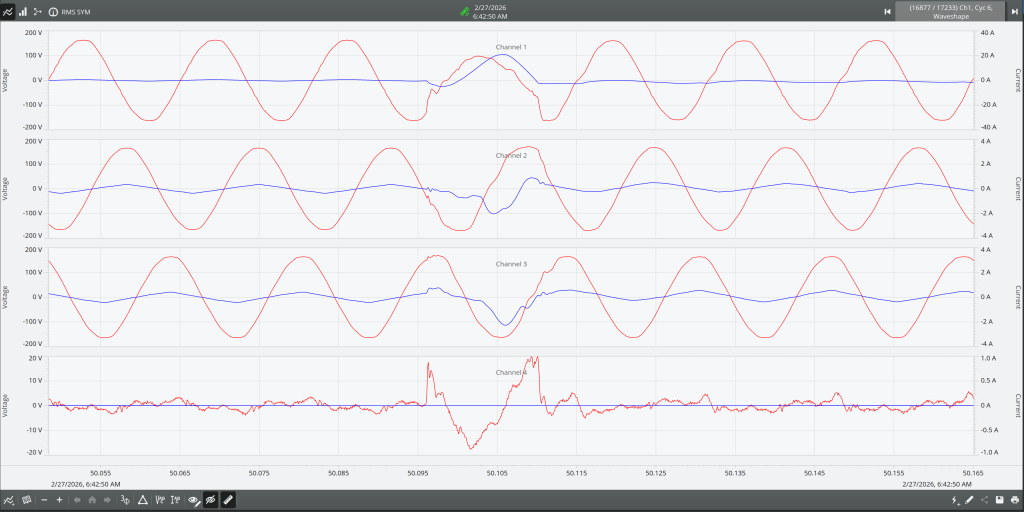
Figure 1: Voltage and Current Waveforms of a fault.
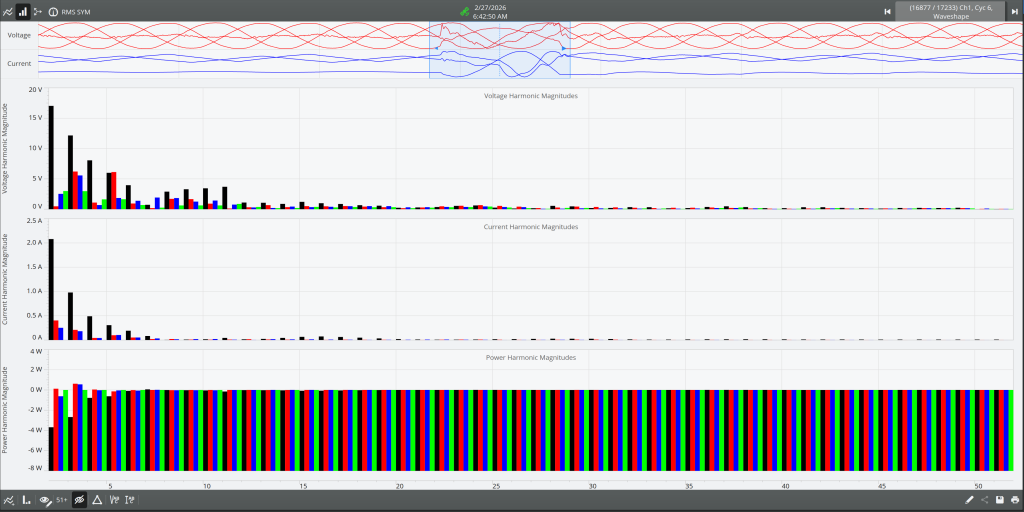
Figure 2: Harmonics graph of a fault.
Transformer energization events produce a very different set of waveform characteristics. When a transformer is energized, the magnetic core must establish its operating flux level. Depending on the switching instant and the residual magnetic flux already present in the core, the magnetic material may temporarily enter saturation. When saturation occurs, the transformer draws a large magnetizing inrush current. This current is not caused by a system short circuit but by the nonlinear magnetization behavior of the transformer core.
Because the inrush current is driven by magnetic saturation rather than system impedance, the current waveform becomes highly distorted and asymmetric. One half-cycle may contain much larger peaks than the other, producing a waveform that appears heavily skewed toward one polarity. This asymmetry is a key visual indicator in waveform recordings, as shown in Figure 3, where the current waveform exhibits strong asymmetry and distortion.
Another defining characteristic of transformer energization is the presence of strong harmonic components, particularly the second harmonic, which can be seen in Figure 4. The nonlinear magnetization curve of the transformer core introduces significant even harmonic content into the current waveform. Protection engineers often use this second harmonic signature to prevent transformer differential relays from misinterpreting inrush current as a fault.
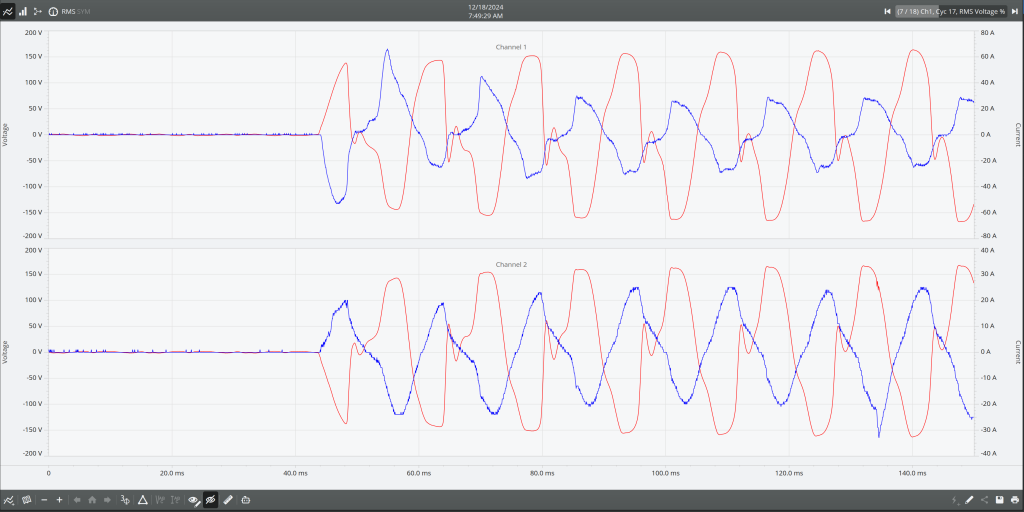
Figure 3: Voltage and Current Waveforms of transformer energization.
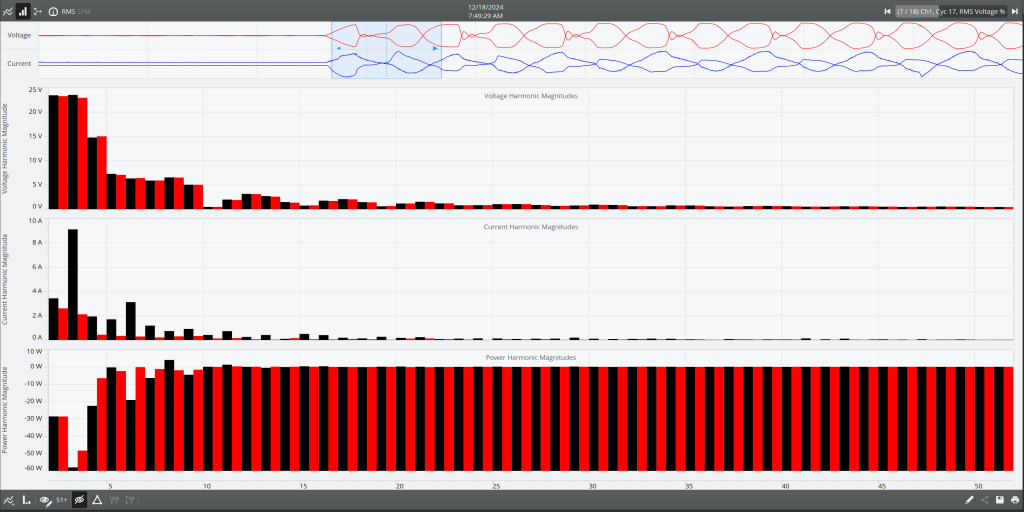
Figure 4: Harmonics graph of transformer energization.
Voltage behavior also differs between the two events. While a fault typically causes a large voltage sag, transformer energization produces only a modest voltage disturbance, especially in systems with relatively strong source impedance. The most prominent feature in PQ recordings is therefore the distorted current waveform rather than a severe voltage dip.
Finally, the current magnitude during energization decays gradually as the transformer core flux stabilizes and the magnetic circuit returns to normal operation. Instead of ending abruptly like a fault event, the inrush current decreases over several cycles or seconds, forming a decaying envelope in the current waveform.
Taken together, these differences provide a reliable method for distinguishing between faults and transformer energization in power quality data. By examining voltage magnitude, waveform symmetry, harmonic content, and event duration, engineers can identify the underlying cause of a disturbance and avoid misclassifying normal switching operations as abnormal system events.
Role of Power Quality Monitoring
Modern power quality monitoring systems are well suited to capture transformer energization events. High-resolution waveform recording allows engineers to examine the detailed shape of current and voltage signals during switching operations.
These recordings can help confirm that observed disturbances are associated with normal system operations rather than faults. Utilities may use PQ monitoring data to verify the behavior of newly installed transformers, evaluate switching practices, or investigate unexpected current events.
Conclusion
Transformer energization is a routine but distinctive event in power systems. The magnetizing inrush current that occurs during energization produces characteristic waveform patterns that are often captured by power quality monitoring tools.
These patterns typically include high initial current magnitude, waveform asymmetry, strong harmonic content, and a gradual decay in current amplitude. Because the associated voltage disturbance is usually limited, energization events can be distinguished from faults by examining both voltage and current waveforms.
Understanding these signatures through software like PQ Canvass allows engineers to correctly interpret PQ recordings and avoid misclassifying normal system operations as abnormal disturbances. As power quality monitoring becomes more widespread, the ability to recognize events such as transformer energization will remain an important skill for engineers analyzing power system behavior.