
Abstract
The increasing adoption of Vehicle-to-Grid (V2G) technology enables electric vehicles to operate as mobile inverter-based energy resources, fundamentally altering their interaction with distribution networks. While the power quality impacts of unidirectional electric vehicle charging have been widely studied, bidirectional operation introduces distinct challenges associated with grid synchronization, DC injection, harmonic emissions, and large-scale aggregation. This paper examines the power quality (PQ) characteristics of V2G-enabled electric vehicles, with emphasis on differences between charging and discharging modes. Particular attention is given to synchronization dynamics, asymmetries in converter operation, and system-level effects arising from the simultaneous discharging of multiple vehicles. The analysis highlights that V2G operation cannot be treated as a simple reversal of charging behavior and underscores the need for dedicated PQ assessment frameworks to support large-scale deployment.
Overview of V2G Converter Architectures
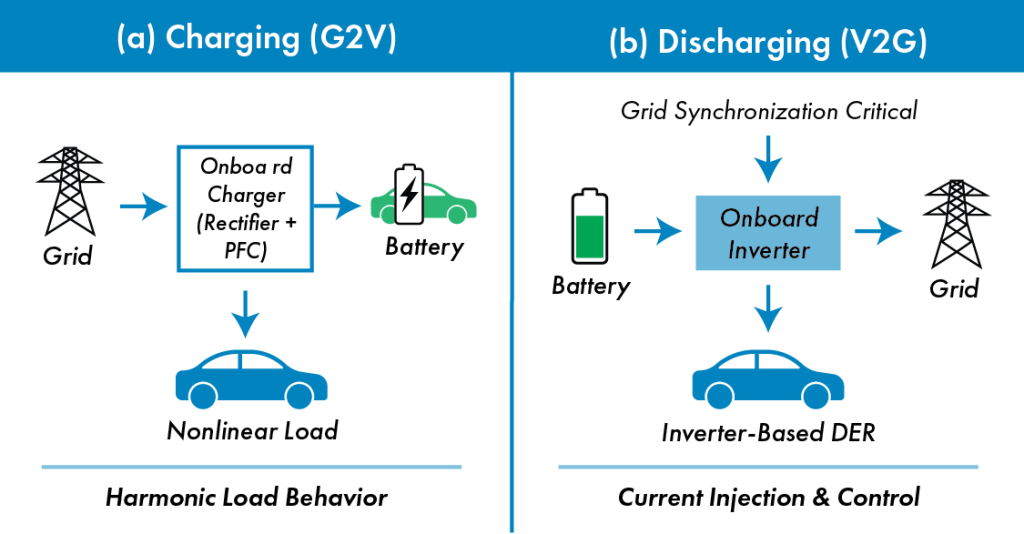
V2G capability is enabled by bidirectional power electronic converters integrated within the electric vehicle’s onboard charging system. Unlike conventional unidirectional chargers, which operate solely as grid-connected rectifiers, V2G converters must support controlled power flow in both grid-to-vehicle (G2V) and V2G modes while maintaining compliance with grid interconnection and power quality requirements. As illustrated in Figure 1, this bidirectional functionality results in fundamentally different grid interactions: during charging, the vehicle primarily exhibits harmonic load behavior, whereas during discharging, it operates as an inverter-based distributed energy resource that actively injects controlled current into the grid. This transition from load to source behavior imposes additional constraints on converter topology, control design, synchronization mechanisms, and protection recognition.
Single-Stage Versus Two-Stage Architectures
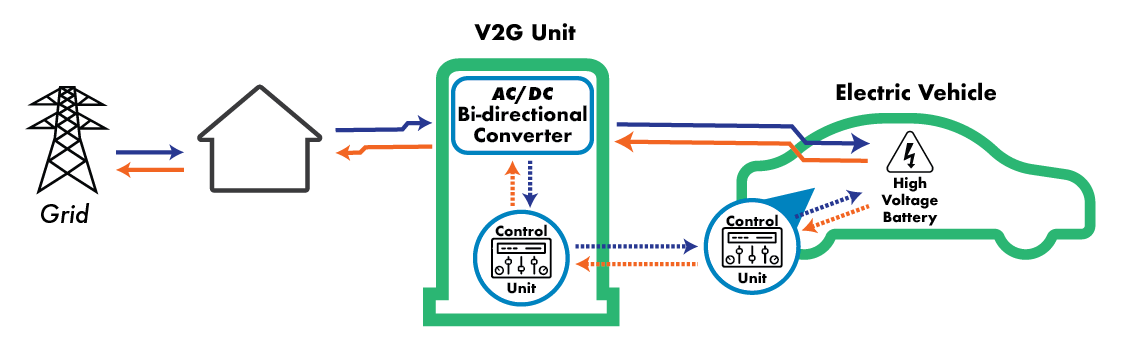
V2G converters may be implemented as either single-stage or two-stage architectures. In single-stage designs, the bidirectional AC/DC converter interfaces directly with the battery pack via a DC link, minimizing component count and system complexity. However, this approach limits control flexibility and may complicate battery management and isolation requirements.
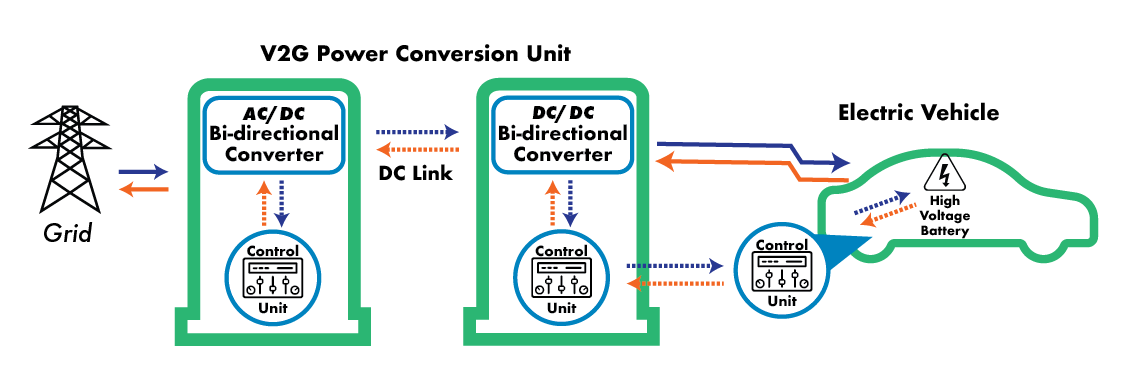
Two-stage architectures decouple grid interfacing from battery conditioning by introducing an intermediate bidirectional DC/DC converter between the battery and the DC link. This configuration allows independent control of battery current, voltage, and state-of-charge constraints, while the AC/DC stage focuses on grid synchronization and current regulation. From a power quality perspective, two-stage designs provide improved capability to shape grid current and mitigate harmonic distortion under varying operating conditions.
Grid Synchronization Challenges in Vehicle-to-Grid Operation
Accurate grid synchronization is a fundamental requirement for safe and stable V2G operation. During discharging, the electric vehicle’s onboard inverter must precisely align its output voltage and current with the grid in terms of frequency, phase angle, and voltage magnitude. Unlike unidirectional charging, where synchronization errors primarily affect power factor and current quality, synchronization inaccuracies in V2G can result in circulating currents, transient overcurrents, and protection system activation.
Most V2G-capable converters employ phase-locked loop (PLL) algorithms to estimate the grid phase and frequency. However, PLL performance can be significantly degraded under conditions commonly found in low-voltage distribution networks, including voltage unbalance, harmonic distortion, and frequency fluctuations. These disturbances can introduce phase estimation errors that manifest as oscillations in injected current or short-duration power quality violations, particularly during connection and reconnection events. These effects are illustrated in Figure 4, which shows the impact of PLL phase errors on the injected current during V2G operation under both steady-state and disturbed conditions.
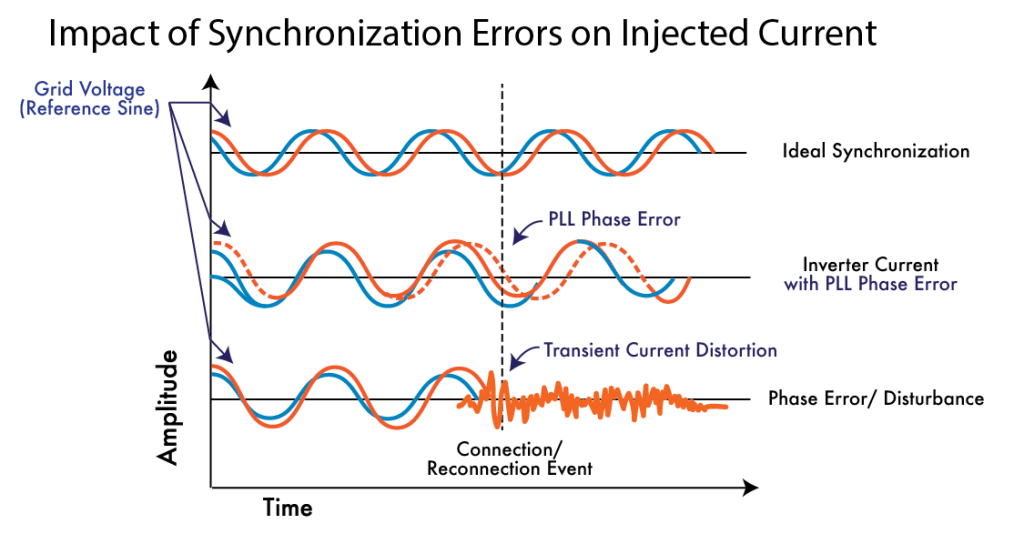
A unique challenge in V2G systems arises from the frequent connection and disconnection of mobile inverters at arbitrary grid locations. Each plug-in event requires rapid synchronization to avoid inrush currents and voltage disturbances, while disconnection events must be carefully managed to prevent phase discontinuities. Inadequate synchronization ramping can lead to abrupt power transitions that contribute to flicker, voltage steps, or momentary frequency deviations at the point of common coupling.
DC Injection into the AC Grid in Vehicle-to-Grid Operation
DC injection refers to the presence of a non-zero direct current component superimposed on the alternating current delivered to the grid by a power electronic converter. In V2G operation, DC injection represents a critical power quality concern due to the direct interface between the vehicle’s DC battery system and the AC distribution network through a bidirectional inverter.
In V2G-enabled electric vehicles, the onboard inverter converts DC battery power into AC grid-compatible current during discharging. Ideally, this conversion produces a purely sinusoidal current waveform with zero DC offset. However, in practice, unintended DC components may arise due to several mechanisms, including current sensor offset errors, asymmetric switching behavior in power semiconductor devices, non-ideal dead-time compensation, and control loop imbalances between positive and negative current directions. Bidirectional operation exacerbates these effects, as control parameters optimized for charging may not be perfectly symmetric when operating in reverse power flow.
The injection of DC into the AC grid can have disproportionate impacts even at relatively low magnitudes. Distribution transformers are particularly sensitive to DC bias, as DC components can shift the operating point of the magnetic core into partial saturation. This saturation increases core losses, elevates transformer temperature, and leads to waveform distortion of the secondary voltage. Over time, persistent DC injection can accelerate transformer aging and reduce system reliability.
Power Quality Characteristics of Charging Versus Discharging Electric Vehicles
Electric vehicles exhibit fundamentally different PQ characteristics depending on whether they are operating in charging or discharging mode. While both modes rely on power electronic converters, the direction of power flow, control objectives, and interaction with the grid differ substantially, resulting in distinct PQ profiles at the point of common coupling.
During charging, electric vehicles primarily behave as nonlinear loads. The onboard charger draws current from the grid to replenish the battery, and modern chargers typically employ active rectification with power factor correction to shape the input current. As a result, charging-related PQ concerns are largely associated with harmonic current emissions, reduced power factor under partial loading, and potential voltage distortion due to aggregated demand. These effects are generally predictable, relatively steady-state, and have been extensively characterized in existing standards and studies.
In contrast, a discharging electric vehicle operates as a grid-connected inverter and functions as a distributed energy resource. In this mode, the vehicle injects controlled current into the grid, requiring precise synchronization with grid voltage and frequency. The PQ profile during discharging is therefore influenced not only by harmonic emissions but also by phase tracking accuracy, control loop dynamics, and transient behavior during power setpoint changes. Discharging EVs may introduce additional spectral components, including interharmonics, particularly when providing grid support services such as frequency regulation or ramped power support.
Another key distinction lies in the symmetry of converter operation. Control parameters and hardware elements optimized for charging do not necessarily exhibit identical behavior during discharging. This asymmetry can manifest as differences in harmonic spectra, increased sensitivity to DC injection, and altered transient response. Consequently, PQ metrics derived from charging operation alone may underestimate or fail to capture PQ impacts associated with V2G operation.
Aggregation Effects of Simultaneous Vehicle-to-Grid Discharging
While the power quality impacts of a single V2G-enabled electric vehicle may be limited and localized, the simultaneous discharging of multiple vehicles introduces system-level effects that can significantly alter the power quality profile of distribution networks. As V2G penetration increases, aggregated inverter behavior becomes a dominant factor in determining voltage distortion, harmonic levels, and overall network stability.
When multiple EVs discharge concurrently on the same feeder or distribution transformer, their injected currents combine vectorially. Unlike stochastic load behavior, coordinated or price-driven V2G operation may cause multiple inverters to respond in a correlated manner, reducing the natural diversity that typically mitigates harmonic summation. Under such conditions, harmonic and interharmonic components may add constructively, leading to total harmonic distortion (THD) levels that exceed those predicted by single-device analysis.
The interaction between aggregated inverter-based V2G sources and distribution system impedance further complicates power quality behavior. Distribution feeders exhibit frequency-dependent impedance due to line inductance, capacitance, and installed capacitor banks, creating conditions under which the combined harmonic and interharmonic emissions of multiple discharging EVs may align with feeder resonant frequencies. In such cases, relatively small individual injections can result in disproportionately large voltage distortion. Aggregated V2G operation can also affect transformer performance, as the cumulative injection of DC or low-frequency components from multiple vehicles connected to a common transformer increases the likelihood of core biasing, partial saturation, elevated losses, and accelerated thermal aging. Beyond steady-state impacts, coordinated discharging across a fleet of EVs may introduce transient PQ disturbances, as synchronized changes in power setpoints can produce voltage steps or flicker at the point of common coupling, particularly in scenarios driven by centralized control or grid service participation.
Conclusion
Vehicle-to-Grid operation fundamentally alters the role of electric vehicles within distribution networks, transforming them from predominantly nonlinear loads into mobile inverter-based energy resources. This paper has shown that bidirectional operation introduces power quality challenges that are not adequately captured by existing analyses of unidirectional charging. Differences in synchronization behavior, DC injection susceptibility, harmonic emission profiles, and transient response highlight the inherent asymmetry between charging and discharging modes.
Furthermore, the simultaneous discharging of multiple V2G-enabled vehicles introduces system-level effects that can amplify power quality impacts through harmonic summation, resonance with feeder impedance, and increased stress on distribution transformers. These aggregation effects underscore the importance of considering V2G deployment not only at the device level but also within the broader context of distribution system planning and operation.
Overall, the results indicate that V2G operation cannot be treated as a simple reversal of conventional EV charging. Dedicated power quality assessment methods, improved inverter control strategies, and enhanced monitoring frameworks will be required to ensure that large-scale V2G integration supports grid reliability without compromising power quality.