
Abstract
Many power quality engineers are familiar with the concepts related to the power triangle such as real power, reactive power, apparent power and power factor. The construction of the power triangle is a crucial part of understanding the power delivered from a source to a load. This construction has one major downside, that being it is only valid for sinusoidal signals. Often harmonics are present in the voltage or current waveform, which means that the results from the power triangle calculation are approximately correct but do not tell the full story. This paper describes a novel mathematical framework based on the work of Francisco Montoya, which naturally extends the ideas of the power triangle to domains of distorted waveforms.
Review of the Power Triangle
Suppose there is a voltage sinusoidal signal with amplitude V and phase offset φ across a load consisting of linear passive components which induces a sinusoidal current signal with amplitude I and phase offset θ, where the direction of current is assumed to be toward the load. Because the calculation of phase offset is always done relative to some assumed starting point, we can make that point be the rising zero crossing of the voltage signal and assume that φ=0. Using the phasor transformation, we can directly associate the voltage signal and the current signal with a unique complex number, where the magnitude matches the sine wave amplitude and the angle off the horizontal axis matches the sine wave phase offset.
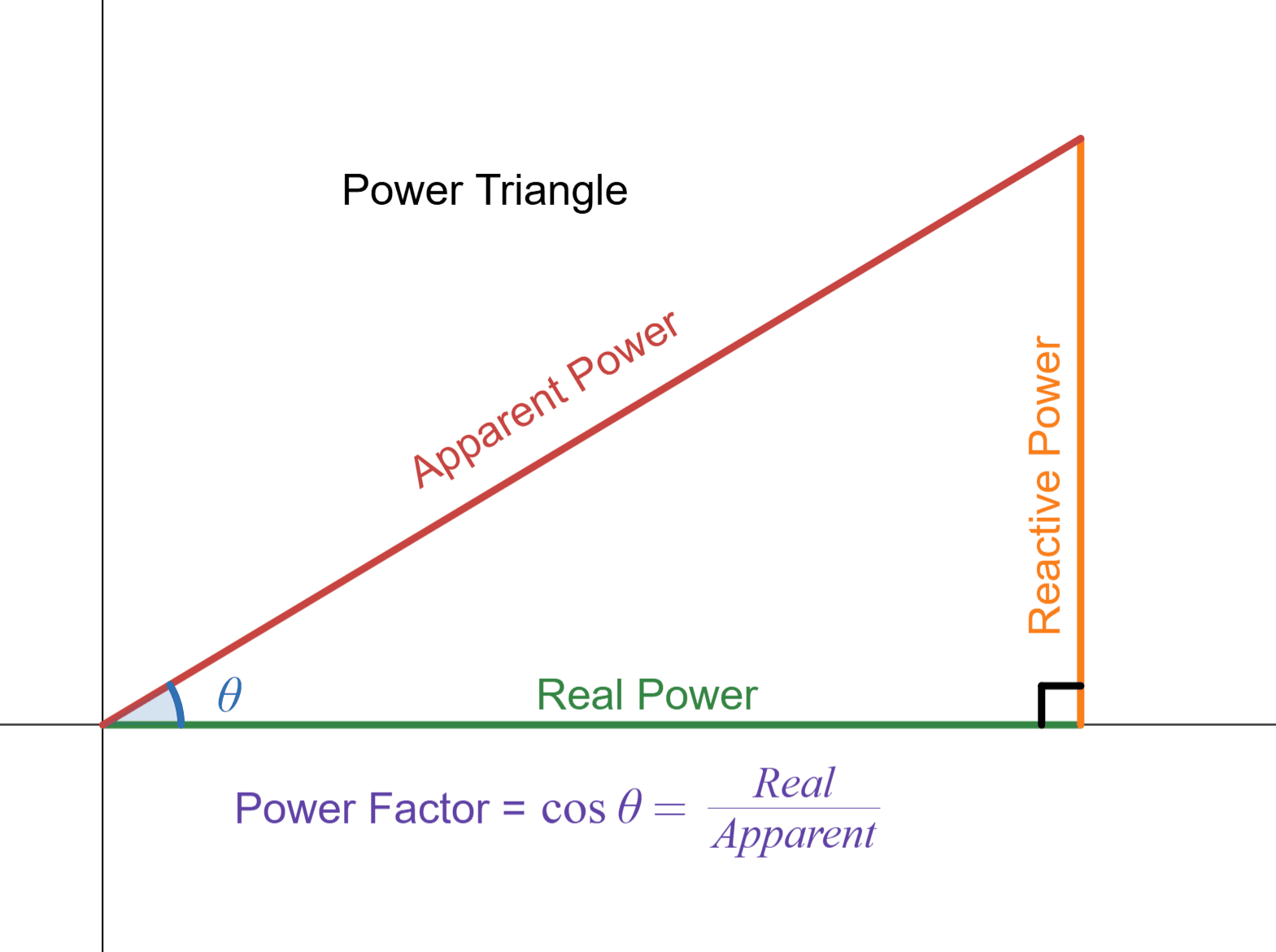
In the DC case, power is defined to be voltage times current. In the sinusoidal case, we can do a similar thing and define the power phasor to be the product of the voltage phasor and the current phasor. The result is a complex number S with magnitude |V|⋅|I| and angle θ. This complex number together with the horizontal axis defines the power triangle and the associated power quantities and can be read off from its lengths. Apparent power is the magnitude V⋅I, real power is the real component of S along the horizontal axis, and reactive power is the imaginary component of S opposite the angle θ. Power factor is defined to be the cosine of θ or real power divided by apparent power. Figure 1 shows a diagram of these relationships.
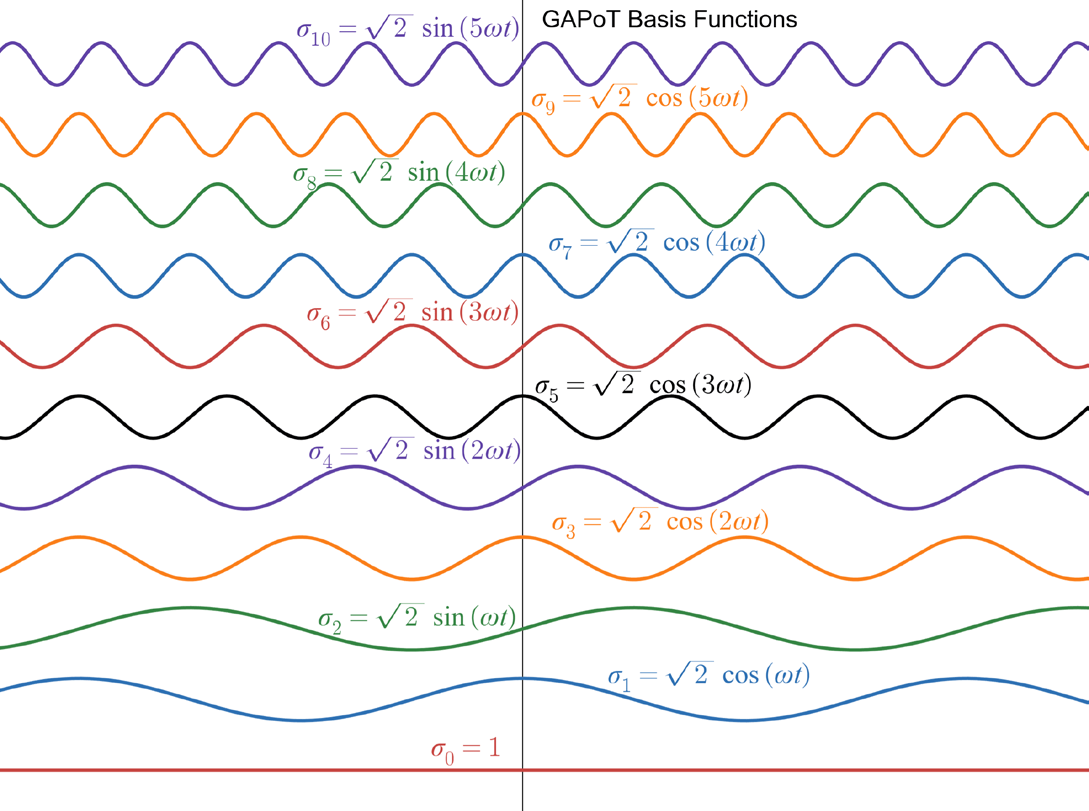
σ-Basis for the GAPoT Framework
Francisco Montoya et. al. from the University of Almeria in Spain developed Geometric Algebra Power Theory (GAPoT) as a mathematical framework to extend the power triangle to situations involving harmonics. They proposed defining the following 2n+1 dimensional function vector space to parameterize signals up to the nth harmonic.
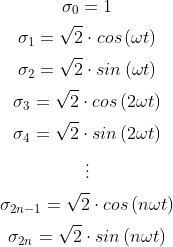

which means that

Within each harmonic frequency, there must be two independent vectors to parameterize the full two-dimensional space of amplitude variation and phase shift variation. Including just one vector would only permit parameterizing amplitude variation. The √2 factor is included just to make the inner product of a function with itself equal to 1 and not 1/2. The orthonormality condition makes decomposing a signal into component parts very easy and nice. For example, given some signal s(t) defined on the interval, 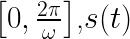 it can be approximated as:

This sum is the best possible approximation of s(t) using the given basis and if the basis is extended to a greater harmonic range, this part of the sum will remain unchanged. This is the same idea as the traditional Fourier series decomposition.
GAPoT Framework
For each k from 0 to 2n, define the sequence V[k] and I[k] as the sequence of coefficients on σk defined above for the voltage signal v(t) across a load and for the current signal i(t) through it.
Then

Montoya defines a multivector geometric power quantity M as VI, the geometric product of the vector V and the vector I. Because this geometric product is a restriction on the tensor product, the product VI is able to be expanded like ordinary multiplication, but it is in general not commutative like ordinary multiplication.
This means that

The defining property of this product is that for any given vector v, vv = v⋅v, meaning the geometric product of a vector with itself, is defined to be the dot product. This implies that σiσj=1 whenever i=j. Applying this restriction property to the vector sum v+w yields the following result:
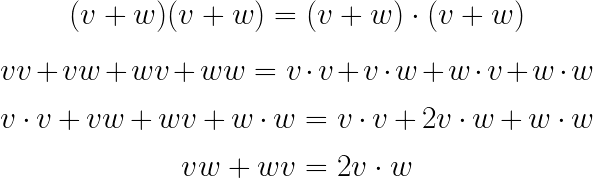
If the vectors v and w are perpendicular, then the right hand side is 0, meaning vw=-wv. This is the case for the σiσj terms in the above expression whenever i≠j. The expression for M is now:
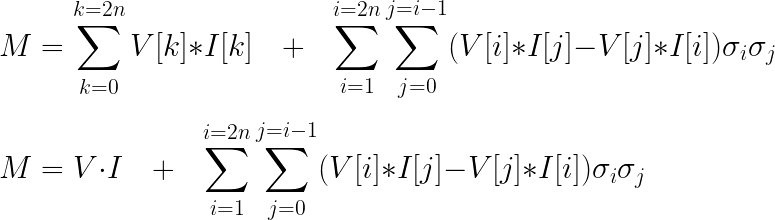
The first term is the dot product between the V vector and the I vector and is just an ordinary number. This part represents the real power component. The other terms where i≠j correspond to an oriented two-dimensional segment spanned between σi and σj and is referred to as a bivector. These bivector terms serve the same purpose as the imaginary unit i, because:
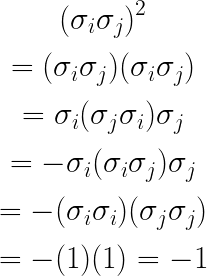
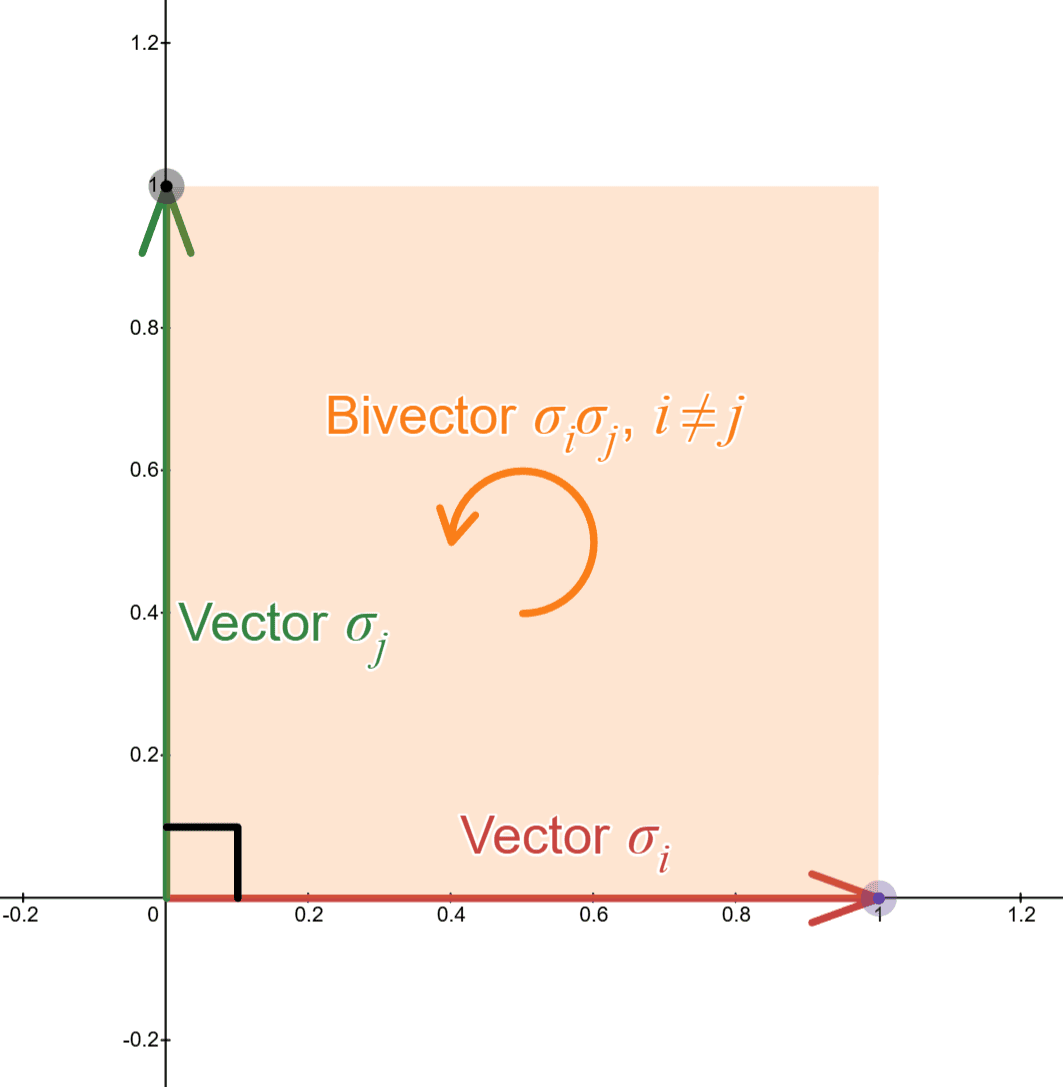
Yhey are, however, more specific than the imaginary unit because they encode specific directions of rotations in the 2n+1 dimensional function space, whereas the complex unit only specifies rotations in 2-dimensional space. Figure 3 gives a simple diagram of a Bivector, where σi and σj are represented as perpendicular arrows. Then the bivector σiσj is represented as a signed area segment in orange, which is equal in area to the parallelogram segment formed by σi and σj vectors.
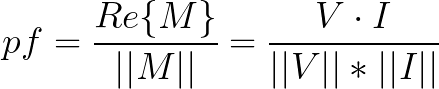
The sum of all the bivector terms represents the reactive power component of M and M itself is the apparent power. ||M|| is the size of the apparent power and is defined to be:

Power factor is then just the ratio of the real component of M to the size of M.
Montoya mentions that bivector terms where the σi and σj components represent sine waves of the same frequency but different phase are terms that are able to be compensated for by passive components like capacitors and inductors. However, bivector terms where the σi and σj represent different frequencies correspond to a kind of frequency scattering that is only possible to correct or mitigate with active filter networks.
Comparison with Power Triangle
It is instructive to compare this definition with the standard power triangle. Using just

we can write the voltage and current waveforms as:
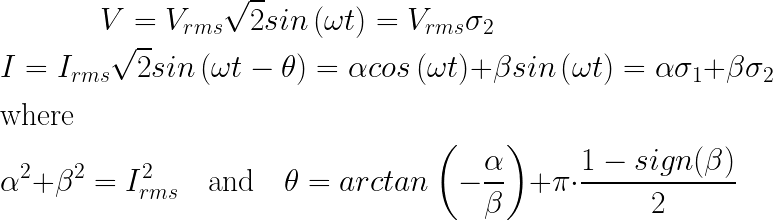
Using this GAPoT framework,

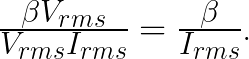
This means that real power is  and the power factor is:
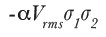
The Reactive Power is the bivector component of M, which is:
Using the traditional power triangle method V can be associated with the phasor Vrms∠0 and the current I is associated with the phasor Irms∠θ. Now set complex number S to be:

The power factor is then the cosine of this triangle.
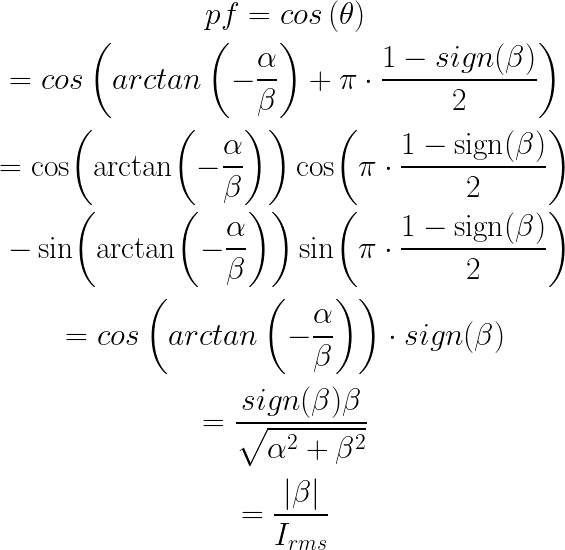
It physically doesn’t make sense for β to ever be negative because that would mean a positive voltage is applied to a load and the current into the load is negative and it becomes a current source against the applied voltage. This then means that the power factor is  just like the GAPoT result.
The reactive power according to the power triangle is given by:
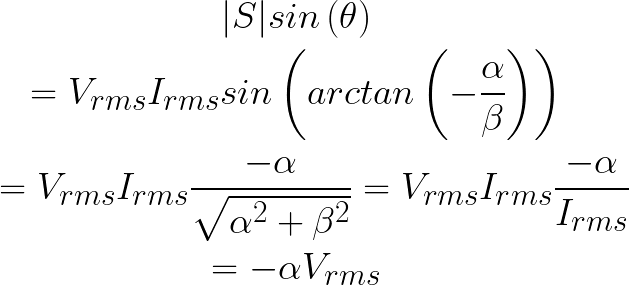
This exactly matches the expected result from the GAPoT theory and demonstrates that when the voltage and current signals are pure sine waves, the results of the Geometric Algebra Power Theory are in agreement with the results of the traditional power triangle approach.
Conclusion
The power triangle is a useful construction in the field of power quality. It allows several ideas related to power, such as real power, apparent power, reactive power and power quality to be drawn on a diagram that explains the relationships between the different quantities. The major drawback of this construction is that it is only exactly valid for pure sinusoidal signals and as signals become more distorted, this construction describes less of the real picture. Francisco Montoya et. al. developed a mathematical framework that extends the power triangle to include distorted waveforms. This is accomplished by first establishing an orthonormal function basis {σ0, …, σ2n} to parameterize signals up to the nth harmonic and mapping the voltage and current signals into this basis. Then they define a multivector power quantity M as VI. The purpose of this paper was to develop and explain some of Montoya’s research in this area.
Source
Montoya, F. G., Alcayde, A., Arrabal-Campos, F., Baños, R., & Roldán-Pérez, J. (2020). Geometric algebra power theory (GAPoT): Revisiting apparent power under non-sinusoidal conditions. arXiv. https://arxiv.org/abs/2002.10011