Abstract
Global cumulative investment in data centers between 2026 and 2030 is projected to reach $3 trillion. This explosive growth is straining electric grids worldwide. This white paper summarizes the IEEE SA Industry Connections report (IC25-004), which surveys active efforts by grid operators, utilities, regulators, and standards bodies to develop the technical requirements needed to safely and reliably interconnect large-scale data centers with the bulk power system (BPS). The central finding: while many organizations are responding, there is a critical lack of harmonized, global standards — a gap that IEEE is uniquely positioned to fill.
Data Centers and Grid Reliability
There has been unprecedented load growth in data centers. They now consume an estimated 3% of global electricity, projected to reach 5–12% of U.S. electricity use within 3–5 years. BloombergNEF’s 2025 forecast was 35% higher than its initial April 2025 projection. There have been no agreed-upon definitions of data center capacity, which complicates long-range planning. Load forecast uncertainty amounts to 250 TWh/yr globally.
Large loads can cause voltage-sensitive load reduction events (1,500 MW observed in ERCOT and Eastern Interconnection), frequency overshoot, and cascading instability. Data centers can be built in months; generation and transmission upgrades take years, creating dangerous mismatches.
New standards are needed for ramp rates, voltage/frequency ride-through, power quality, load modeling, backup power behavior and real-time data sharing.
Regulatory Response
The NERC Large Load Task Force (LLTF), established in 2024, published white papers on characteristics and risks of large loads and a reliability guideline on risk mitigation that was released for comment in November 2025. This guideline identified seven BPS risk categories including stability, power quality, and cybersecurity.
The NERC Load Modeling Working Group (LMWG) is developing a Data Center Technical Reference (expected Q2 2026) to standardize how data centers are modeled in power system studies.
In October 2025, DOE directed FERC to assert jurisdiction over large-load interconnections exceeding 20 MW.
FERC’s resulting ANOPR (Advance Notice of Proposed Rulemaking) proposes generator-style interconnection procedures, hybrid facility frameworks, and expedited 60-day timelines for curtailable loads.
Grid Operator and Utility Responses
The report surveyed 12 grid operators and utilities across North America, Europe, and Australia. While each organization has developed its own approach shaped by regional grid conditions, regulatory structures, and the pace of data center growth, a clear set of converging priorities has emerged:
- Interconnection process formalization: Most operators have created or are developing dedicated large-load interconnection pathways, moving away from case-by-case treatment toward structured, repeatable processes with defined milestones and data submission requirements.
- Performance and ride-through mandates: Virtually all operators now require or are developing voltage and frequency ride-through standards to prevent large loads from tripping offline during minor grid disturbances and compounding system stress.
- Load modeling and data requirements: Operators are mandating detailed, validated load models — including dynamic, electromagnetic transient, and steady-state representations — as a prerequisite for interconnection approval.
- Ramp rate and oscillation controls: Several operators have introduced explicit limits on how fast data centers can ramp power consumption and requirements to mitigate power oscillations introduced by AI and high-density compute workloads.
- Ongoing evolution: All surveyed organizations acknowledge their requirements are still developing, underscoring the urgency of harmonized global standards to provide consistency for data center developers operating across multiple regions.
Industry Group and Standards Body Initiatives
ESIG (Energy Systems Integration Group) launched a Large-Loads Task Force in December 2024 covering eight domains: data collection, load forecasting, interconnection process, requirements, modeling, market design, transmission planning, and resource adequacy. First publications are expected Q1 2026.
The IEEE Power and Energy Society (PES) has multiple active task forces including those on Data Center Interaction with T&D Systems (report due July 2027), Data Center and AI Load Integration (DALI TF), Large Electronic Load Modeling, and Protection/Automation (PSRC C54). IEEE IAS is developing guidelines for Modular Data Center electrical design with a target of December 2029.
International Council on Large Electric Systems (CIGRE) has a task force on “Role and Requirements for Large, Inverter-Based Loads” covering fault ride-through, power quality, resource adequacy, and grid code needs. EPRI DCFlex launched an initiative in 2025 to transform data centers into active grid resources through flexible design, utility program development, and real-world Flexibility Hubs.
Key Findings and Standards Gaps
There are no industry-wide standards that currently set consistent capability or performance expectations for data centers as grid loads. Therefore, utilities are each independently developing grid codes which, in turn, is creating a fragmented patchwork of requirements that raises costs and complexity for global data center operators. Common requirements converging across regions include: voltage/frequency ride-through, ramp rate limits, oscillation control, power factor, post-fault active power recovery, harmonics, and dynamic load modeling. Computing hardware is designed to a single global standard, yet must now must comply with dozens of divergent grid
codes — an inherently inefficient and risky situation.
Path Toward Harmonized Standards
The report calls on IEEE to lead the development of new global standards covering:
- Data Center Interconnection Processes and Data Requirements — standardized modeling data for steady-state, phasor-domain, and electromagnetic transient studies.
- Data Center Performance and Interoperability — ride-through capabilities, ramp rates, oscillation control, power quality, post-fault recovery, and communications protocols.
- Co-Located Generation and Data Center Coordination — operational and planning standards for facilities that pair on-site generation with data center loads.
- Data Center Modeling for Power System Studies —
- data requirements for steady-state, positive-sequence phasor, and electromagnetic transient analyses, including model validation and benchmarking procedures.
- Certification and Testing — a compliance framework analogous to those established for inverter-based resources.
- “Chips-to-Grid” Design Integration — grid performance requirements spanning the entire data center design chain, from semiconductor components to facility-level systems.
- Standards Evolution Roadmap — a framework for updating standards as AI workloads and liquid cooling systems continue to reshape data center load characteristics.
Power Quality Issues from Data Centers
Much of the new data center growth is due to the rise of AI training and usage, which presents new challenges to utilities. Some of these challenges include:
- Harmonic Distortion: Data centers are packed with non-linear loads: servers, routers, and Uninterruptible Power Supplies (UPS). These devices do not draw current in a smooth, sinusoidal wave; instead, they pull it in short, rapid pulses. These pulses create harmonics that flow back into the utility’s transformers.
- Rapid Load Fluctuations: With the rise of AI training, data center power demand has become bursty. Unlike traditional cloud computing, which is relatively stable, AI workloads, like training of Large Language Models, can cause power demand to swing by hundreds of megawatts in seconds. These sudden surges create voltage sags or swells on the local grid.
- Control Interaction Oscillations: Modern data centers use sophisticated Power Electronic Interfaced Loads (PEILs)—specifically high-speed rectifiers in UPS systems and server power supplies. These devices use “closed-loop” control systems to maintain a steady output. If the utility’s grid is weak (low short-circuit ratio), the data center’s controllers and the grid’s impedance can start fighting each other. This creates Sub-Synchronous Oscillations (SSO). These are oscillations at frequencies lower than the standard 60Hz. They can travel long distances back into the grid, potentially causing mechanical fatigue in the shafts of distant power plant turbines or tripping protective relays.
- AI Pulse Oscillations: AI training is unique because it is massively parallel. When an AI model finishes a computation step and moves to the next, thousands of GPUs might ramp their power consumption up or down at the exact same millisecond. If these computation cycles happen at a regular interval (e.g., every 2 seconds), they create a periodic oscillation in power demand. If this AI pulse frequency happens to match the natural resonant frequency of the utility’s transmission lines or nearby capacitor banks, it can lead to voltage instability.
- Harmonic Resonance: The oscillation aspect is a specific risk. Data centers use large banks of capacitors to keep their power factor high. These capacitors can interact with the inductance of the utility’s transformers to create a resonant circuit. If the data center (or a neighbor) produces even a small amount of harmonic current at that specific resonant frequency, the oscillation gets amplified significantly. This can result in localized high-voltage spikes.
How to Analyze Data Center Power Quality Issues
PMI’s recorders can detect these power quality issues and report them to PQ Canvass, PMI’s web-based cloud software which can, in turn, alert users to these issues in near real-time.
Additionally, this data can be analyzed with Merlin™ — a Large Language Model — driven analysis tool built specifically for integration into PQ Canvass. Merlin™ is designed to review all major elements of a PQ dataset and surface the most relevant issues, helping engineers move quickly from raw data to focused, actionable insight.
As grid and load complexity increases and data centers proliferate, utilities face a torrent of sensor data, ranging from simple RMS voltage and current to complex distortion, flicker, and stability metrics. In this environment, artificial intelligence is not replacing engineers — it is amplifying their interpretive capacity. Systems such as Merlin™ represent a quiet but powerful shift: instead of asking engineers to read every chart, they have “eyes on” every piece of data — classifying, ranking, spotting patterns, and summarizing what matters — so the human expert can act sooner and with greater confidence.
Conclusion
The data center boom is outpacing the grid’s ability to plan, interconnect, and operate reliably. While global operators are responding, the absence of harmonized standards threatens both grid reliability and data center deployment timelines. Coordinated IEEE standards development — built on the converging practices documented in this report — is urgently needed.
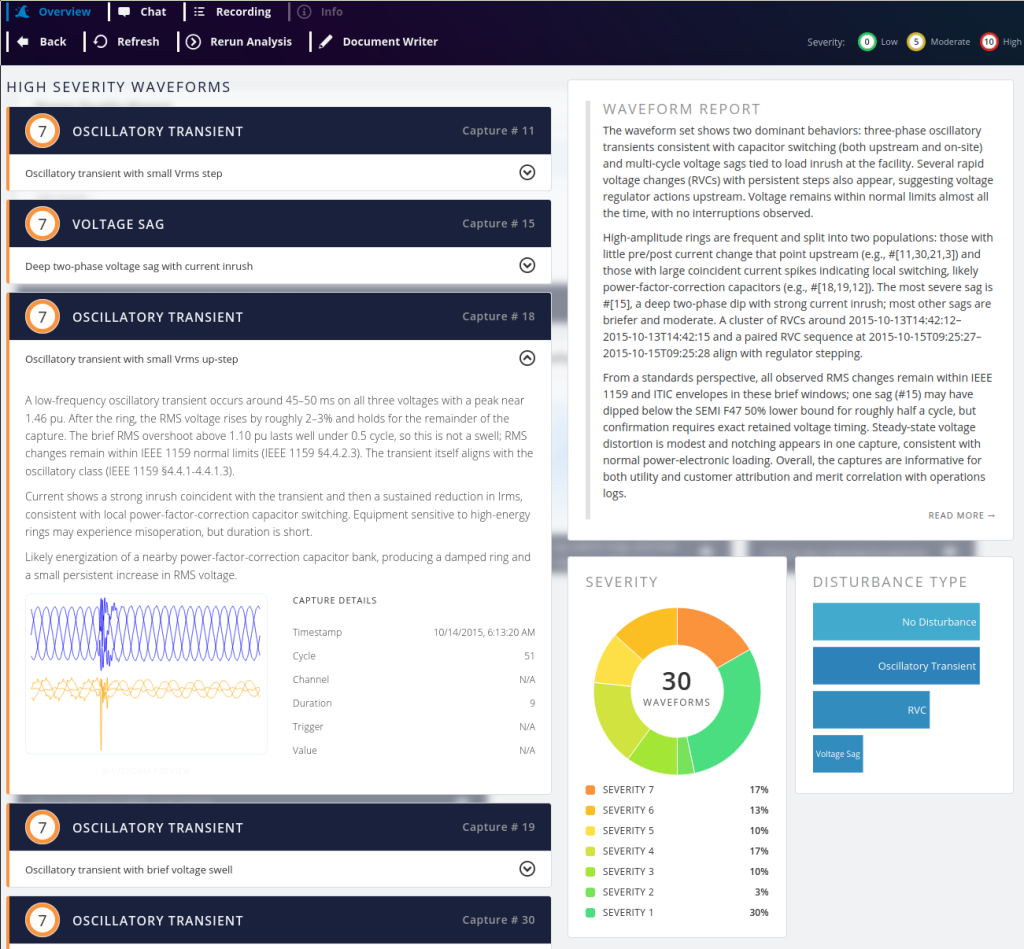
Figure 1. Merlin™ waveform analysis of oscillatory transients in a PQ Canvass recording.
Citation
Data Centers Standards Needs Analysis and Recommendations Activity, “Review of Industry Efforts and Standards of Grid Readiness For Data Center Deployment,” Review of Industry Efforts and Standards of Grid Readiness For Data Center Deployment 29 Jan. 2026 (ieeexplore.ieee.org/document/11366058)
Additional Resources
To see Merlin™ in action scan the QR code below or visit
www.powermonitors.com/merlin-in-action