Abstract
In the world of electrical engineering and power distribution, understanding the relationship between different voltage types is essential. One of the key distinctions in three-phase power systems is the difference between line-to-line (delta) and line-to-neutral (wye) voltages. This white paper explores what delta voltage is, why it is valuable in both industrial and commercial applications, and how it can be calculated from wye voltage configurations.
What Is Delta Voltage?
Three-phase power systems are the standard for electrical distribution in industrial and commercial applications. Unlike single-phase power, which delivers power through one live wire and one neutral, a three-phase system delivers power through three live conductors, with voltages that are 120 degrees out of phase from each other.
There are two main configurations for these systems:
- Wye (Star) configuration
- Delta (Triangle) configuration
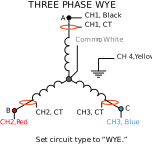
Fig. 1 Wye configuration three phase system
In a wye configuration, the three phase windings are connected with one end joined together at a common neutral point, forming a “Y” shape. The other ends connect to the line conductors.
In this setup:
- Line-to-neutral voltage (VLN) is the voltage between any line and the neutral
- Line-to-line voltage (VLL) is the voltage between any two line conductors
One of the most useful aspects of a wye system is its ability to supply two different voltages: a higher line-to-line voltage and a lower line-to-neutral voltage. This makes it ideal for buildings or systems requiring both high-power equipment and standard 120V or 240V devices.
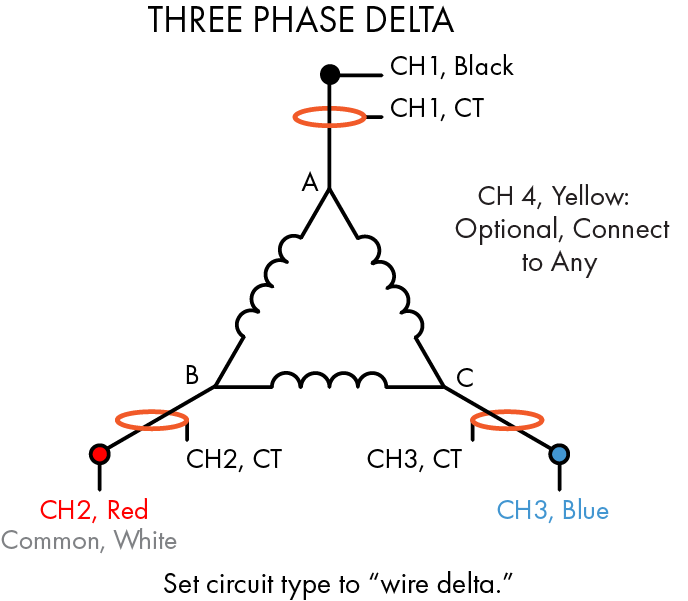
Delta voltage, also known as line-to-line voltage, is the voltage measured between any two of the three conductors in a three-phase power system.
In a delta configuration, the three phase windings of a transformer or generator are connected in a closed loop (a triangle). Each corner of the triangle is a connection point for the line wires. There is no central neutral point unless one is artificially created with a ground reference.
This configuration has the following characteristics:
- The line voltage equals the phase voltage
- There is typically no neutral wire
- Loads can be balanced or unbalanced
Where Are Delta Configurations Used?
One of the most common uses of delta voltages is in three-phase induction motors, which are often configured to run on delta voltage supplies (e.g., 400V, 480V, 600V line-to-line). Delta connections provide higher starting torque and are typically used in heavy machinery (compressors, pumps, conveyors), HVAC systems (chillers, air handlers), mining and milling equipment. Delta configurations are also prevalent in power transformers. Delta-Wye transformers are used to supply both line-to-line (for motors) and line-to-neutral loads (for lighting), while Delta-Delta transformers are used for industrial loads. In generator and UPS systems, delta connections provide the ability to maintain synchronization with grid-supplied delta systems. Overvoltage protection, undervoltage relays, and surge protection devices are often set based on line-to-line voltage levels, even in a wye system. Accurate calculation ensures correct operation of these systems.
Delta Voltages in Wye System
Although delta voltages are primarily associated with delta configurations, their role in wye systems is critical for diagnosing problems in a three-phase system including load imbalances, phase loss, and transformer anomalies. Delta voltages reflect the relative vector difference between two phases, often revealing issues that are masked when only phase-to-neutral voltages are considered.
To measure delta voltages in a wye system, technicians typically use a three-phase voltmeter or power quality analyzer (including a Power Monitors Seeker or Bolt) capable of recording phase-to-phase voltages. Calculation from the wye voltages looks like this:
- VAB = VA – VB
- VBC = VB – VC
- VCA = VC – VA
These measurements are vector differences and can show angular or magnitude deviations from expected values. The expected line-to-line (delta-equivalent) voltage can be calculated from the line-to-neutral voltage using this formula:
VLL = √3 • VLN
Where:
- VLL = Line-to-line voltage
- VLN = Line-to-neutral voltage
Here are some particular cases in which delta voltages are useful in diagnosis.
Load Imbalance
In a balanced load, the delta voltages are equal in magnitude and phase-displaced by 120°. When a load imbalance occurs, particularly with single-phase loads, the resulting delta voltages will not match the expected values. It could present as one delta voltage significantly lower than the other two, or an asymmetrical vector diagram.
Open Phase
An open conductor in one of the three phases can result in misleadingly “normal” phase-to-neutral voltages due to the presence of backfeed or induced voltages. While there may still be line-to-neutral voltage on the open phase, delta voltage would confirm the discontinuity.
Ground Fault
A ground fault alters the phase relationships in a wye system. This is particularly detectable when comparing the vector pattern of delta voltages to the expected symmetrical triangle, where the phase angle shifts across the system.
Transformer Issues
Wye-wye and wye-delta transformers are susceptible to winding failures, tap changer issues, or core problems. These faults alter impedance paths and load balance. Asymmetrical delta voltage readings can indicate unequal impedance or winding damage. Tap misalignment across phases causes disproportionate voltage output.
Voltage Sags and Swells
Delta voltage monitoring is essential during transient analysis. Phase-to-neutral monitoring alone may not distinguish between true system imbalance and momentary fluctuations due to harmonics or switching. Analyzing delta voltages during motor starts can reveal if the voltage drop is uniform or phase-specific.
Additional Considerations
Neutral Shift Effects: In ungrounded or impedance-grounded systems, neutral displacement can complicate interpretation of delta voltage magnitudes and phase angle. If the system has a derived neutral, measure the voltage between that point and ground, a significant voltage indicates a neutral shift.
Conclusion
Measuring delta voltages in a wye-configured electrical system provides critical insights that go beyond traditional phase-to-neutral monitoring. By capturing the line-to-line (delta) voltages, engineers and operators gain a more comprehensive understanding of system imbalances, fault conditions, harmonics, and load characteristics. This expanded visibility enhances the accuracy of power quality assessments, improves fault detection and localization, and supports more informed decision-making for system protection and maintenance. In applications ranging from industrial automation to utility-scale distribution, incorporating delta voltage measurements into monitoring strategies ensures a more robust, reliable, and resilient electrical infrastructure.
Further Reading
For information about using Power Monitors recorders to collect and analyze delta voltage from a wye hookup, please see WP383 Line and Phase Voltage in PQ Canvass.