
Abstract
Rapid Voltage Change (RVC) represents a specific category of power quality phenomena characterized by a fast transition in the RMS voltage between two steady-state conditions. Unlike a voltage dip or swell, which involves a temporary excursion outside of normal operating bounds, an RVC is defined by the speed and magnitude of the change itself rather than a breach of a specific voltage threshold. According to international standards such as IEEE 1159, an RVC is typically identified when the RMS voltage stays within the normal operating range but shifts significantly—often by more than 1%—over a very short period. These events are distinct from transients because they focus on the fundamental frequency RMS profile rather than sub-cycle instantaneous peaks, making them a critical metric for assessing the stability of a distribution system under fluctuating loads.
Measurement and Triggering
Accurately capturing these events requires sophisticated monitoring equipment capable of high-resolution sampling and intelligent triggering mechanisms. PMI’s power quality recorders utilize advanced triggered waveform capture to ensure that subtle yet impactful shifts are documented. One of the most effective methods for detecting RVC is through waveshape triggering, which monitors cycle-to-cycle changes in Total Harmonic Distortion (THD). This allows the recorder to identify distortions in the voltage sine wave that accompany sudden load switching. Furthermore, PMI PQ recorders (such as the Bolt, Seeker, Guardian and Revolution) can be configured to trigger based on cycle-to-cycle step RMS changes, using either a percentage-based threshold or an absolute voltage limit. This ensures that even if the voltage remains within “legal” limits, the abruptness of the shift is recorded for a more detailed analysis, providing the granular data necessary to distinguish a standard load fluctuation from a problematic RVC event.
Customer Symptoms and Flicker
For the average electric utility customer, a Rapid Voltage Change is most frequently perceived as a sudden, sharp change in the intensity of lighting. While a single RVC might be seen as a solitary “blink” or “shimmer,” a sequence of these changes leads to the more complex phenomenon known as flicker. This is why RVC is fundamentally linked to the Short-Term Flicker Severity (Pst) and Long-Term Flicker Severity (Plt) metrics. High Pst values are often the direct result of frequent RVCs caused by industrial equipment like arc furnaces, motor starts, or even modern renewable energy inverters. Beyond visual annoyance, these rapid shifts can cause sensitive electronic controllers to malfunction, lead to premature wear in contactors, and create “nuisance tripping” in automated manufacturing environments, often leading to customer complaints even when the utility’s steady-state voltage appears perfect.
Common Causes of RVC
Common causes of Rapid Voltage Change are primarily rooted in the abrupt connection of heavy magnetic or capacitive loads, which temporarily destabilize the voltage profile. When a motor is started or a transformer is energized, the device behaves similarly to a short circuit until its inductive field is fully established, drawing a massive inrush current limited only by the resistance of the conductors. This sudden surge in reactive energy demand creates a sharp voltage drop that recovers only once the system reaches its steady-state inductance. While capacitor bank energizations also trigger RVCs, they can sometimes serve as a reactive energy reservoir to mitigate these shifts; however, the switching event itself often causes a transient step-change in voltage. Collectively, these events represent a rapid transfer of energy that, while often remaining within legal voltage limits, produces the distinct RMS transitions that define an RVC.
Comparison with Voltage Sags
While both phenomena describe a reduction in voltage, the fundamental difference between a Rapid Voltage Change (RVC) and a voltage sag (or dip) lies in their magnitude and how they are classified by standards. A voltage sag is officially defined as a significant drop where the RMS voltage falls below a specific threshold—typically 90% of the nominal voltage—usually caused by system faults or the start-up of massive industrial motors. In contrast, an RVC is a quick transition between two steady-state conditions where the voltage fluctuates but specifically does not cross the sag or swell thresholds. Essentially, if a voltage drop is severe enough to go below the 90% limit, it is recorded as a sag; if it is a sudden shift that stays within the normal operating range (for example, a 5% drop that stabilizes at 95% of nominal), it is classified as an RVC.
Measurement and Analysis
As mentioned already, the primary means of analyzing Rapid Voltage Change records is through triggered waveform captures. These records are easily inspected within PQ Canvass by looking at the “Waveform Capture” events for a given recording.
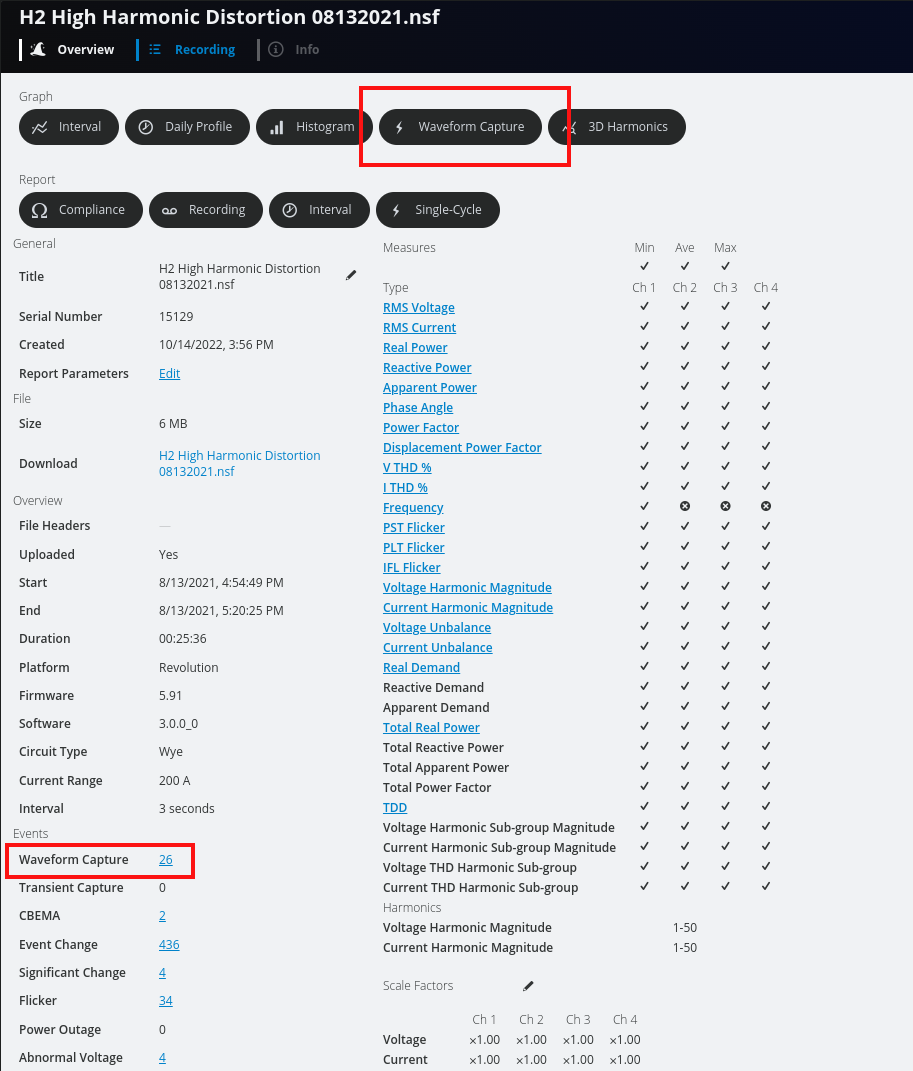
While extremely powerful in their “raw” form, the triggered waveform captures reach their full potential with Merlin™ – PMI’s flagship AI-based analysis tool that is built into PQ Canvass. Once a PQ recording has been analyzed with Merlin™, each waveform capture is ranked based on severity and is presented in the waveform capture list with a one-line “short” description of the capture.
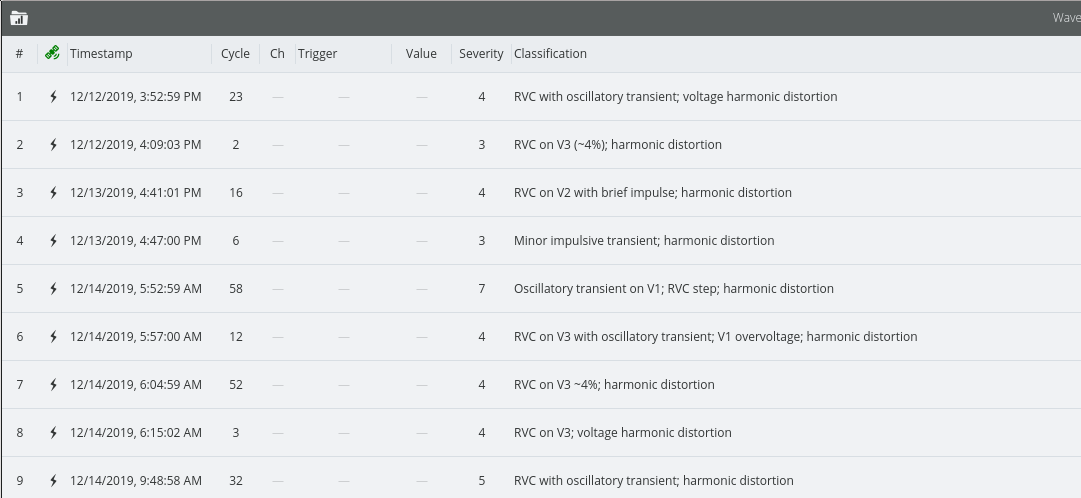
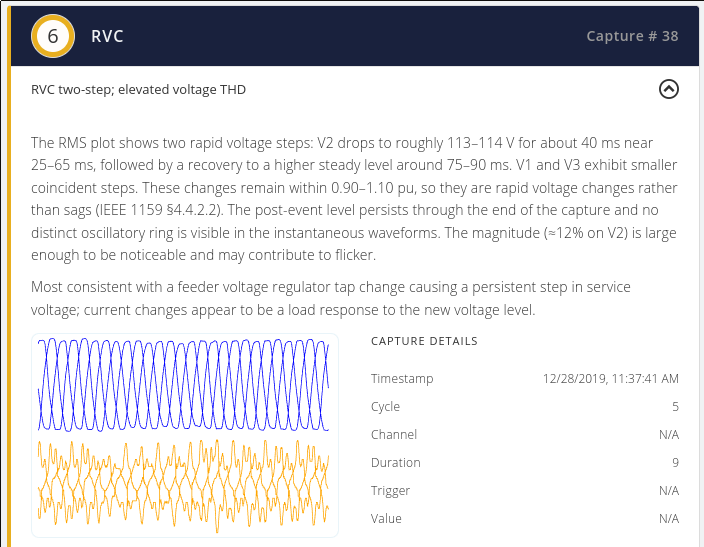
Since PMI’s recorders don’t trigger specifically on RVC or voltage sag criteria, identifying and quantifying these events is best done using Merlin™. While users can inspect a waveform capture using the traditional built-in waveform analysis suite inside of PQ Canvass, allowing Merlin™ to quickly and effortlessly analyze the whole recording to provide a fully integrated and holistic approach to your analysis is recommended. In fact, at this time users will only find RVC identification within Merlin™ itself.
Remediation Strategies
From an electric utility standpoint, remediating Rapid Voltage Change requires addressing either the source of the fluctuation or the impedance of the delivery system. If the RVC is caused by a specific customer’s heavy equipment, the utility may require the installation of soft-starters or Variable Frequency Drives (VFDs) to ramp load more gracefully. On the distribution side, increasing the “stiffness” of the grid is a primary solution; this can involve upgrading conductors to reduce impedance or moving the point of common coupling for the offending load closer to a substation. Additionally, the deployment of Static Var Compensators (SVCs) or STATCOMs can provide sub-cycle reactive power compensation, effectively “cushioning” the voltage and preventing the step-change from propagating through the feeder to other sensitive customers.
Conclusion
In summary, PMI’s power quality recorders provide a robust and highly sensitive platform for identifying and documenting Rapid Voltage Change before it leads to equipment failure or significant customer dissatisfaction. When the high-resolution data from these recorders is integrated into PQ Canvass, PMI’s flagship analysis software, and processed through Merlin™, utilities gain an unprecedented ability to conduct deep power quality investigations. Together, these tools transform complex RVC data into actionable insights, making them the perfect companions for resolving even the most challenging customer complaints.