
Abstract
One of the most visible customer-facing challenges an electric utility can face comes in the form of voltage interruptions. From the short, fraction-of-a-second momentary to the prolonged, multi-hour (or even – as in the event of natural disasters – multi-day) sustained interruptions, the consequences – both direct and indirect – can be somewhat varied. This paper is going to tackle the issue of a common phenomenon occurring after a prolonged interruption: Cold Load Pickup.
Cold Load Pickup Defined
Cold Load Pickup is essentially defined as the combination of two major factors: inrush and the lack of load diversity. The lack of load diversity is really the distinguishing mark for the effects of cold load pickup. During a shorter outage, switched loads are affected (such as televisions, computers, windows A/C units and other similar appliances). These loads tend to be manually switched back on by users after the outage has ended. However, for prolonged outages, not only do these loads go away, but so do periodic loads – such as those controlled by thermostats or charge controllers (water heaters, air conditioners, heating units, electric vehicle chargers, etc.). After a prolonged (several hour) interruption, these loads will be set to trigger and will frequently come on
line at or very near the same moment. This is in contrast to their normal operation, where they are cycling off and on mostly randomly. With a long interruption, thermostatically controlled loads tend to demand power in unison (e.g. every water heater has cool water, calling for heat, etc.). The result of normally uncorrelated loads demanding power simultaneously is an unusually high total load current, leading to low voltage. As these loads drift back towards their uncorrelated patterns, the overall load reduces to the normal, along with the system voltage. The high initial current is the “cold load”, and the low voltage condition that arises is the problem.
Graphical Analysis
The key signature of cold load pickup is the presence of uncharacteristically low voltage at the onset of service restoration. This is due to the lack of load diversity that was mentioned above – the synchronized startup of several potentially heavy loads all at once causing that immediate heavy draw on the service. See Figure 1 for an example of a graph demonstrating cold load pickup.
Looking at Figure 1, the reader will likely first notice the interruption beginning at around 18:40. What should be noted is the line voltage before the interruption which, in this particular instance, is sitting at around 124V. Next is the time of service restoration – about 19:50. The interruption in this graph had a duration of approximately one hour and ten minutes.
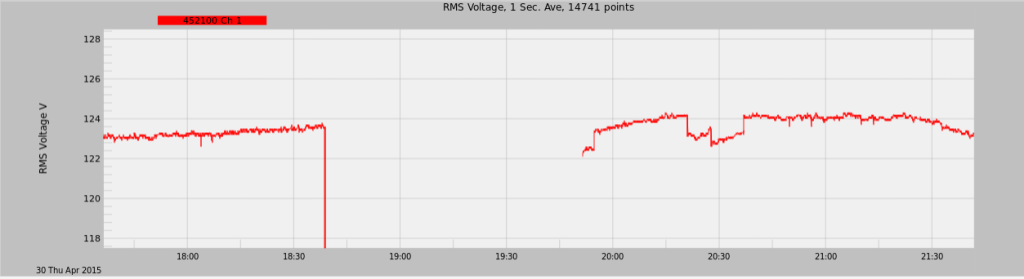
The cold load pickup signature, while not very strong, is still present in Figure 1. What the reader should notice is the pickup voltage at the time of restoration. Previously, we had determined that the line voltage before the interruption was around 124V. After the interruption, however, the line voltage has dropped to around 122V.
Mitigation Strategies
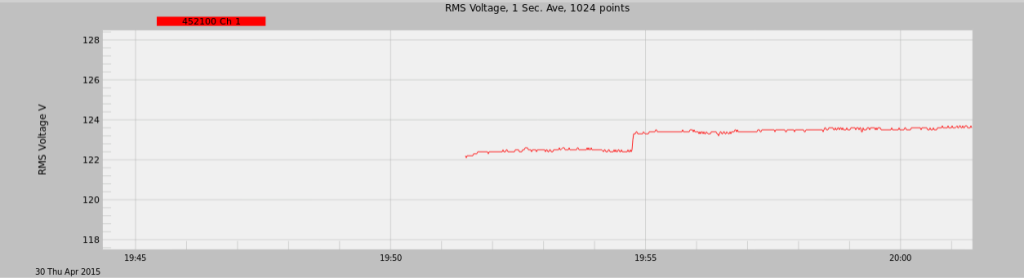
The possibilities for mitigating cold load pickup is really somewhat limited in scope. The most straight-forward and recommended course of action would be to install a voltage regulator if one is not already present. In Figure 2, the reader will notice that a voltage regulator is in place and – after a brief period of about four minutes – it steps the voltage back up to around 123.5V (around a half of a volt below where the line voltage was before the interruption).
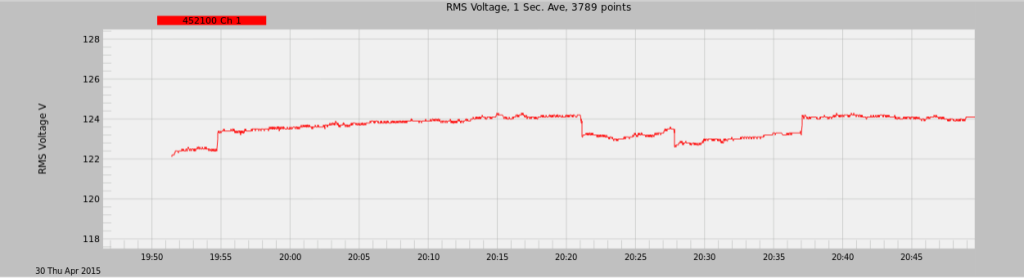
As the load starts to diverge over time following the interruption, the voltage on the line begins a natural recovery as seen in Figure 3. From 17:55 until around 20:22 the voltage is slowly creeping back up to the 124V mark. At this point (20:22), the voltage regulator steps the voltage back down to about 123V. This is approximately 30 minutes following recovery from the interruption. Continuing in Figure 3, if the reader looks at around the 20:27 mark, they will note that the regulator once again steps the voltage down due to the preceding increase in line voltage. The voltage remains at this level for another ten minutes (possibly because the cold pickup event had not yet finished) before the regulator steps the voltage back up to 124V, where it remains.
If a regulator is present, its programming or defaults may need to be adjusted to better compensate for cold loads if the effect is pronounced on a circuit. A real-time feedback system through SCADA may be helpful, along with voltage monitoring with a Boomerang just after the regulator, and at the end of the line.
Conclusion
Cold load pickup is a phenomenon that is common after prolonged interruptions. An interruption is already a serious customer-facing issue, and following an interruption with low voltage can lead to equipment damage and even more irate customers. Power Monitors Inc.’s Boomerang product in conjunction with Canvass can help easily identify these phenomena in order to mitigate their effects.