Introduction
Effective greenhouse management requires consistent monitoring of environmental extremes and equipment performance. This white paper examines the role of the PMI Tensor in verifying the adequacy of ventilation and heating systems. Through high-resolution data logging, we investigate the operational cadence of climate control hardware and the specific current draw of various electrical assets, ensuring that thermal regulation remains both effective and efficient..
The Tensor is a powerful tool used for PQ analysis at any location with a standard 120V 3-prong receptacle whose features include cellular and WiFi communications, remote access to real-time historical data, receptacle power control, environmental monitoring, email and text message notification, waveshape triggering for waveform captures and access to PQ Canvass.
This allows the Tensor to monitor individual pieces of equipment or voltage at a 120V location. Designed for ease of use, the user just needs to plug the Tensor into the wall outlet and then plug in the 120V equipment into the Tensor.
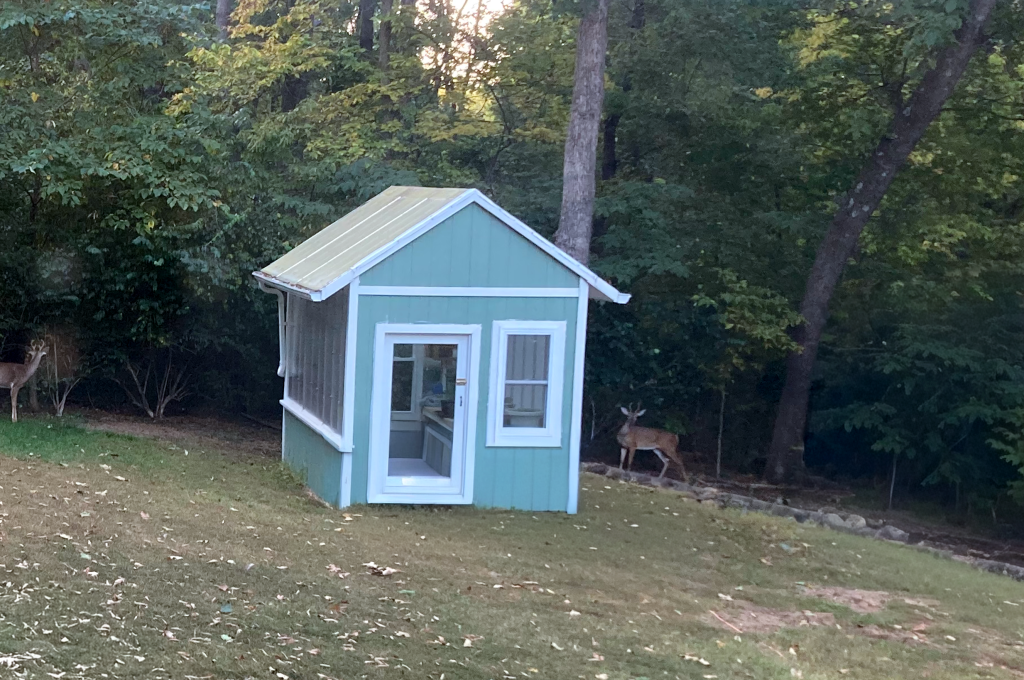
This case study demonstrates its use in a small 12×8 greenhouse in the author’s backyard where the Tensor was connected to several devices including an exhaust fan, electric heater, circulating fan and a warming mat.
When connected to the internet, the Tensor can continuously stream voltage, current, power and other power quality measurements as well as a handful of environmental measurements (temperature, barometric pressure and humidity) to PQ Canvass. This streamed data can then be analyzed to answer the aforementioned questions. Additionally, alert notifications can be set to warn if any of these measurements fall outside of user-specified ranges.
PQ Canvass is used to configure the Tensor and view the information sent by the Tensor. The Tensor data is streamed to PQ Canvass using the WiFi router in the house (for domestic use cases) or, if equipped, through the embedded cellular modem for Cell Tensors.
PQ Canvass
PQ Canvass provides web-based data analysis tools, email/SMS notifications, and long-term data storage. Live waveforms and meter displays are available for real-time information from any PQ Canvass-enabled device.
Since the data can be viewed at any time from the comfort of the office, problems can be discovered earlier. After reviewing the recording data, if further investigation is needed, the user can change the recording settings without having to go to the location. The ability to see the data and change the settings from the office can greatly decrease the troubleshooting time and save expenses.
Beyond simply confirming that each device operates as expected, the Tensor, along with PQ Canvass, provides a deeper understanding of how the greenhouse behaves as a system. Long term data trends can be seen in PQ Canvass. For example, as the outside temperature continues to drop as winter approaches, the amount of time the heater runs can be used to determine if a larger heater is required when the coldest nights are expected.
Exhaust Fan
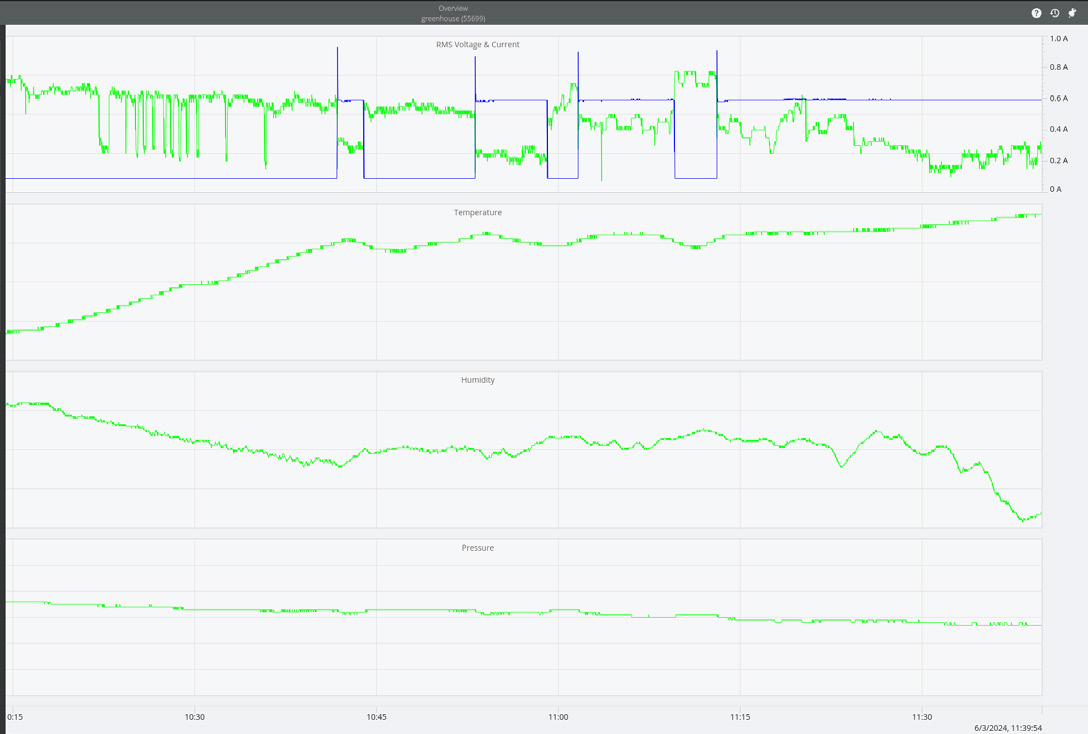
In the summer, excessive heat is a problem. The greenhouse is equipped with a 600mA exhaust fan in the eaves shown in Figure 1 that has a temperature-controlled fan controller (Figure 2).
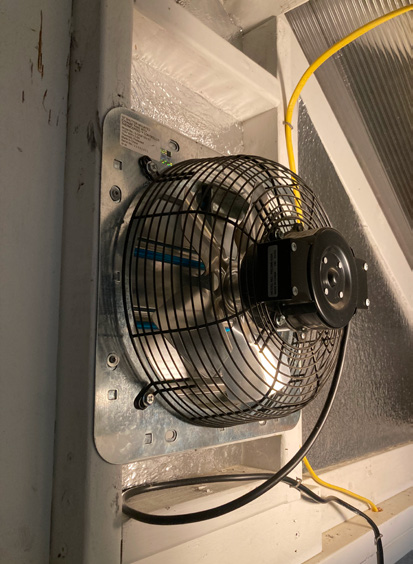
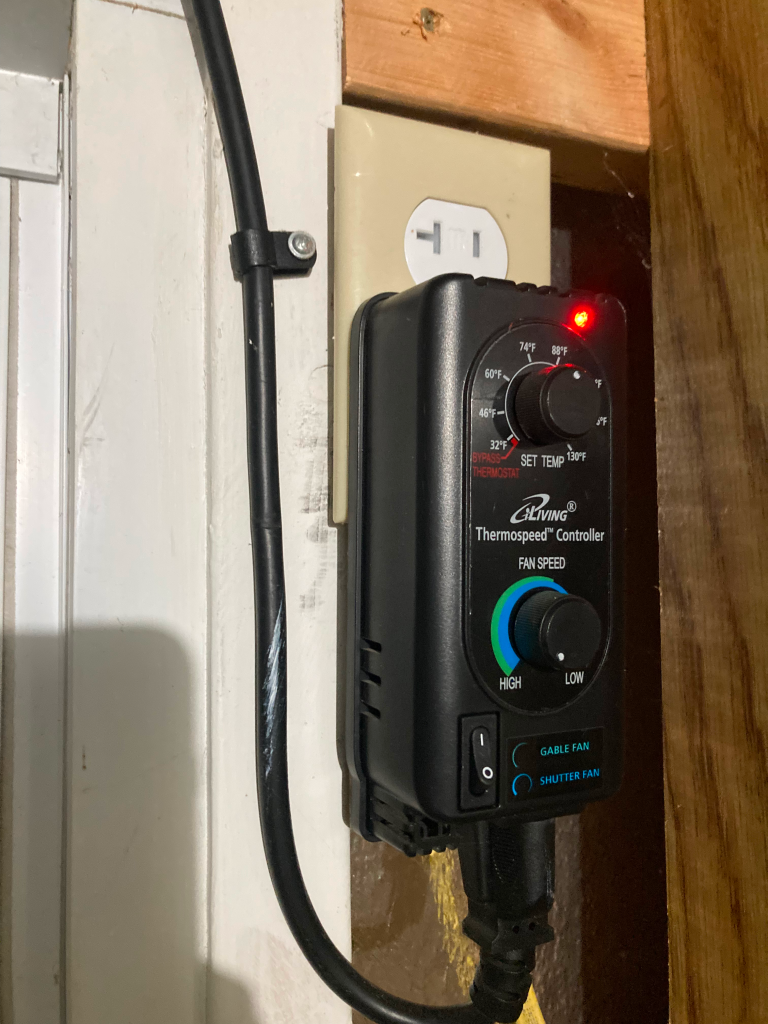
Figure 2. Exhaust Fan Controller
Electric Heater
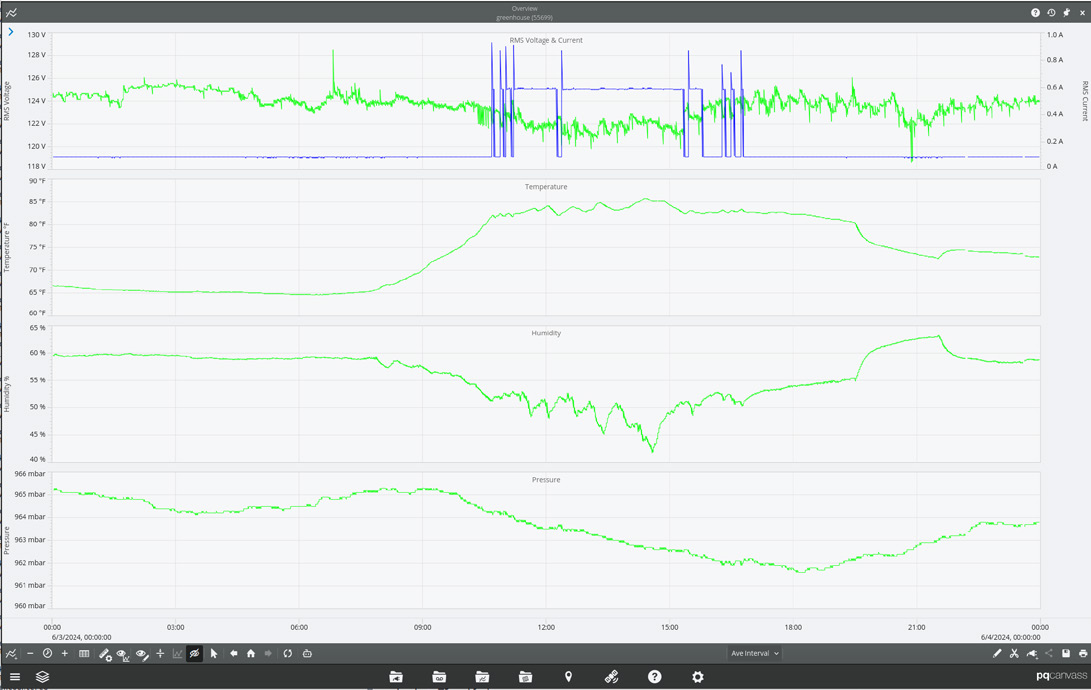
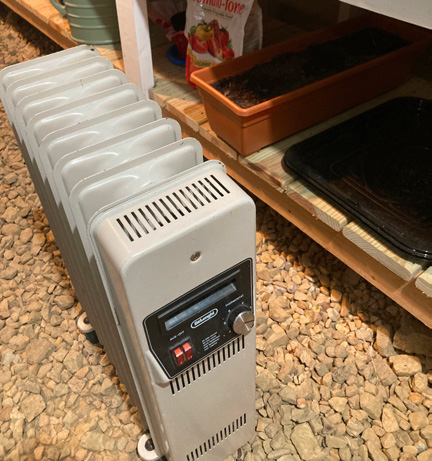
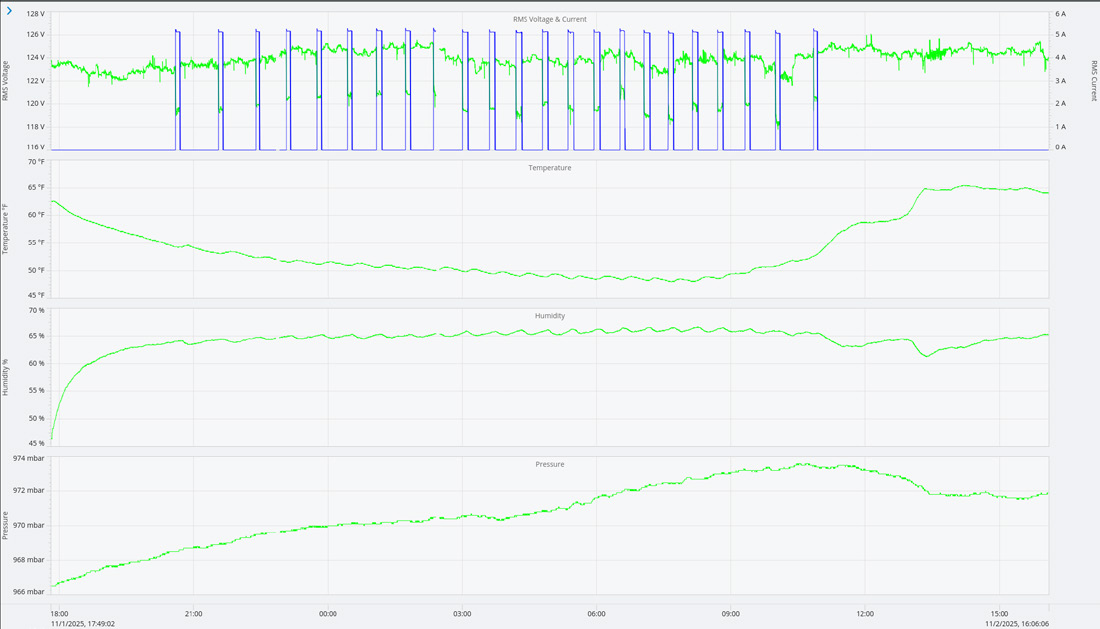
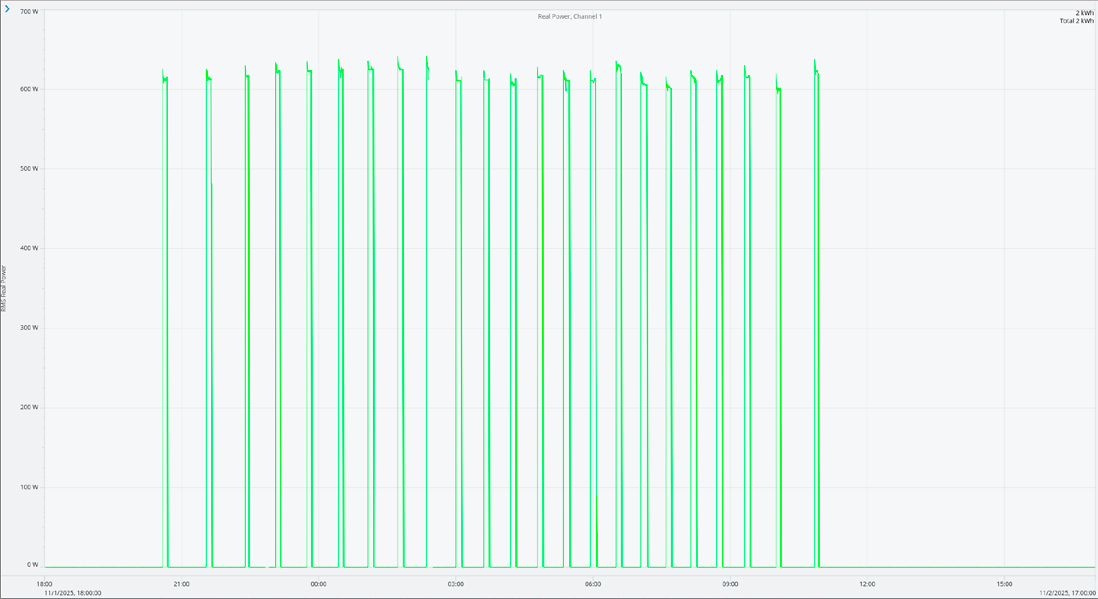
When the weather gets cold, a heater is required. In this case it is an oil-filled electric heater (Figure 5) with only one switch turned on so it is running at 5A. When the temperature drops the heater comes on as shown in the PQ Canvass Overview Graph (Figure 6). The corresponding change in voltage, temperature and relative humidity is shown. Figure 7 shows the PQ Canvass Real Power graph showing the heater power draw for one night.
Circulating Fan
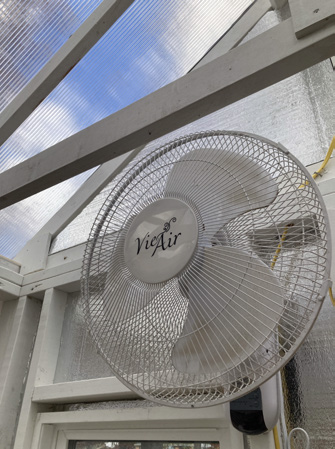
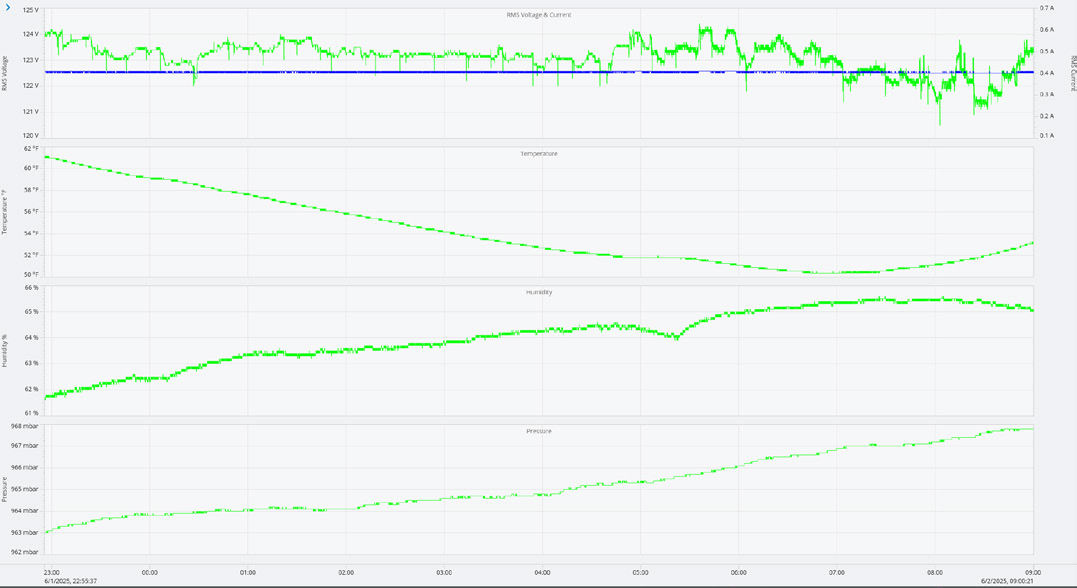
A circulating fan (Figure 8) is used in a greenhouse to keep air moving. Some plants need wind to pollinate and a breeze helps strengthen plants. Also, a fan keeps the air temperature even and helps reduce humidity buildup. Figure 9 shows the steady 400mA current draw from the circulating fan.
Warming Mat
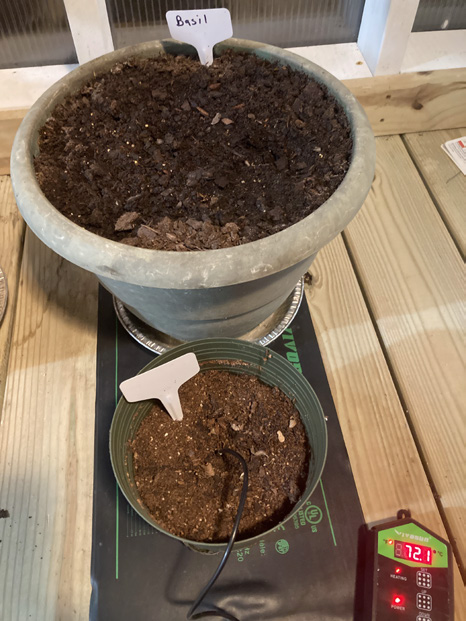
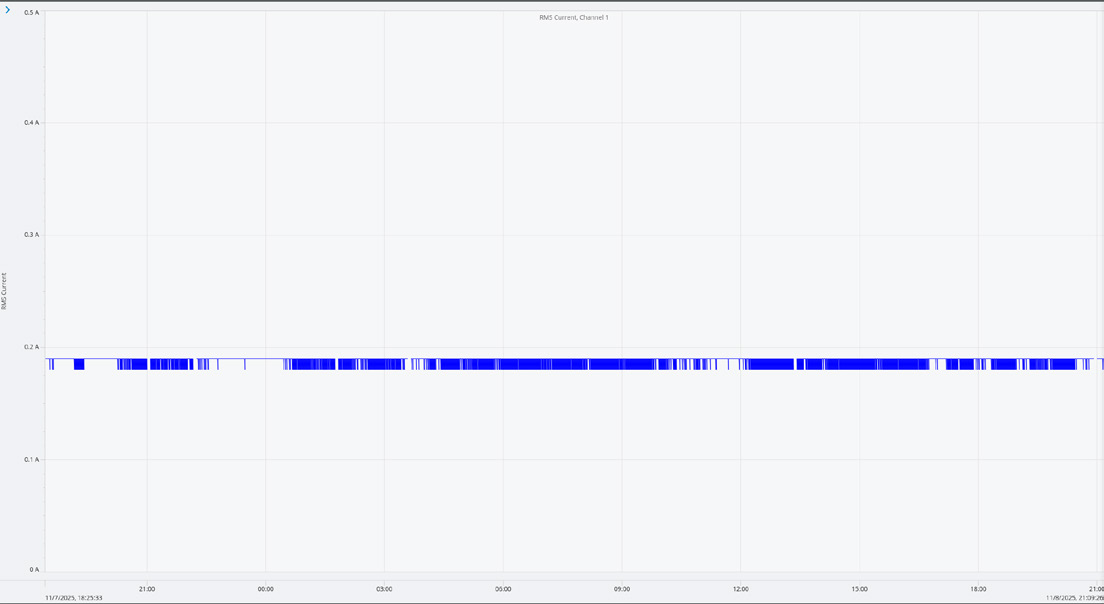
A warming mat is used to warm the soil to help seeds germinate (Figure 10). Figure 11 shows the PQ Canvass RMS Current graph showing a steady 200mA current draw.
Alert Notifications
The Tensor can be configured to send email and text alerts. The alert notification distribution system revolves around a number of components, two of which are Events and Alarms.
An Event is an occurrence which is just what it sounds like – a single event that, when it occurs, generates data transmission to the PQ Canvass system which in turn generates a notification for all those who have been registered to receive a notification for said event. Events do not necessarily span an amount of time – each event will trigger an update packet to PQ Canvass and, if there are any registered notification recipients, they will be notified.
An Alarm is a state that a device may be in. These states may span long periods of time (hours or even days) or may be as brief as just a second or two. Users who have created distribution lists to receive Alarm notifications will be notified when the device enters an alarm state and when it exits an alarm state. This method of notification was selected to prevent multiple notifications from being sent for a device that remains in an alarm state for a prolonged period.
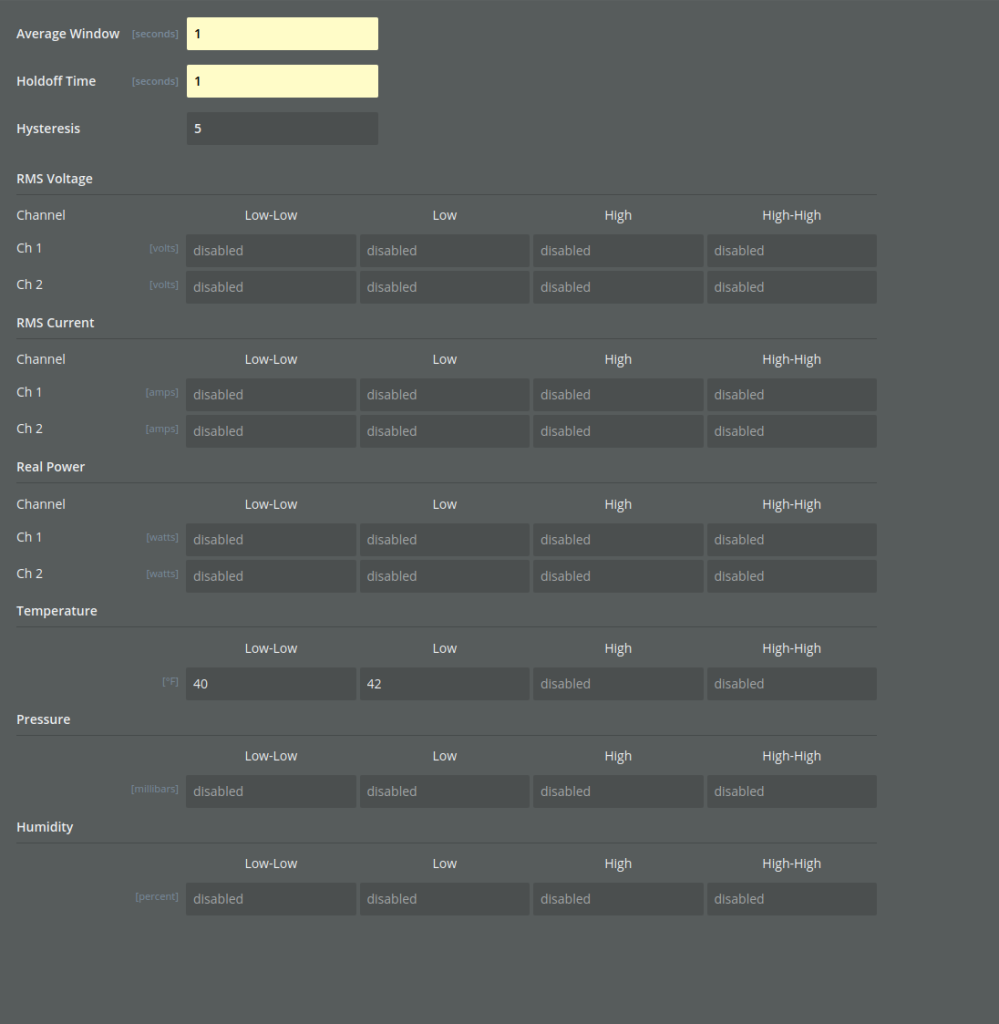
A practical use case for alerts would be a situation in which an alert is configured to trigger a notification if the temperature falls too far so that there is time to take action before the greenhouse reaches freezing temperatures. Figure 12 shows the PQ Canvass alert notification page where the low and low-low alert thresholds are set to 42°F and 40°F respectively. If the greenhouse temperature drops below 42°F, a notification is sent. In addition to temperature notifications, the Tensor can be configured to alert on voltage interruptions. These are equally as useful in that they allow the user the opportunity to manually intervene within moments of the interruption occurring, potentially preventing significant loss.
Conclusion
A backyard greenhouse shows on a small scale what a large commercial greenhouse would contain. This paper has demonstrated how a Tensor in a greenhouse is a good example of power quality and environmental monitoring at the point of use. Coupling a Tensor with PQ Canvass provides the level of information needed to maintain stable growing conditions.