Abstract
In this whitepaper, I will discuss zero sequence harmonics: what they are, how they are created, and what issues they present to distribution systems and power quality.
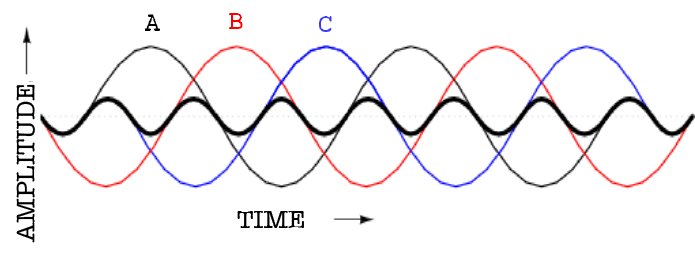
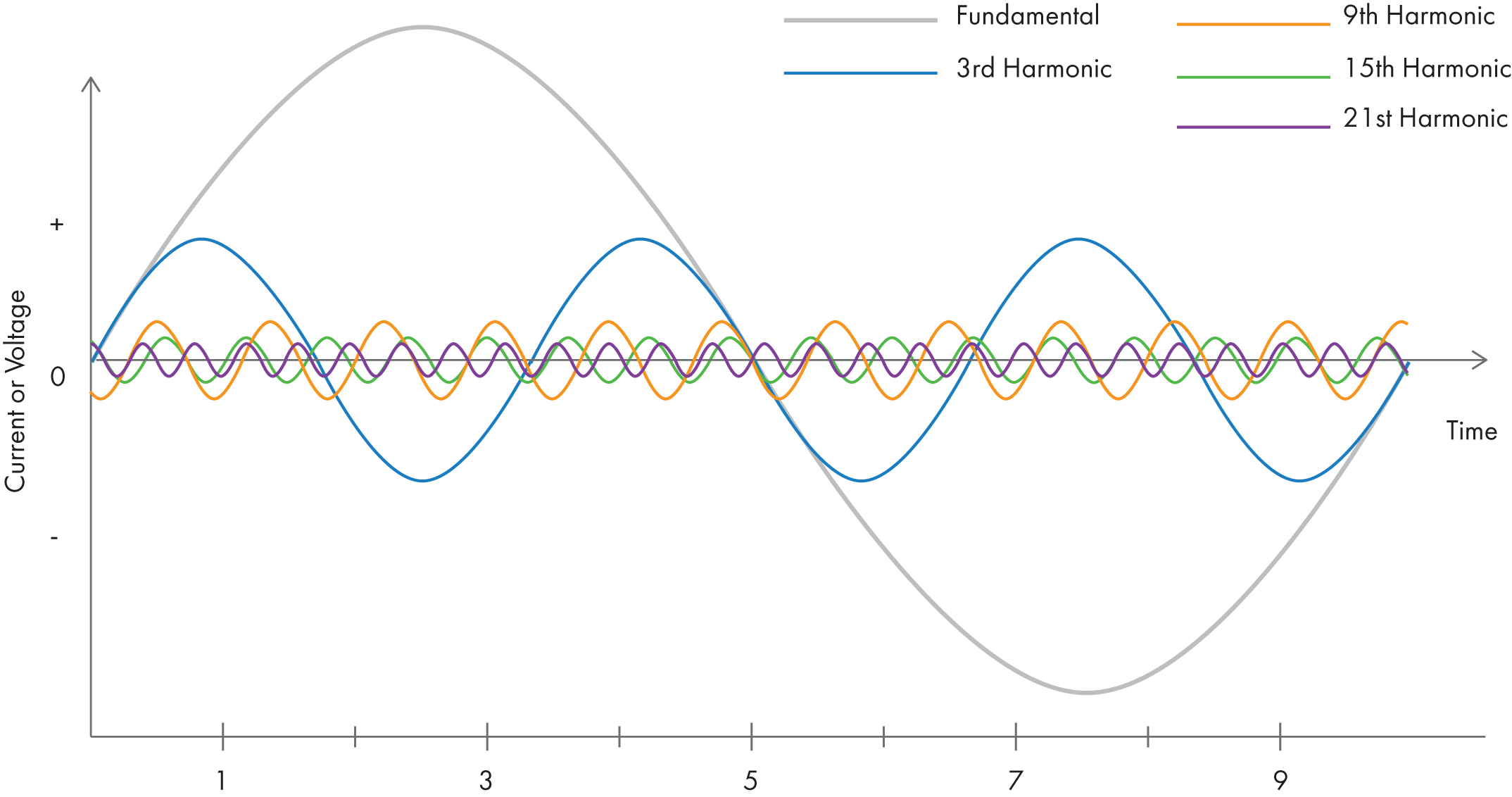
Zero sequence harmonics can only occur in a polyphase system, generally three-phase power systems in which each phase is separated by 120 degrees. In a three phase system, the third harmonic multiples of the frequency at 180 Hz become in phase with each other.
Below is the relationship of an ideal polyphase system where phases A, B, and C are represented in a time domain graph.
What Are Zero Sequence Harmonics?
To understand what zero sequence harmonics are, it is important to define positive and negative sequence harmonics. Positive sequence harmonics are those such that the harmonics add with the fundamental, such as the 7th, 13th, 19th etc. This is very important, especially when dealing with polyphase motors. These harmonics place a positive or forward torque on the motor and are referred to as a positive sequence harmonic. On the other hand, some harmonics such as the 5th do the opposite. The 5th harmonic is subtracted from the fundamental and places a negative torque on the motor’s rotor. Therefore, the 5th harmonic is referred to as a negative sequence harmonic. The remaining harmonics are zero sequence, and are also referred to as triplen harmonics: the 3rd, 9th, 15th, 21st etc.
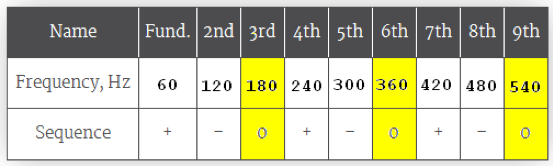
Triplen harmonics are neutral, do not add or subtract from the power line’s fundamental magnitude, and are in phase with each other, causing zero net torque on an AC motor. Triplens are therefore referred to as zero sequence harmonics. Note in figure 2, the sequence numbers in yellow are the zero sequence values. When it comes to three phase AC motors, zero sequence harmonics do cause motor heating. However, a much larger concern may be the lower order negative sequence harmonics, especially the 5th harmonic which is actually working against the forward rotation causing heating. The higher harmonics are attenuated more by the magnetic core losses and the motor’s winding inductance, but the net zero sequence can contribute to substantial losses in the system. Another detrimental effect that zero sequence harmonics can have on an AC motor is torsional oscillation of the motor’s shaft. This torsional oscillation phenomenon is not clearly understood and sometimes goes unnoticed or ignored which can lead to early motor failure. In an AC motor, differing torques are produced by the interaction between the air gap’s magnetic field and the currents induced in the motor’s rotor. This happens when the motor is supplied with a non-sinusoidal voltage such as with zero sequence harmonics.
If left unchecked, a nonlinear load placed on a single phase will introduce harmonics that propagate into the polyphase system. Normal three phase distribution systems have four wires; 3 for the different phases, 120 degrees apart, and the 4th for the neutral. Since the zero sequence harmonics are of the third order, the third harmonic and its odd multiples have a zero phasor displacement. Thus, unlike the positive and negative sequences, harmonics are not canceled out but add together on the neutral wire.
The main concern with zero sequence harmonics is within the neutral wire. Unlike positive and negative sequence harmonics, in a 3 phase system, zero sequence harmonics do not cancel in the neutral conductor. The result is that the neutral wire carries the net difference of any positive and negative sequence components (the largest being the 60Hz fundamental unbalance), but the net addition of any zero sequence harmonics. This extra current can cause the neutral wire to overheat, especially if the neutral is undersized due to the expectation that the current will be less than any single phase current.
Sources of Zero Sequence Harmonics
Zero sequence harmonics are produced as a result of non-linear loads on a power system. The rectifier is a major offender, as a nonlinear device that takes the alternating current and converts it to a DC pulse. Any power supply that converts AC to DC uses a rectifier which will present a non-linear load. Switch mode power supplies, being more efficient than the linear type, are very popular. This type of power supply is used in almost all electronic equipment plugged into AC power. Computers, UPS, TVs, radios, amplifiers, are just a few examples that provide a very non-linear load. The more power they consume, the more zero sequence harmonics are usually generated. The total can contribute to an overall problem even if each device on its own does not consume much power. For example, a single personal computer may not present much of an issue, but in a location such as an office building, 100 PCs could easily become a nonlinear burden on the system. The amount of harmonic voltage distortion is directly related to the amount of harmonic current that is being drawn by the load and depends on the power source’s impedance. The source impedance of the generator is usually not an issue as much as the distribution system’s impedance including all the transformers and wiring between the source and the load. Because of the non-cancellation nature of the zero sequence harmonics, they tend to produce problems more often upstream.
Most of the electronic devices that generate the zero sequence harmonics could be cleaned up with additional filtering, but extra filtering adds more cost. Companies producing these electronics in an attempt to improve profit margins will sometimes skimp on the filtering causing the burden to fall on the power electric distribution system.
Common Symptoms of Zero Sequence Harmonics
The most obvious indication of zero sequence harmonics is a high neutral current, with high neutral total harmonic distortion. Along with the high neutral current and THD, is high neutral to ground voltage, a high peak phase current along with higher RMS phase current, and a lower power factor. Since zero sequence harmonics are a specific type of harmonic, THD of the current and voltage are always elevated in their presence. Other symptoms are higher transformer losses causing excess transformer heating and other apparatus heating associated with the higher neutral current. Sometimes electronic protective devices such as circuit breakers will trip or malfunction because of higher neutral current. Noise is sometimes generated due to vibrations generated by the excessive neutral current. In other cases, the zero sequence harmonics can propagate into nearby telephone lines causing a higher TIF, telephone interference factor.
Locating Zero Sequence Harmonics
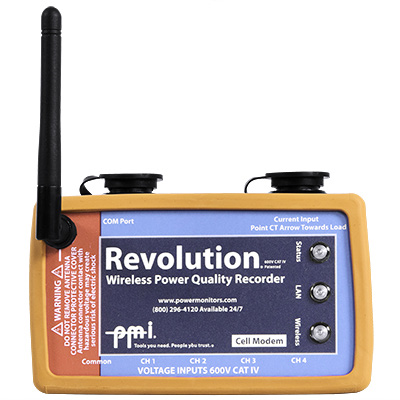
A good place to start monitoring if symptoms exist is the point of common coupling (PCC). This is the point in the distribution system where other customers may be connected, and is usually the primary of a distribution transformer, or secondary in a residential location. Nowadays, there are very few industries that don’t present nonlinear loads due to electronic power supplies even in high power loads. Some spot checks can be done with handheld power quality meters, but to get the true picture of the power quality environment it’s necessary to use a recorder, such as a Revolution (see below), to record over a period of time. Gathering data over at least a one week period is useful to capture hourly and daily variations in load operation.
Cures and Solutions
One way to reduce or eliminate zero sequence harmonics is by using a zigzag transformer. A very similar idea is using a smaller version of the transformer as a zero sequence filter (ZSF) to isolate a non-linear load rich in zero sequence currents from the distribution system. If possible, a better option when driving a nonlinear load, is to use a delta configuration as opposed to a wye-configuration. In a delta configuration, the neutral line is eliminated; therefore the harmonics have no neutral line in which to travel (they are trapped as circulating currents in the transformer, which must be sized appropriately). If it is necessary to use a wye-configuration and zero sequence harmonics are present, steps can then be taken to up-size the neutral line in order to handle the extra load.
Conclusion
Zero sequence harmonics are caused by nonlinear loads placed on the distribution system, and present special challenges compared to positive and negative sequence harmonics. Sometimes improvements in one area like improved load efficiency can cause problems in another area such as nonlinear current. Zero sequence harmonics that are caused by nonlinear loads can cause issues, including excessive neutral currents, transformer failures, excessive heating of motors, increased hysteresis losses, electronic device failures, failed capacitor banks, breakers and fuses tripping, and communication issues related to RFI and noise ingression into the communication system. In some cases, especially without monitoring, the harmful effects of zero sequence harmonics can go unnoticed until distribution equipment such as a transformer starts to fail, leading to expensive repairs. With the right monitoring equipment and integrated software, along with an understanding of power quality fundamentals, it is possible to continually and effectively assess overall system health and prevent potential system failure.