Abstract
Wave notching is a type of voltage distortion that appears as a very fast, repetitive dip or “notch” in the sinusoidal waveform of an AC power system. This periodic disturbance is typically caused by the abnormal operation of power electronic devices such as converters and rectifiers, which use switches to control power. During commutation, current draw is transferred from one phase to another. If there are problems with the switch timing, two conduction paths, or a short circuit may briefly occur. This tiny switching overlap causes a brief current spike, and thus voltage “sag” that results in a notch in the voltage waveform.
The effects of notching can be problematic, including:
- Malfunction of sensitive electronic equipment
- Radio disturbances
- High-frequency resonances, causing oscillations
This white paper discusses these effects in more detail and explains how to identify and measure this power quality issue.
Commutation
To begin, commutation is a fundamental process in electrical engineering, particularly in motors and power converters, that involves changing the direction of current flow in a circuit. In DC motors and generators, a mechanical device, called a commutator, that works with brushes periodically reverses the current in the armature windings. This ensures electromagnetic forces are always acting in the correct direction to either produce continuous rotation in a motor or to convert alternating current into direct current for a generator.
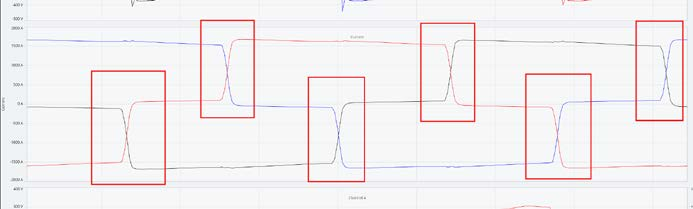
In modern power electronics, commutation is achieved electronically using switches such as thyristors and transistors to control current flow. Sometimes, these switches conduct simultaneously, creating a momentary short circuit between the two phases. This overlap in conduction causes a temporary voltage dip, known as a notch, in the AC waveform.
Harmonic Content
As mentioned above, wave notching in a three-phase system is often caused by the rapid switching of power electronic devices such as rectifiers or variable frequency drives. The notches, which are brief voltage dips during commutation create sharp transitions during commutation that generate broadband harmonic content, often extending into the kHz range. This resulting distorted waveform can cause:
- Overheating in transformers
- Increased motor losses
- Interference with sensitive electronic equipment
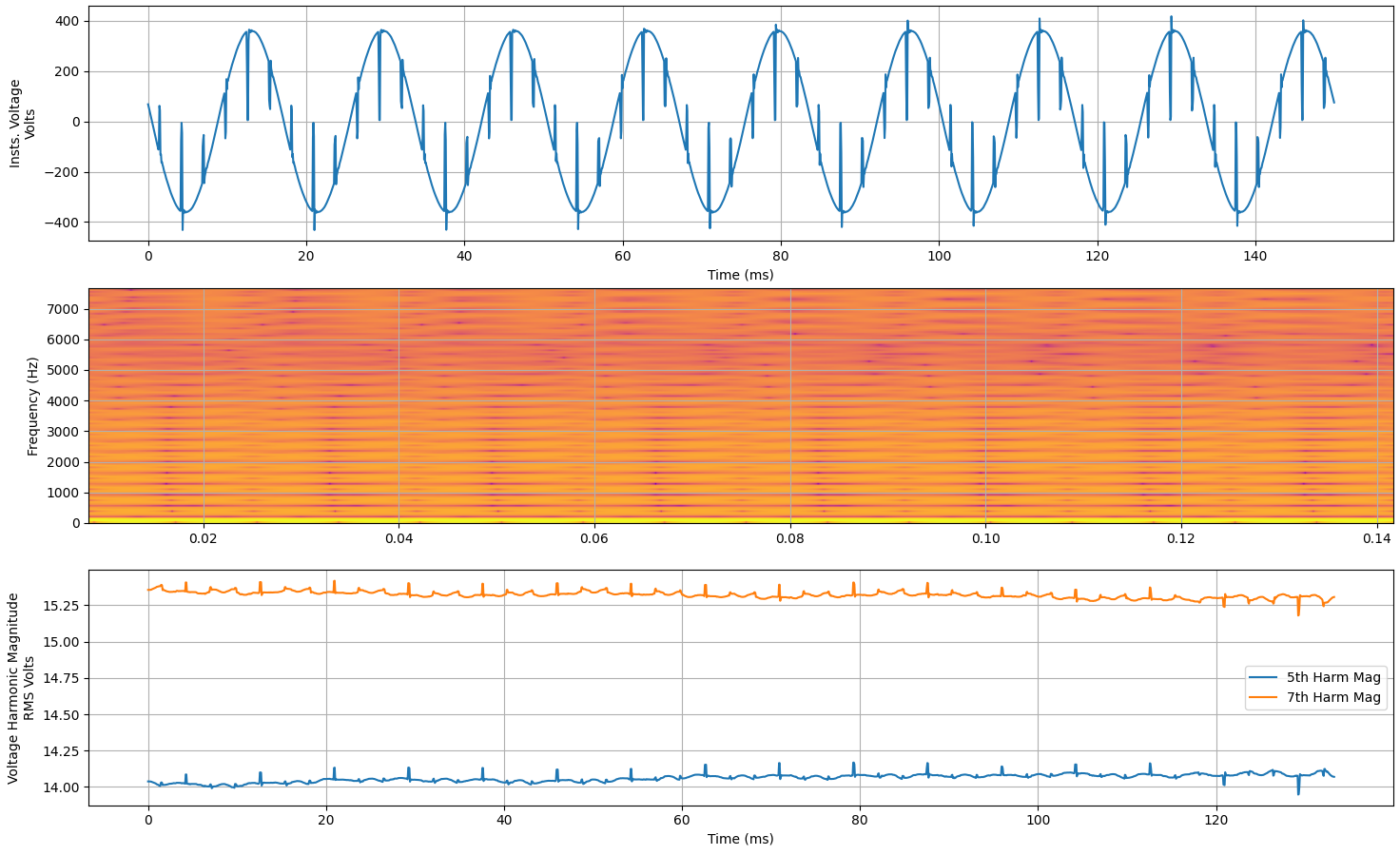
The above figure shows a three-plot graph of a single waveform capture from a location that was experiencing severe wave notching. The top plot shows the instantaneous waveform for channel 1 voltage. Note that the notching is far more frequent than just when channel 1 current is at the 0-crossing. It is present when any two phases conduct during commutation. The middle plot is a spectrogram which shows the harmonic content in dBFS. The x-axis is the time in seconds, the y-axis is the frequency in Hz. The brighter yellow means more energy, the deeper reds means less energy. As you can see, there is a lot of yellow starting at around 100Hz and rolling all the way up to about 5kHz.
That is very characteristic of wide band harmonics induced from wave notching. Finally, the third plot is a rolling RMS harmonic magnitude trace that shows the 5th and 7th harmonics, which were the most predominant harmonics in this particular recording.
(Graphs were generated using Python, matplotlib, and PMI’s Python analysis library for PQ recordings. See related white paper “Advanced Waveform Analysis Using Python” for more details.)
Warning Signs of Wave Notching
Common signs and symptoms of wave notching in three-phase systems include:
- Flickering lights
- Erratic operation of sensitive equipment (PLCs, computers)
- Unexpected breaker or relay trips
- Increased motor noise, vibration, or overheating due to harmonic-induced torque pulsations
In some cases, control systems might experience data errors, false sensor readings or even communication failures, while transformers could produce unusual humming sounds or show elevated temperatures.
Additionally, power quality meters may detect high levels of harmonic distortion (in this particular recording the steady-state THD is at about 21%), particularly at higher-order frequencies (see the spectrogram in Figure 2) and a quick check with an oscilloscope might reveal characteristic voltage dips or spikes in the waveform, indicating the presence of notching-related disturbances.
Solutions to Wave Notching
To remedy wave notching, mitigation strategies include:
- Installing line reactors or inductors in series with power electronics to smooth out voltage transients and reduce harmonic distortion.
- Deploying active or passive harmonic filters to specifically target high-frequency harmonics.
- Using shielded cables and proper grounding techniques to minimize electromagnetic interference with sensitive equipment.
- Employing isolation transformers to provide a clean power supply to critical loads.
Finally, upgrading to modern power electronics with advanced switching controls, such as soft-switching inverters, can reduce the severity of notching. However, there is no one-size-fits-all solution and most cases require a combination of methods.
Regular PQ monitoring with harmonic-enabled PMI recorders (Seeker, Bolt, Guardian, Tensor) ensures early detection and fine-tuning mitigation strategies to maintain system reliability. PMI recorders that have active, live-streaming connections to PQ Canvass can be configured to trigger real-time e-mail and SMS notifications when notching conditions are met, helping to ensure that remedial action is taken promptly.
Conclusion
In conclusion, wave notching in 3-phase electrical systems, driven by the commutation process in power electronic devices, poses significant challenges to power quality, manifesting as harmonic distortions, equipment malfunctions and system inefficiencies. The characteristic high-frequency harmonics, visible in spectrograms and harmonic analyses, contribute to issues like flickering lights, erratic PLC behavior, motor overheating and transformer noise, with steady-state THD levels reaching as high as 21% in severe cases.
Effective mitigation strategies, including line reactors, harmonic filters, isolation transformers and advanced switching controls, combined with proactive monitoring using tools like harmonic-enabled PQ recorders, can significantly reduce the impact of notching. By implementing these solutions and leveraging real-time monitoring systems, such as those integrated with PQ Canvass, facility managers can ensure early detection and correction of notching-related disturbances, safeguarding equipment reliability and maintaining operational efficiency.