Abstract
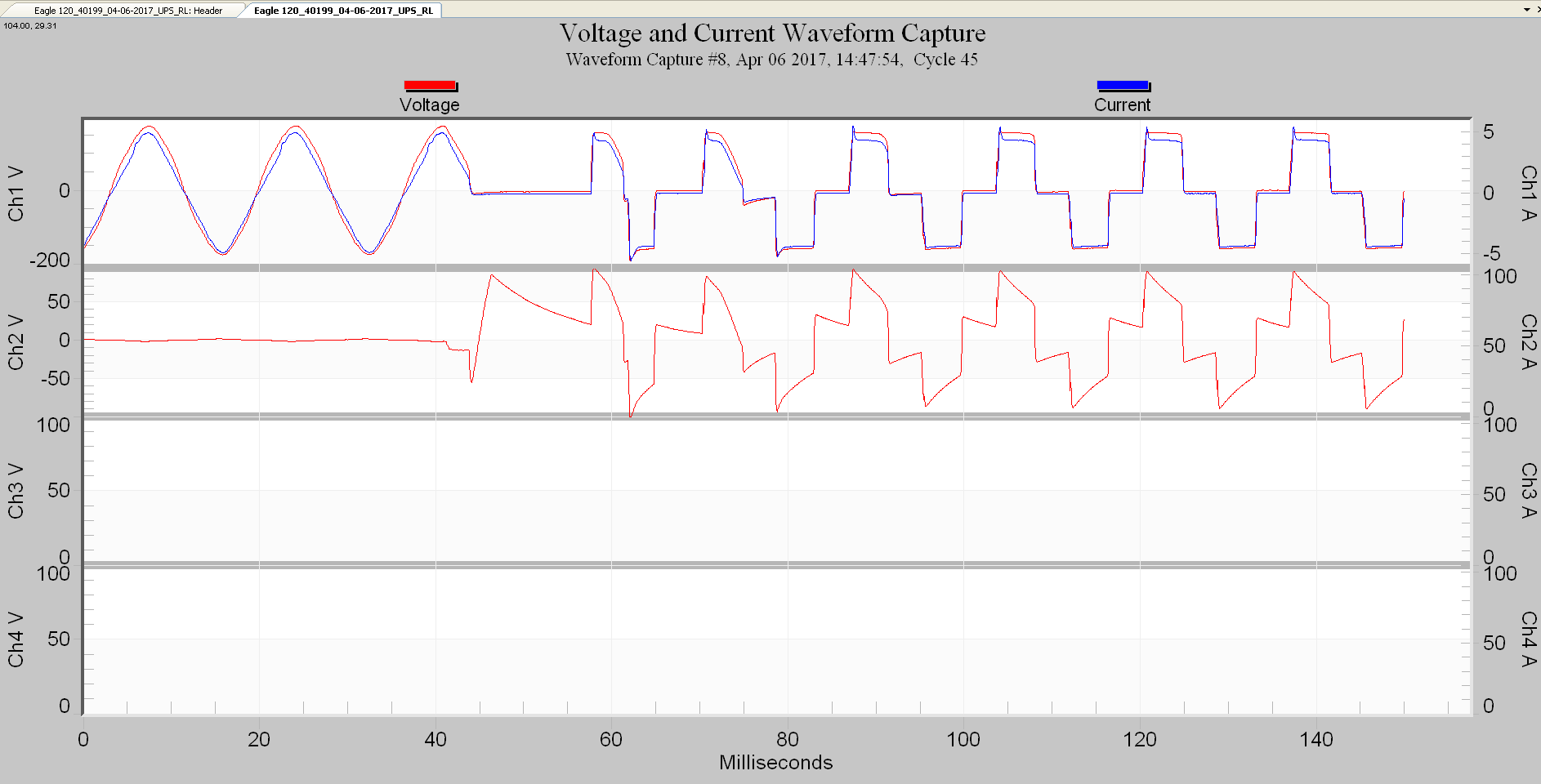
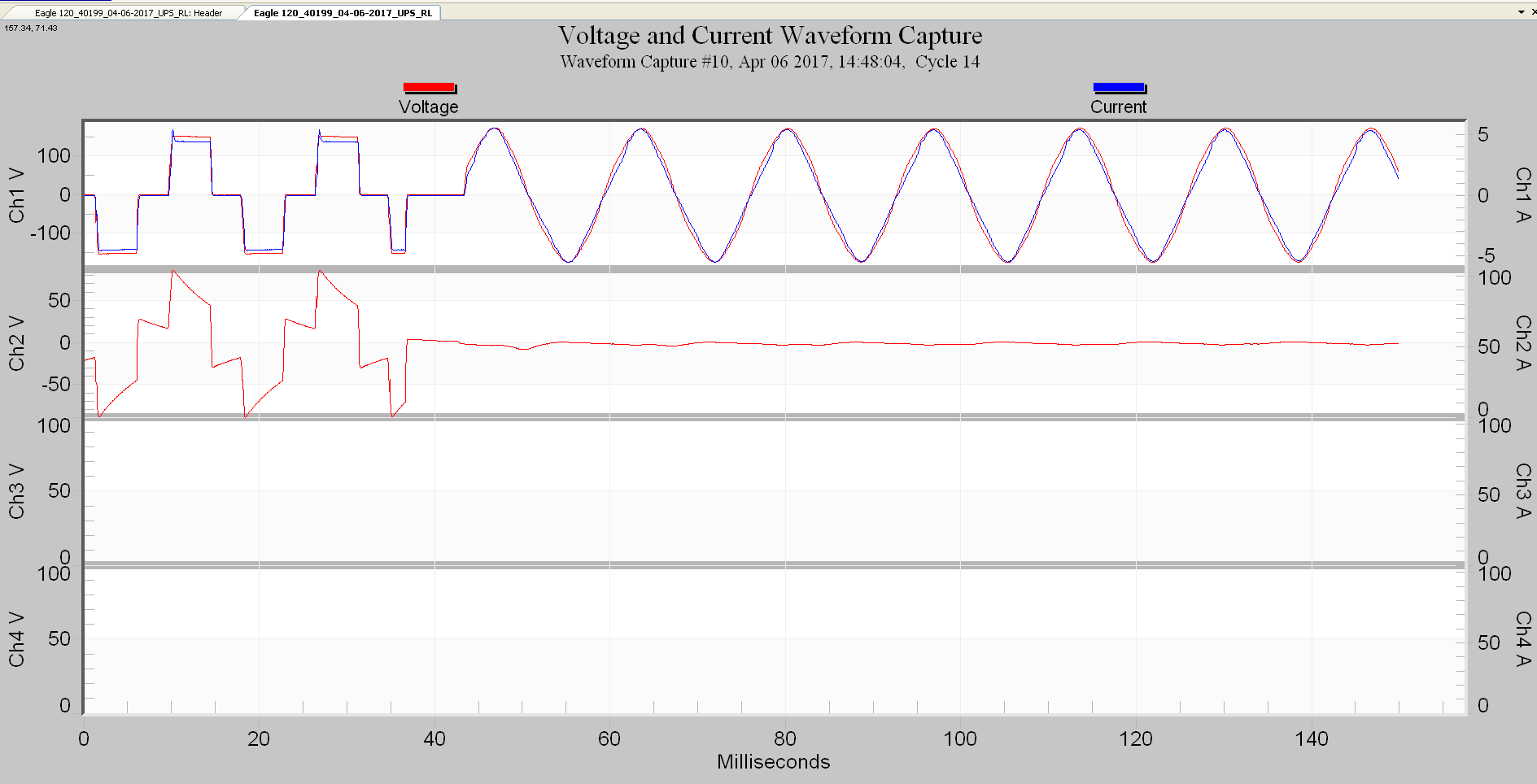
In this white paper, power quality issues that can result from an Uninterruptible Power Supply (UPS) are discussed. Covered are the basic operational concepts of the more popular types of UPS units, along with how different types of loads can affect and interact with the UPS and its power quality, and the importance of matching the load to a UPS. An Eagle 120 PQ recorder is used to monitor output power quality from a constantly running UPS along with an offline standby type. In particular, the UPS switchover events are monitored.
The main function of a typical UPS is to provide power to electrical and electronic equipment in the case of power failure from commercial power or another power source. Most UPS units are also designed to provide protection against voltage surges and spikes along with resistance to voltage sags. They are designed to provide an adequate AC voltage output in the nominal voltage range to the load of the appropriate power line frequency of 50 or 60 Hz.
Load Limits
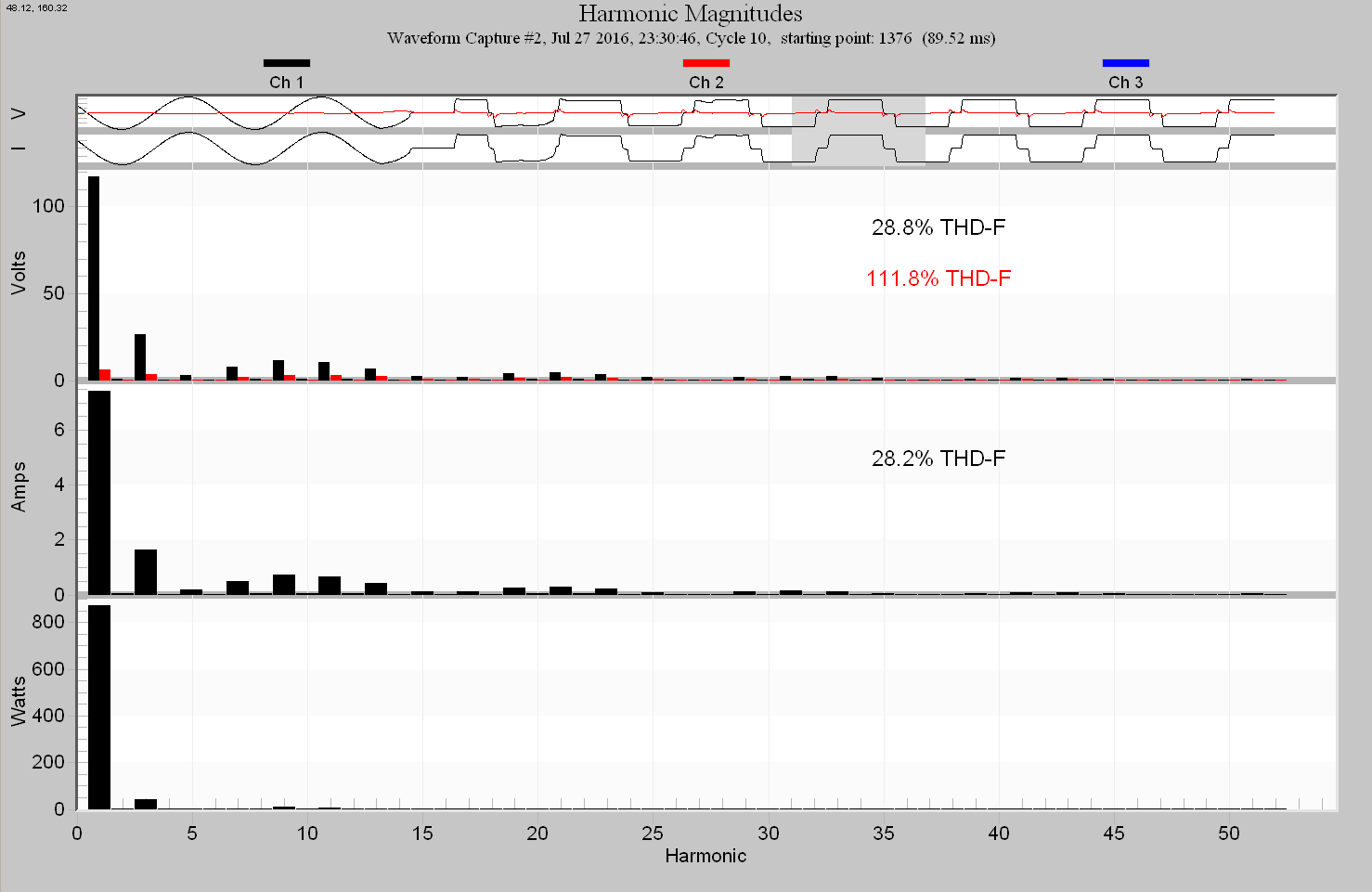
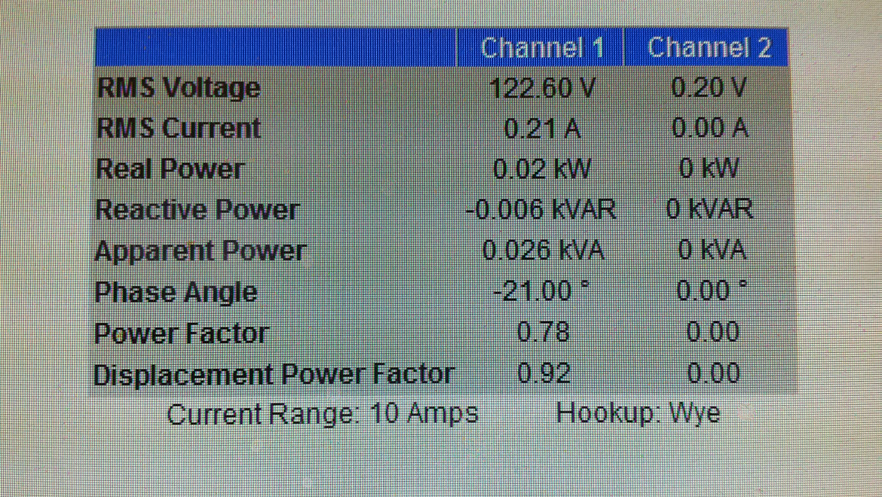
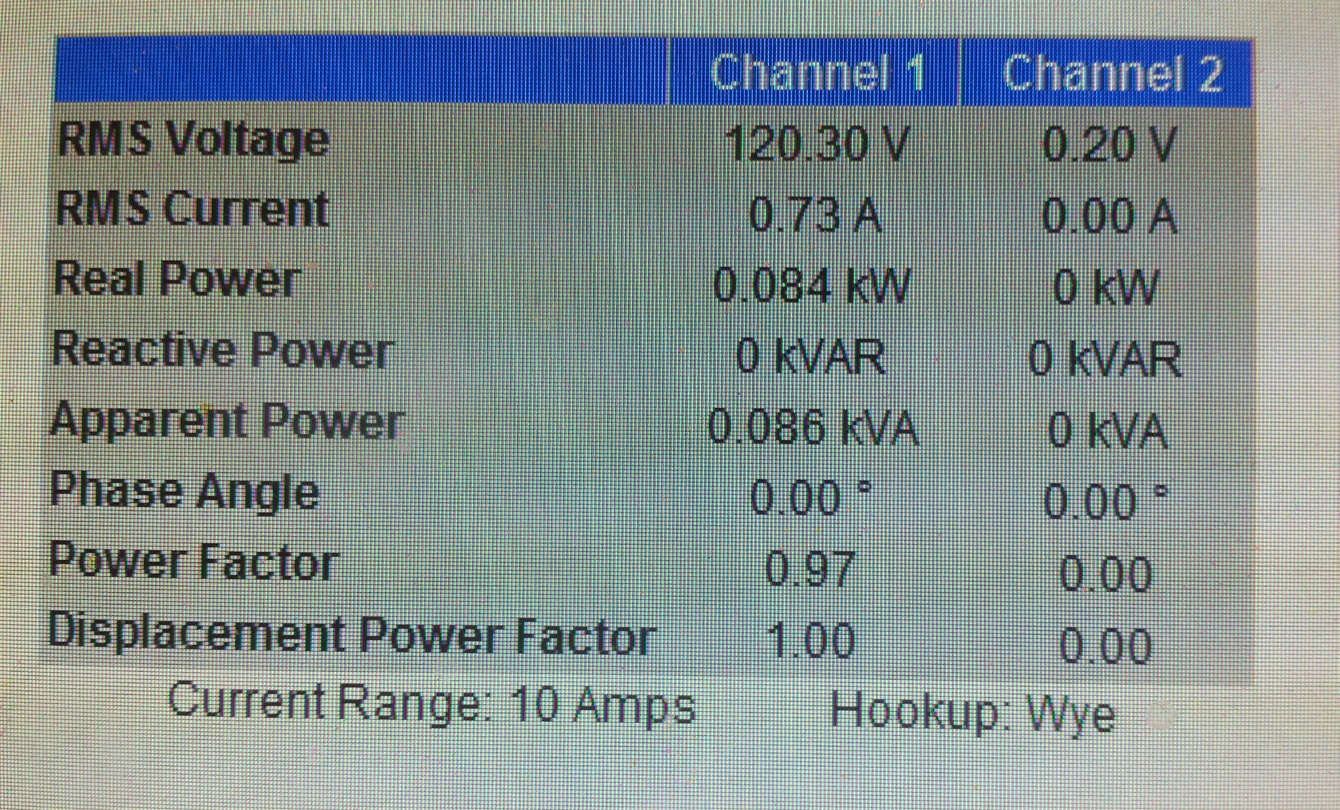
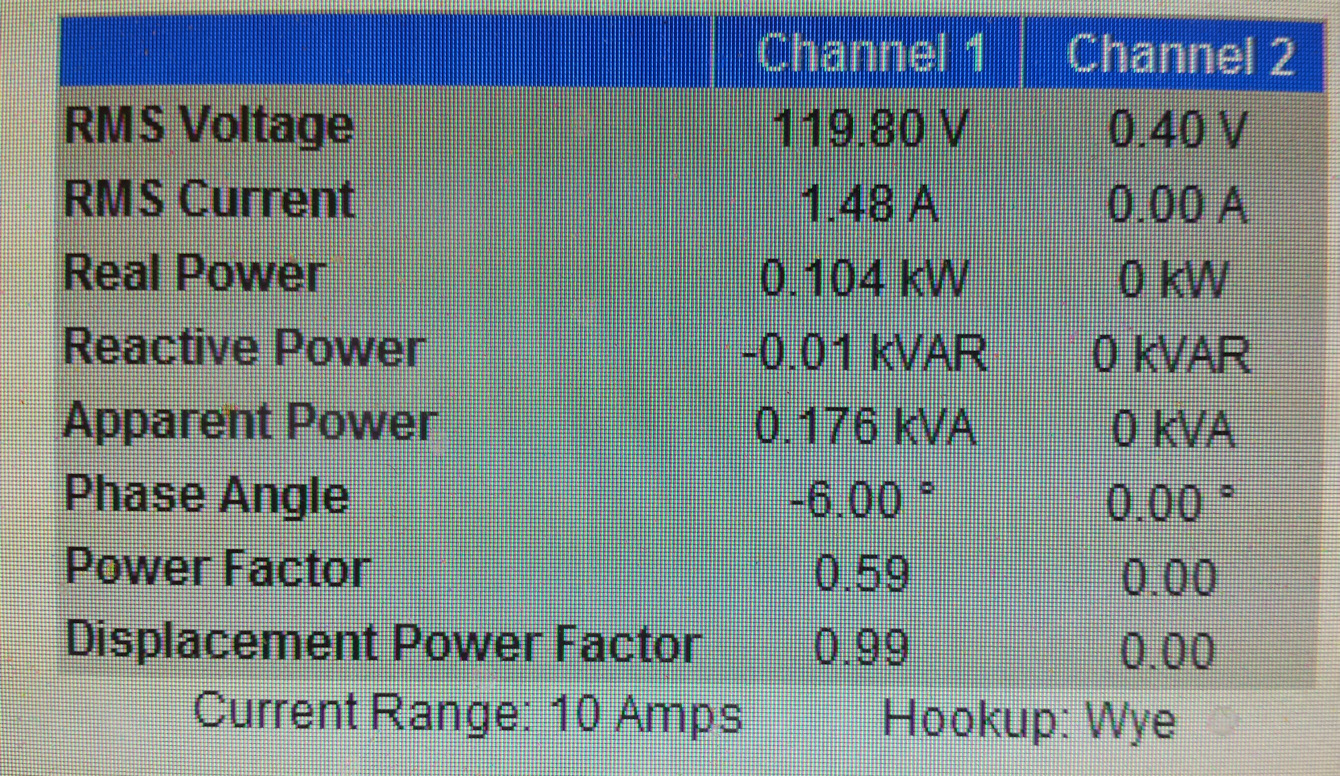
To maximize the power quality of a UPS output, there are a few items which should be addressed to assure the proper match between the UPS type and size, and the load. It’s almost always better to have a little more capacity than finding out during an outage you really needed more. When considering the size of the UPS needed, it is important to know whether the load is typically more linear or non-linear. If it’s non-linear, which most computer power supplies are, consideration needs to be made for the power factor and crest factor. Some manufacturers of modern switching power supplies are incorporating power factor correction (PFC) circuitry which allows a more resistive load thus a better power factor. Unfortunately the improved PF often comes at the expense of worse harmonic distortion. If the UPS is loaded with switching power supplies that don’t incorporate power factor correction, the power factor can be as low as 0.5 to 0.7. That means the apparent power, VA, will be significantly larger than the power consumed (real power, or watts). One of the computers used as a load in these tests incorporated a power factor correction circuit allowing it to have a good power factor of 0.97. An older computer without PFC only had a power factor of 0.59.
Another important item to consider is the load’s crest factor. PC power supplies and other electronic loads are composed of rectifiers and other non-linear switching components. These components often result in high peak currents, with power only consumed during the peak of the voltage waveform. Electric motors, with their large in-rush current, create similar peak current issues for a UPS. The UPS must have ample peak current handling capabilities in order to power these devices without voltage sag. This is referred to as the UPS load’s crest factor. Crest factor is the ratio of the instantaneous peak to average RMS current. (For more information on crest factor, see white paper Understanding Crest Factor)
For UPS types that synthesize the voltage waveform electronically, the peak current is often the limiting factor for load size (from the peak current limits of the pass transistors, diodes, etc. used). An industry standard PC crest factor is 3.0, (compared to a pure sine wave at 1.41), and thus many UPS devices are designed to that level. It’s important to check any nonlinear loads for excessive crest factor.
Types of UPS
There are several types of UPS systems in common use. The most prevalent type, the standby UPS, will be discussed here in the most detail.
Offline Standby UPS
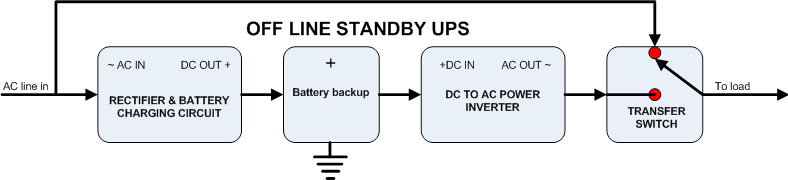
The standby UPS is the type normally used to backup desktop and office computers, allowing an almost seamless transition between utility voltage and UPS power. This requires the UPS circuitry that produces the backup power to be powered up and supplied to the computer in five milliseconds or less without creating power quality issues which could damage the load. Some of these standby UPS units only have enough battery capacity to allow the computer to shut down cleanly. In fact, most are designed to start shutting down the computer in a predetermined time once sensing a power outage. Others are setup to run loads for a much longer duration and in some cases until the commercial power is returned.
As with most UPS units, there is surge protection and filtering at various stages between the input and load. The exact location where surge protection and filtering is implemented depends on the brand of the UPS and its design. On many standby UPS units, there are two sets of power receptacles. One set of receptacles is only surged protected and filtered while the other has the actual power backup system in line. Due to simplicity, the filtering section is left out of the block diagrams.
Line-Interactive UPS
Line-interactive UPS are usually found as a backup system for small business computers and small networks servers. The line-interactive UPS is very similar to the standby type except it has an AC voltage regulator that utilizes a switchable taped transformer configuration that automatically corrects for variations in the input voltage. This allows the output to the load to remain constant within a nominal operating voltage range. There is a preset range that the voltage regulator can correct for. So if the voltage drops beyond this preset threshold, the load would then be switched to run off the battery backup inverter until the input voltage returns to a range that the automatic voltage regulator can compensate for. The line-interactive UPS is a step up from the basic standby UPS offering better protection against dips in power line voltage and brownout conditions.
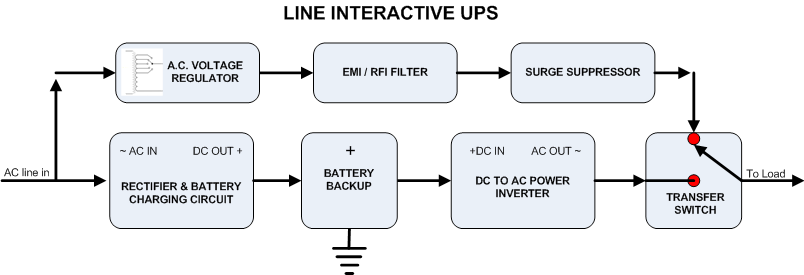
Continuous or Double-Conversion UPS
Another type of UPS that is worth mentioning is the online or continuous type UPS, sometimes called a double conversion type. The UPS gets its name from converting AC to DC and then converting it back to AC again to power its load. In this online UPS, the computer or load is run directly the battery-powered inverter at all times, instead of sensing the outage and quickly switching in the power inverter. In a continuous type UPS, batteries are continuously being charged from a power source until that power source is interrupted. The UPS’s internal battery charger is designed to supply only enough power to keep the batteries charged and topped off but not enough to cause the batteries to overcharge. Since the power is continually being produced from the output power inverter, and running off the charged batteries, there is no need to switch the load onto the backup because it is already there. When the power again comes online, the smart charger senses the batteries have been drained and produces enough power to charge the batteries and also run the load. This is done by changing the pulse width of the charger only until the batteries are topped off again. This type of UPS provides power with zero transfer time making it the most ideal supply for sensitive equipment, and in most cases it provides the highest level of protection by completely isolating the load completely from the power distribution system. One disadvantage over some of the other types of UPS is the efficiency. Since this type of UPS is continuously converting AC to DC and then back to AC, and converters are not 100% efficient, they are less efficient than the UPS units that pass the AC directly through to the load except when an outage occurs. Typically this type of UPS runs around 65 to 75% efficient. With the proper design, however, the efficiency of these continuous types of UPS can be quite high, in the 80 to 85% range. So the advantages of have zero transfer time in some cases may be worth a little loss in efficiency.
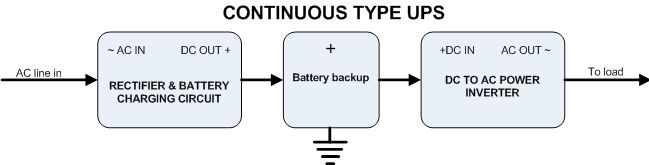
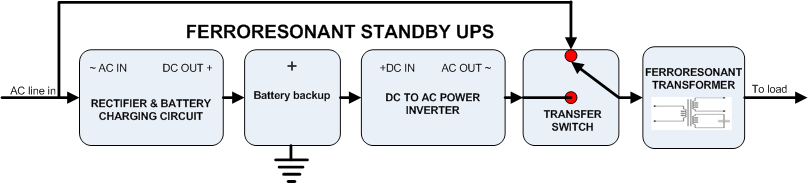
Ferroresonant UPS
The ferroresonant UPS is a standby type that is very similar to the standby offline type except for one additional functional component, a ferroresonant transformer. A simplified model of a ferroresonant transformer can be visualized as a power transformer that has two secondary windings, one with a capacitor across it tuned to 60 Hz or the power line frequency and the other secondary connected to the load. During normal operation, some power is stored in the transformer’s magnetic field and the capacitor’s dielectric field. During the time that is required for the inverter to come up on line and the transfer switch to engage, the flywheel effect between the stored energy in the transformer and capacitor keep the AC swinging or oscillating at the 60 Hz line frequency. This allows a seamless transition keeping the power to the load from being interrupted. The stored energy in the ferroresonant transformer and associated capacitor allows the inverter ample startup time which lets the inverter to stay powered down until the input power drops off. Not having to run the inverter continuously keeps the efficiency high without any spikes or dropouts.
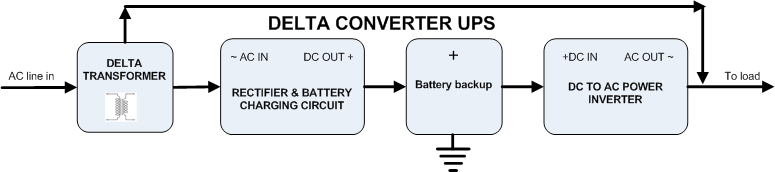
Delta Conversion Online UPS
The Delta Conversion Online UPS is a new technology that has some close similarities to the continuous or double conversion UPS. As with the double conversion UPS, the Delta Conversion has a battery charging stage that is continuously charging the backup battery and an inverter stage that is continuously providing power to the load. The Delta Conversion UPS has one major element that the double conversion UPS does not have, an inline delta pass transformer. This transformer takes the main brunt of the load current when the commercial power is online instead of all of the power passing through the charger and battery circuit. Since the delta transformer’s power efficiency is quite high, it allows the less efficient power supply and inverter circuit to carry less of the load during the time when commercial power is online, thus increasing the efficiency of the system. During power failures, the inverter already online starts pulling more of its energy from the storage battery to compensate for the power that is not flowing through the delta transformer to the load. This makes the transition seamless, allowing no power interruption to the load.
There are a few other less common types of UPS that exist that are not covered in this white paper. One type worth mentioning is the Flywheel type, FES, with a motor generator configuration that uses a rotor or flywheel to store energy in the form of kinetic energy while commercial power is online. When a power failure occurs, the generator converts the stored kinetic energy back into usable electricity to power the load.
Classes of UPS
There are three basic classes of uninterruptible power supplies; the sine wave, the simulated sine wave and the square wave. Equipment that is sensitive to power quality may require a true sine wave power supply. The sine wave type can sometimes improve the equipment’s performance and longevity. The sine wave class utilizing an online double-conversion UPS tends to be more expensive but is the best solution for mission-critical equipment where dependability is paramount.
The most common UPS are the simulated sine wave class, sometimes referred to as Pulse Width Modulated (PWM), which are mainly used to backup computers so they can be shutdown gracefully during a power outage. If the battery capacity is sufficient, they can also be used to continue to backup a computer or computer server to allow uninterrupted service during the power outage. Most UPS designed for this application also have extra outlets to support other computer related devices, such as monitors and printers. Usually there are two zones of outlets. One zone runs the computer and related electronics that need to be gracefully shutdown to avoid damage or lost data while the other zone is for less critical hardware that only requires surge protection.
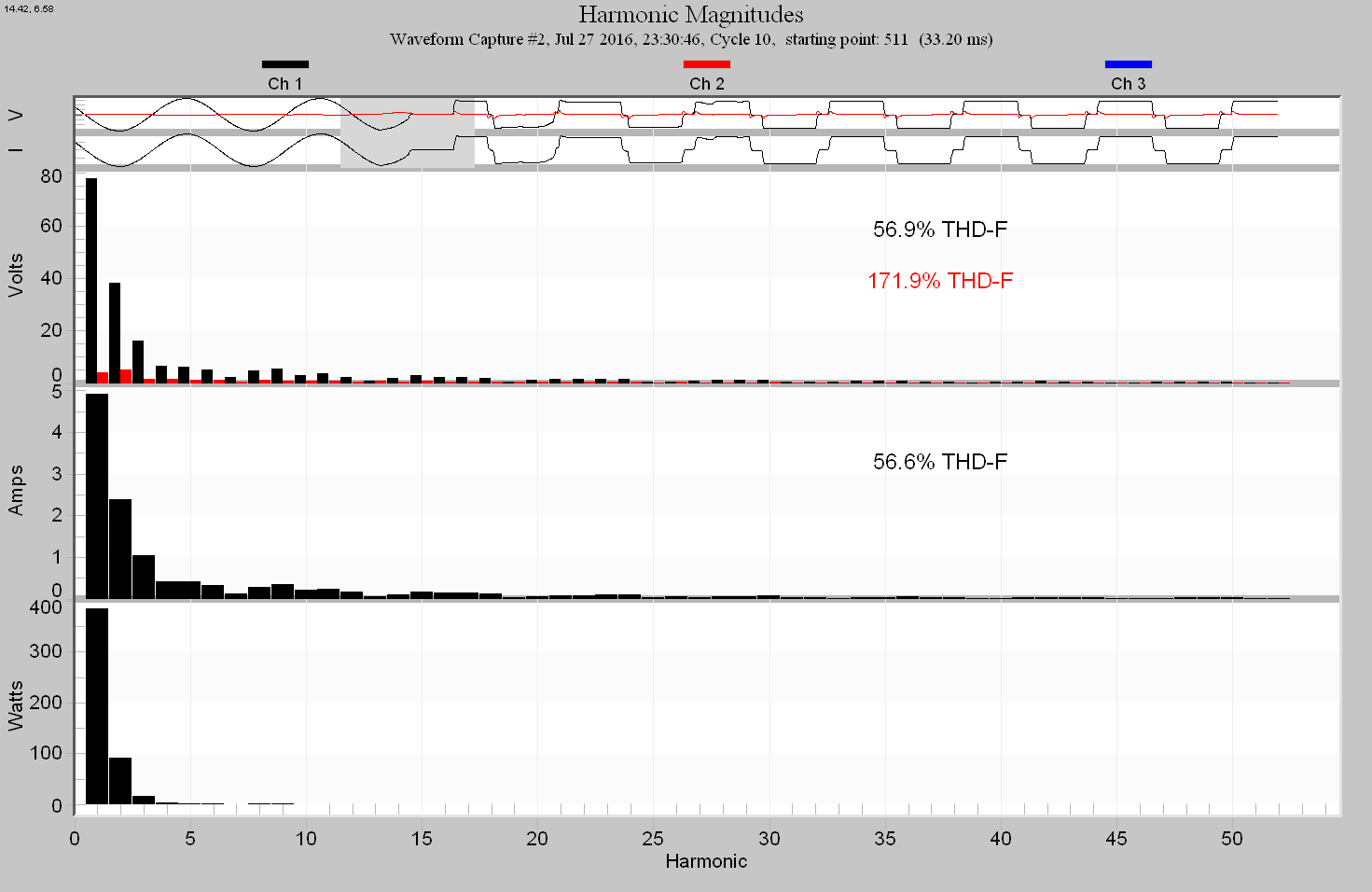
UPS systems do contain rectifiers and other non-linear devices that can present power quality problems to the incoming power, usually in the form of harmonic current. They can introduce harmonics into the distribution network, affecting the voltage quality upstream. As with the switching power supplies used in computers, most newer UPS units contain PFC circuitry which may improve the power factor but possibly increase harmonic levels compared to older UPS models.
Conclusion
There are different types, classes, and sizes of UPS. Finding the appropriate UPS for a specific load requires researching the load’s requirements. Some loads are more sensitive to power quality than others. Loads themselves can actually affect the power quality of the UPS and, depending on the load’s linearity, its power factor as well. The UPS needs to have ample capacity and headroom to handle loads with high crest factors, imperfect linearity, and power factor. A good target for the load handling capacity is somewhere above 40% and below 80% of the UPS maximum load capacity. At very low load capacities especially with continuous type UPS, the efficiency suffers. However it is important to always have a little extra headroom to prevent the UPS from being overloaded. It must also have the energy capacity to power load for the duration of the outage, or in the case of a computer, until it can be shut down gracefully to keep from losing data. As the backup battery ages, the capacity of the battery diminishes depending on several factors including usage and temperature and should be checked and replaced periodically to prevent UPS failures. If the load is sensitive to power transits or sags, the UPS must be of the type not to introduce these power quality issues. It is a good idea to take power quality measurements with the intended load in place to get a better understanding of how well the UPS is matched with the load.