Abstract
With the push for energy efficiency comes the proliferation of non-linear loads whose overall effect on the power transmission system may not always be as beneficial as originally intended. The triplen harmonics that are caused by nonlinear loads can cause issues such as excessive neutral currents, transformer failures, excessive heating of motors, electronic device failures, failed capacitor banks, breakers and fuses tripping, and communication issues related to RFI and noise ingression into the communication system. This paper details what triplen harmonics are, what causes them, system issues that result from triplen harmonics, and best practice for mitigating triplen harmonics and their effects.
Triplen Harmonics
Triplen harmonics are odd multiples of the 3rd harmonic, where the name triplen is derived from. This would be for example the 3rd, 9th, 15th, 21st etc…
Figure 1 shows the relationship of the fundamental and the first triplen harmonic. Because triplen harmonics are of the zero sequence unlike the fundamental which is positive, the magnitude of the currents of these harmonics on a 3-phase system is additive in the neutral circuit. This can cause very large currents to flow in the neutral, and unless the neutral is sufficiently oversized to handle the extra current, significant heating can occur causing a fire hazard. In the past, before the introduction of PCs, UPS, and other devices causing large nonlinear loads, the manufacturers of powering strips would sometimes undersize their neutral wires to save money. For resistive linear loads, the neutral currents were usually quite low. This undersizing of the neutral wiring turned out to be a major factor contributing to many fires in the past. Now it is commonplace to see the neutral wires oversized to prevent a potential fire hazard.
Figure 2 shows how the three phases add together to enhancing the third harmonic on the neutral when the load becomes nonlinear. With a linear load, there is no current flow on the neutral line. In other words, in a four wire system as shown in Figure 2, where there are three phases and a neutral, the phase currents’ return path is by the neutral conductor. In a distribution system with an ideal resistive linear load, the 120 degree phase shift between the different phase currents allows them to be perfectly balanced, cancelling out any neutral currents, resulting in no current flow in the neutral. In a real world situation, distribution systems always have some mix of linear and non-linear loads, so the current on one phase does not have a pulse on the other phases with which to cancel out the other, causing current to flow at intervals of three times the fundamental frequency thus creating triplen harmonics. At the extremes, currents generated in the neutral due to non-linear loads can be as high as 173% of the phase currents.
To compound this problem, when harmonics are higher in frequency than the fundamental, they use less of a conductor to carry the current. This phenomenon is known as the skin effect. This is clearly illustrated in Figure 2b on the Neutral. This shows that the frequency of the neutral current when providing power to a non-linear load is nearly 3 times the frequency of the fundamental or 180 Hz on a nominal 60 Hz power distribution system. As the frequencies of the harmonics become higher, they utilize less of the cross-sectional area of the conductor and stay closer to the conductor’s surface. This raises the resistance of the conductor causing the I2R losses to increase. These elevated currents also put a strain on power transformers causing them to generate excessive heat which may cause them to fail or fail sooner. These triplen harmonics are not only problematic to 3 phase systems, they also affect single phase power supplies.
Sources of Triplen Harmonics
Triplen harmonics are not produced by the generating station or a power generating source. Triplen harmonics are produced as a result of nonlinear loads on a power system. The rectifier is a major offender being a nonlinear device that takes the alternating current and converts it to DC pulses.
One of the most common rectifiers in use today is the silicon based P-N junction type. For simplicity, the waveform in Figure 3 represents a single diode charging a capacitor. When the rectifier is forward bias, it begins to conduct, allowing the capacitor to charge, thus loading the AC line. As demonstrated in Figure 3, the amount of current that is drawn from the AC source is repeated every cycle. In a full wave bridge configuration, this action happens twice as often, on both the positive going edge and negative going edge of the sine wave after the diode has sufficient voltage to overcome the junction voltage drop, usually 0.7 volts for silicon. Depending on the charge of the capacitor, the capacitor value, and the load on the capacitor determines when the diode will start to conduct and how long the conduction cycle is. This will also govern the conduction angle. It is clear to see this is not a linear process and will cause harmonics. Also, on 3 phase systems, since rectification occurs on each of the three phases, the conduction cycle of the rectifier will occur at three times the rate as on a single phase. This along with a doubling of the line rate due to the use of a full wave bridge raises the frequency of the harmonic generated, but also tends to lessen the conduction time, thus the conductive angle which may lessen the severity compared to a rectification system with fewer poles.
Triplen harmonics are the result of devices that offer non-linear loads to the system. Any power supply that converts AC to DC uses a rectifier, which presents a non-linear load. These types of power supplies are used in almost any electronic component plugged into AC. Computers, UPS, TVs, radios, amplifiers, are just a few examples. The more power they consume, usually the more triplen harmonics are generated, even if each device on its own does not consume much power, the total can contribute to an overall problem. For example, a single PC may not present much of an issue, but in a location such as an office building, 100 PCs could easily become a nonlinear burden on the system.
Another source of triplen harmonics are electronic ballasts use in fluorescent lamps. In some department stores and offices, there can be hundreds or even thousands, and with the reduction of incandescent type lighting, this trend is not likely to improve. Even light dimmers for the incandescent lighting can be a source of triplen harmonics.
With the push for more efficient lighting, and the phasing out of incandescent lighting, compact fluorescent lamps, CFL, and LED type lighting are rapidly becoming the norm. Incandescent lamps, even though not nearly as efficient as CFL and LEDs, have one distinct advantage, they presented a much more linear load to the power system, causing virtually no harmonics—this is not the case with CFL and LEDs.
Issues Resulting from Triplen Harmonics
One of the main issues that result from triplen harmonics is the overheating of transformers and rotating equipment. If triplen harmonics containing 5th or 11th harmonics are applied to a 3-phase motor, it will attempt to drive the motor in reverse. In order to compensate, the motor must draw additional current at the fundamental, eventually causing it to overheat. Some of the other negative effects of triplen harmonics include increased hysteresis losses in transformers, decreased kVA capacity, neutral overloading, unacceptable neutral-to-ground voltages, distorted voltage and current waveforms, failed capacitor banks, breakers and fuses tripping, interference on phone and communications systems, unreliable operation of electronic equipment, erroneous register of electric meters, wasted capacity and inefficient distribution of power, and an increased maintenance of equipment and machinery.
Ways to Reduce Triplen Harmonics
There are ways to mitigate the large voltage distortions caused by triplen harmonics. One of the most effective ways is to install an inductor on the source. The inductor acts as a low pass filter, passing the fundamental 60 Hz frequency and blocking the higher frequency harmonics from affecting the power line feeding the nonlinear load. Adding inductors to devices such as computer power supplies and UPS’s can also reduce triplen harmonics.
Another way of reducing triplen harmonics from a nonlinear load is with a drive isolation transformer. Figure 4 shows how an isolation transformer improves the waveform powering single phase VFD loads that can cause triplen harmonics.
When driving a nonlinear load, it is better, if possible, to use a delta configuration as opposed to a wye-configuration. See Figure 5. In a delta configuration, the neutral line is eliminated; therefore the harmonics have no neutral line to travel in. Even though the triplen harmonics are trapped in the delta load’s loop, there is a downside, the triplen harmonics are still generated in the non-linear load causing monetary losses in the delta transformer’s efficiency. This does isolate the harmonics from line and source, but at a cost of causing higher currents to flow in the secondary windings of the load’s delta transformer. Because of this, the delta transformer’s load capacity needs to be de-rated to keep the triplen harmonics from causing them to overheat.
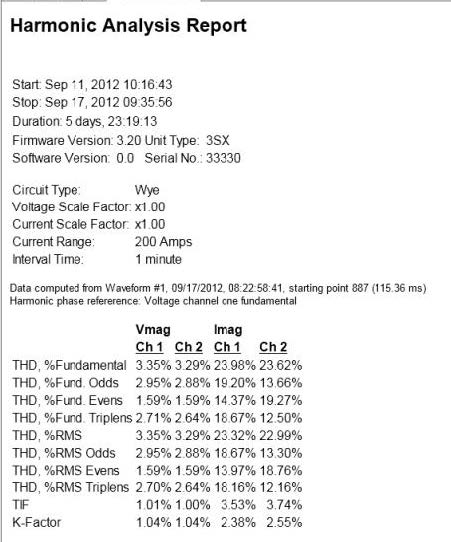
With the use of PMI’s Recorders and Provision, it is easy to measure and verify the triplen harmonics’ contribution to the Total Harmonic Distortion of a system. In Figure 6, it is very clear to see how Provision displays the measured THD, % of the Fundamental Triplens by the recorder. In this case, the current magnitude of Channel 1 is 18.67% and Channel 2 is 12.50%. This can be a very valuable tool in analyzing the triplen harmonics of a system at different points in the distribution system. With this knowledge of where and what is causing the excessive triplen harmonics, it allows action to be taken to control the triplen harmonics before equipment damage occurs.
Conclusion
As time progresses, new regulations and technologies will continue to introduce energy saving devices such as the switching power supplies, fluorescent lamps, CFL, LED lighting and other non-linear electronics. Even though the efficiency of each individual devices continues to increase, its effect to the power transmission system may not always be as positive as first thought. Sometimes improvements in one area, as in improved efficiency, can often cause problems in another area, such as nonlinear loads. Triplen harmonics that are caused by nonlinear loads can cause issues such as excessive neutral currents, transformer failures, excessive heating of motors, electronic device failures, failed capacitor banks, breakers and fuses tripping, and communication issues related to RFI and noise ingression into the communication system. With the right monitoring equipment and integrated software, and an understanding of power quality fundamentals, it is possible to continually and effectively assess overall system health and prevent potential system failure. Even though triplen harmonics may not be completely eliminated, steps can be taken to control them, such as filtering and designing the system to be able to handle them by upsizing the neutral lines and transformer capacities.