Abstract
Arc Fault Breakers (or AFCI breakers) are sensitive breakers that augment traditional breakers’ functionality by using logic and signal processing to determine whether or not an arcing condition is present. Sometimes, non-traditional loads and other power quality phenomena – while not a problem in and of themselves – can generate “false positives” resulting in nuisance breaker trips. This white paper gives an overview of Arc Fault Breakers, some of the power quality conditions that may lead to “false positives” and some ways to attempt to detect what specifically is causing a breaker to trip.
What Are Arc Fault Breakers?
Arc Fault Breakers (or AFCI breakers) are a class of intelligent breaker that trip not only when current exceeds a maximum specified level, but also when current drops below a minimum specified level and an “arcing event” has been detected. These “arcing events” are typically instances where a complete short circuit isn’t present but conditions are still hazardous (for instance a lamp cord with a broken conductor).
AFCI breakers come with a variety of capabilities. In addition to the standard, no-frills AFCI breaker that has been discussed up to this point, there is also a combination AFCI breaker that can protect against parallel arcing, series arcing, and ground arcing. Combination AFCI breakers can also protect against overloading and short circuiting.
Electrical Code
With arc faults being one of the primary causes of residential house fires, many local electrical codes have adopted requirements for the use of AFCI breakers on circuits for residential outlets. The National Electrical Code made this a requirement in 2014 and in 2015, the Canadian Electrical Code adopted similar standards. Adoption of the latest NEC is often delayed as states gradually update their building codes. In many states, AFCI breakers are already required in bedroom residential circuits, and will likely be required for all residential branch circuits in the next few years.
Arc Faults
As mentioned briefly above, the idea of an AFCI breaker is to trip when an arcing event is detected. Arcing due to insulation failure or medium resistance conductor contact may result in current flow that’s under the nominal breaker trip rating but still presents a fire hazard. The current, and thus overall power, is relatively low compared to the branch circuit capacity. If that power is concentrated in a small area, the temperature rise can be high enough to start a fire.
An example of a tripping condition is one in which insulation may be failing. On a 15A breaker, the current of one or two amps would not be sufficient to trip – but two amps at 120VAC results in 240 watts of power, which is more than enough to cause a fire if concentrated at a single point. A relatively high resistance “short” formed by a very small conductance path through failed insulation or just a few strands of a conductor will present enough resistance to limit the current so that the breaker doesn’t trip, but consume enough power to overheat. A true arc through air can produce the same effect – the arc resistance is high enough to avoid a direct short circuit (which would easily trip the breaker) but low enough that significant power flows. That power, concentrated in a small volume, can produce enough heat to present a fire hazard.
How They Work
Since the RMS current is below the nominal trip value, other properties of the current flow must be examined in real time by the breaker. An AFCI breaker analyzes the current waveform signature and, if arcing is detected (usually for just a few milliseconds), the breaker will trip, thus preventing the potential fire.
This real-time determination requires some advanced electronics – basically a circuit board measures and analyzes each waveform that passes through the breaker. The algorithms to distinguish arc faults from normal current flow involve trade-offs between the rate of false positives (leading to nuisance trips), false negatives (missing a real fire hazard), and complexity (leading to an impractical design). Many arc currents exhibit a pattern where the arc begins at a certain voltage point in the waveform (where the voltage is high enough to establish the arc), and end at the voltage zero crossing (see Figure 1). This characteristic current shape can be recognized by the breaker. Other arc patterns include high frequency components in the hundreds of kHz to low MHz range. This broadband current noise is far above the normal harmonic frequencies associated with power quality issues and normally causes no problems on the powerline. Typically various arc current features are quantified and scored internally by the breaker, and if the aggregate measurement exceeds a threshold, the breaker trips.
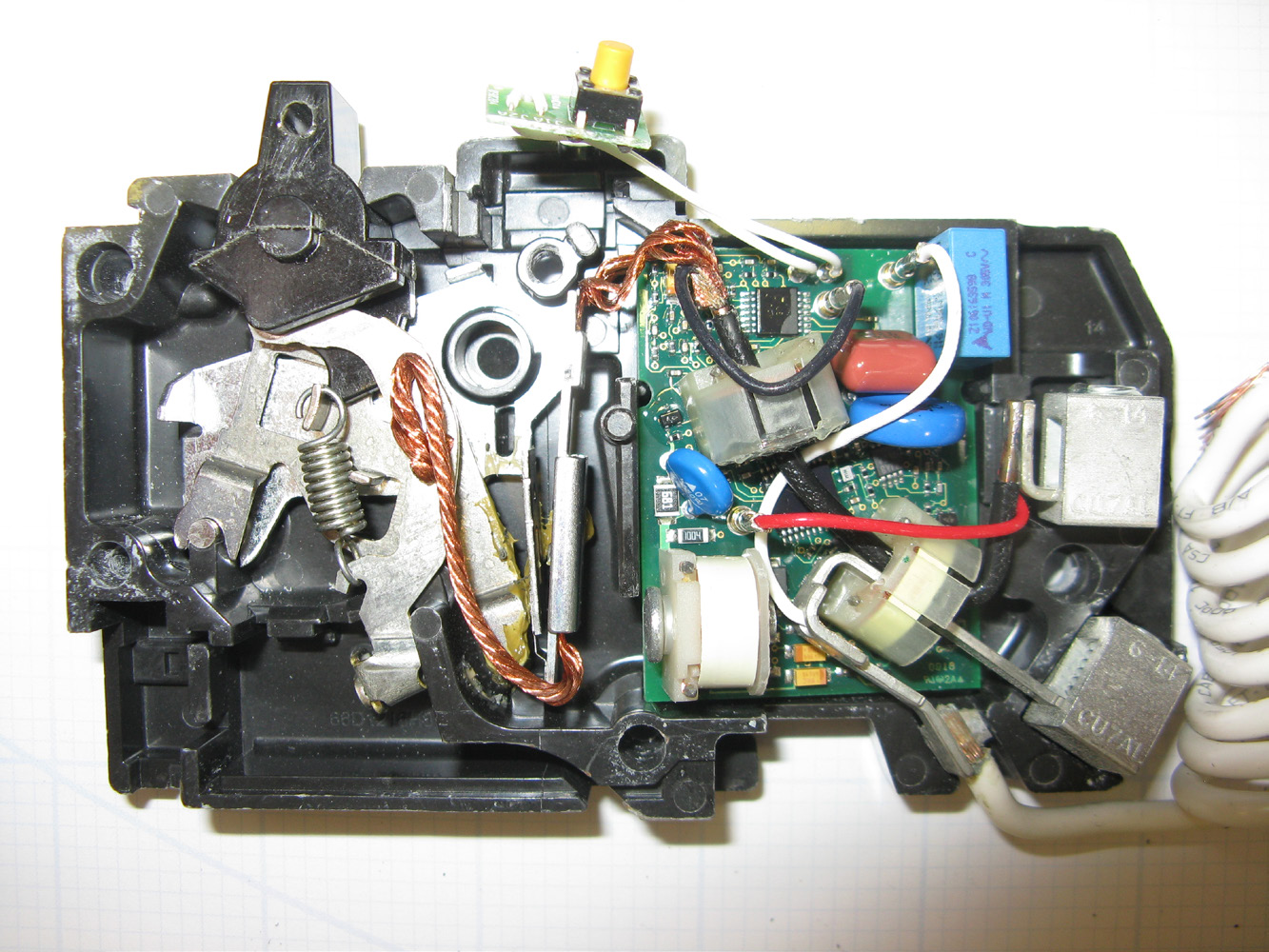
Unfortunately, some normal loads may show these same patterns. Power tools and other loads with brush motors produce arc-like currents, and switching events can also generate high frequency noise. Creating a small, low-cost device that can accurately distinguish these patterns is a challenge for breaker manufacturers, and false trips are inevitable. A typical arc-fault breaker is shown in Figure 2. In addition to the traditional overcurrent hardware, an arc fault breaker includes electronic circuitry and a microprocessor to implement the detection algorithms.
Identifying the Source of an Arc Fault Trip
There are several sources that can cause unintentional tripping: lightning strikes, vacuum cleaners and other brushed motor loads, uninterrupted power supplies (UPS), and refrigeration equipment.
However, more often than not, the false tripping is due to a handful of common issues. Probably the single most common cause of AFCI tripping comes from faulty installation and is detected immediately since the breaker will trip as soon as energized.
Single pole AFCI breakers cannot share a ground with another circuit. It’s an integral part of the design of the breaker – the breaker must be able to sense an arcing condition and this is impossible without a distinct hot and neutral conductor.
The next most common cause of trips are legitimate concerns: line-to-neutral and line-to-ground arcing (often as a result of inadequate insulation). These, of course, are typically concerns of the installing electrician and not specifically the utility.
From the Utility’s Perspective
As noted above, the majority of AFCI issues are not directly utility-related. It is worth noting, however, that there are some issues of which a utility should be aware. In troublesome cases, an electrician may rule out wiring or load problems, and the incoming utility voltage quality is suspected for the breaker trips.
While most high frequency noise arriving at a distribution transformer from upstream will be attenuated by the transformer itself, in some circumstances the noise originating on the secondary of a transformer (harmonics or perhaps even a transient) could induce “false-positive” tripping of an AFCI breaker.
Monitoring at the secondary side of a transformer can be useful in detecting these situations (using a recorder such as the Revolution). While a PQ recorder doesn’t measure in the 100 kHz+ range, often high frequency noise occurs along with lower frequency noise in the normal harmonic range. In addition, there will likely be 60 Hz current changes when the AFCI breaker trips. Identifying the load at this time would prove beneficial as it is likely the culprit of the trip, regardless of the waveform specifics. Keep in mind that loads from other customers on the same transformer secondary could be the root cause.
A voltage waveform shape with no corresponding current changes at the time of a trip may indicate an upstream voltage problem. This is more likely due to switching transients than upstream loads, but in any case, the waveform capture will provide details about the source. A ringing transient captured at the same time as a reported breaker trip may point to a capacitor switch operation or possible insulation failure at the transformer or service drop.
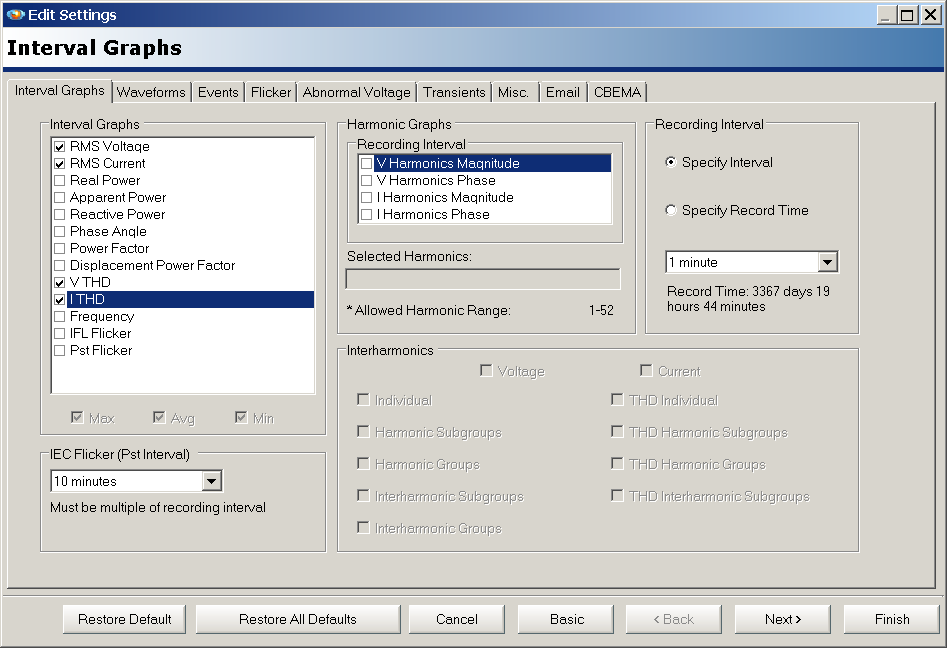
Recommended settings for stripcharts are shown in Figure 3. At a minimum, record RMS voltage and current along with voltage and current THD. The harmonic distortion will be useful in correlating noise loads with nuisance trips, and the RMS current can also help identify different loads if needed.
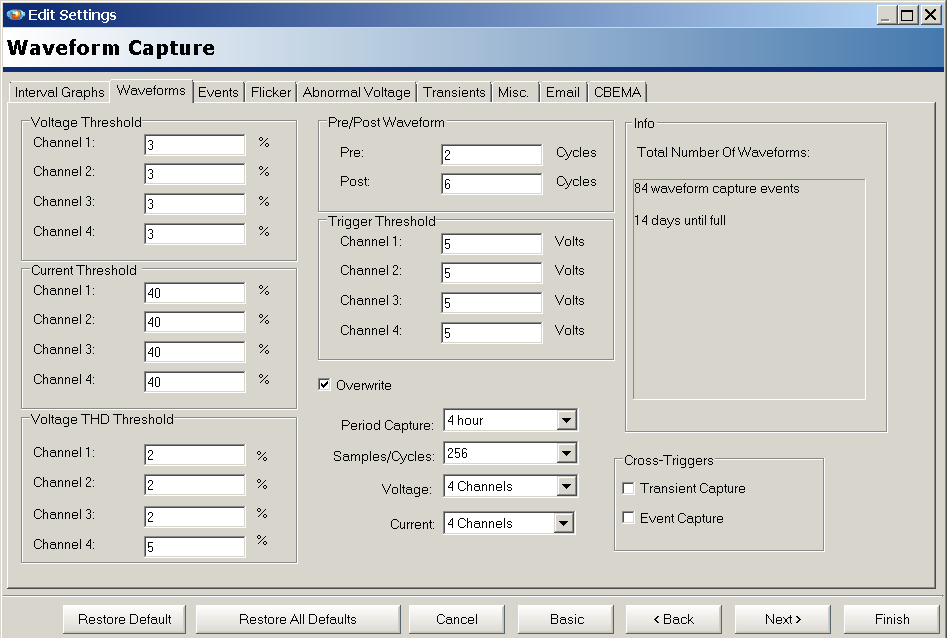
Waveform capture settings are shown in Figure 4. The key settings are the periodic capture (set here to 4 hours), to get representative baseline waveforms for this location and the low 2% voltage THD threshold. The 2% THD value is a change within one cycle, and this will help capture voltage transients that may be confusing an arc fault breaker.
In difficult cases, the breaker manufacturer may be able to help. In some applications, special debug arc-fault breakers are available to utilities or large customers. A debug breaker may be used in place of a standard arc-fault breaker, and can provide information on what caused a trip. This debug information can help identify the source of a mis-classification and nuisance trip, and also give the breaker manufacturer feedback to help improve the next series of breakers.
Conclusion
AFCI breakers are here to stay. While their intended goals are laudable, the technology is still not perfect – “false positive” trips are still going to happen and as long as they are happening, utilities are going to be receiving customer complaints. Knowing the primary causes of AFCI trips, and some ways to monitor potential external factors, can go a long way in helping customers to resolve AFCI-related nuisances that are referred to the electric utility.