Abstract
This white paper is a technical explanation of the form, fit and function of Boomerang PQ monitors. These units are intended to assist utility companies in troubleshooting and maintaining their sections of the local power grid. Since issues may occur anywhere along the supply line, there is not one monitor that can satisfy every possible issue.
Types of Boomerang Units
The Boomerang is designed for steady-state voltage, current, and power monitoring, and can work with a utility SCADA system and PMI’s cloud-based Canvass data collection and analysis system. Each Boomerang measures all available parameters once per second. These measurements are filtered through user-adjustable averaging windows, sent through comprehensive triggering logic, and made available to a SCADA master. If any trigger conditions are met, a DNP3 response can be sent immediately to a master, and/or sent to Canvass for further distribution via email or text message. The one second readings are collected and sent to Canvass for storage in PMI’s cloud database, and are available in any web browser.
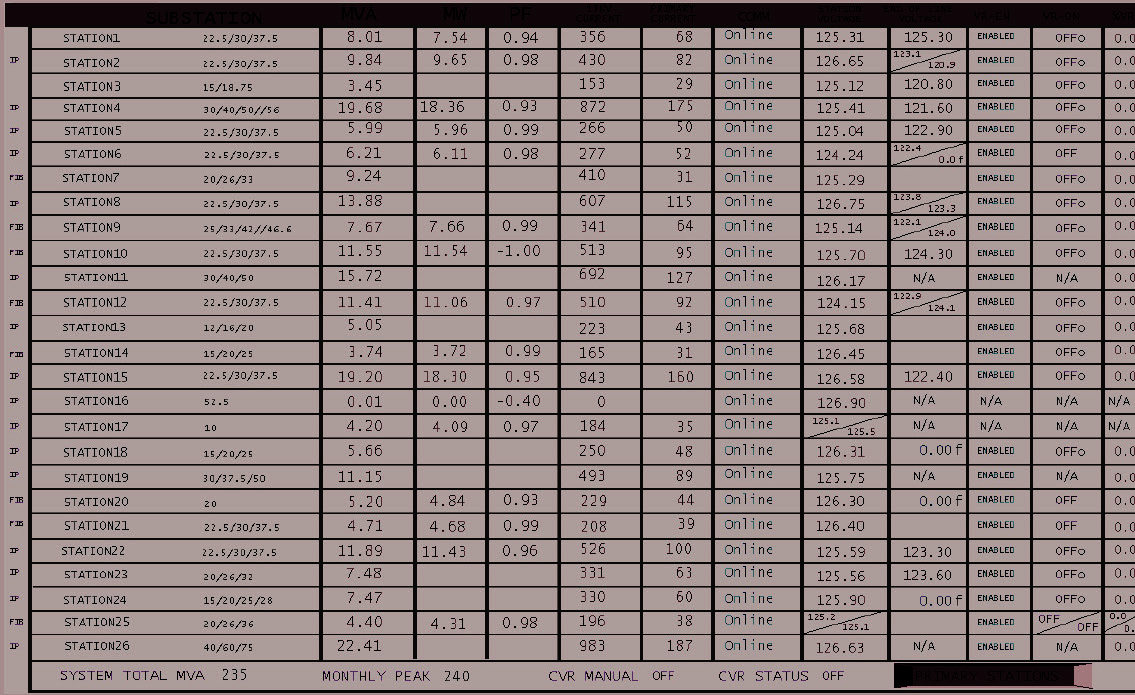
The Boomerang family of single-phase wireless voltage, current and power monitors extend the user’s SCADA (Supervisory Control and Data Acquisition, see Figure 1) system to anywhere needed – whether that be a residential meter base, a voltage regulator on a pole, the end of a distribution line, or a 120V receptacle. Each Boomerang unit includes an integrated cell modem with internal antenna for unobtrusive real-time monitoring anywhere. Fine-tuned for use with low-cost telemetry data plans, the Boomerang’s full-featured DNP3 interface is optimized for demand management and conservation voltage regulation systems, including multiple configurable thresholds, unsolicited report by exception and polled modes, as well as analog and binary points.
All members of the Boomerang family (Table 1) are able to monitor voltage as well as having the ability to measure current and power, either as standard or an optional feature. Boomerangs also include a fully-featured remote interface optimized for demand management and conservation voltage regulation systems, including multiple configurable thresholds, unsolicited report by exception and polled modes, as well as analog and binary points. With customizable alarm settings, a Boomerang unit can act through Canvass to notify the user of all types of voltage issues, with current as an option.
Instead of an internal battery, each Boomerang unit utilizes an internal super cap to maintain a charge sufficient to last about one minute. This gives the unit enough time to send a notification of the outage. Normal operation resumes when power is restored to the unit.
While the Boomerang is not a recorder on its own in the strictest sense of the word, it does maintain a small memory buffer. The buffer holds a few minutes of accumulated readings, so that the readings may be compressed before sending through the cell system to Canvass. This compression allows for lower data rate telemetry plans, while still keeping one-second time resolution on all readings. Multiple buffers and a retry strategy are used to handle cases of low signal strength or other temporary network issues.
| Model | Plug-In | 2S | 3-Phase | Pole Mount |
|---|---|---|---|---|
| Voltage Input | 80-140V RMS | 80-300V RMS | 80-300V RMS* | 80-300V RMS |
| Voltage Power | 1% | 1% | 1% | 1% |
| Voltage Resolution | 0.1V | 0.1V | 0.1V | 0.1V |
| Current Ranges | 0-40A, 15A Continuous | — | 0-400A RMS Total (200A per leg) | 20, 200A TLARs 100, 1K, 5KA, w/ Flex CT |
| Current Accuracy | 0.50% | — | 0.50% | 0.50% |
| Current Accuracy | 1% | — | 1% | 1% |
| Power | 1% | 1% | 1% | 1% |
| Communication CDMA Cellular | Yes | Yes | Yes | Yes |
| Ethernet | No | No | Optional* | No |
| Dimensions L | 4.9" | 6.75" | 4.8" | 6.5" |
| Dimensions W | 2.7" | 6.75" | 3.35" | 6.5" |
| Dimensions H | 1.25" | 4.625" | 1.84" | 4.25" |
| Case Properties | Indoor Use Only | — | NEMA 4X | NEMA 4X |
*Model with Power over Ethernet feature can measure up to 600V RMS. However, unit will not power through voltage leads.
Single-Phase Monitors
While mounting wires on poles is an efficient and cost-effective way to run utility lines, it has its drawbacks. Unlike underground wiring, overhead lines are subject to weather, accidents, and other sources of damage. The large box pole mount Boomerang is ideal for outdoor mounting. It consists of 2 nested NEMA 4X enclosures, one inside the other. Available in single-phase or 3-phase models, the pole mount Boomerang is perfect for power pole applications, such as voltage regulators, capacitor bank measurements, or end-of-line monitoring. The rugged NEMA 4X enclosure includes a terminal block and mounting feet for permanent installations. The latches also have an interlocking pass-through that can accept standard locks as an extra security feature. Each Boomerang includes an integrated cell modem with an internal antenna, and the pole mount Boomerang contains a screw terminal mounting block which allows the customer to choose the style of voltage leads best suited to his needs. All the user needs to do is pass his voltage cable through the NEMA 4X strain relief port, wire the leads to the terminal block, and seal the strain relief.
The meter socket Boomerang is a standard pass-through form 2S meter socket adapter for single-phase and 3-phase applications. With no external antenna or ports, it is perfect for residential locations. The internal housing is also designed to meet NEMA 4X specifications. Installed behind most standard revenue meters, the Boomerang socket model will provide data right at the point of common coupling. Designed to work with a standard residential meter base, each socket Boomerang includes an integrated cell modem with an internal antenna for unobtrusive real-time monitoring anywhere. The unit acts as a simple pass-through module, and all that is required for the user is to plug the Boomerang into the meter base and then install his revenue meter into the monitor.
Designed for industrial and commercial use, the plug-in IV monitor Boomerang monitors individual pieces of equipment or voltage at a 120V location. Made for use in a single-phase 120V outlet at up to 15 Amps (continuous), it is designed for ease of use. To operate the plug-in model, the user just needs to plug the unit into the wall outlet and then plug in his 120V equipment into the Boomerang unit, being mindful of the 15A max continuous rating. Through Canvass, the plug-in can also communicate data to pre-selected people through email and/or text messaging. The plug-in form factor is perfect for spot checks at troublesome locations, as well as for reclosers and outage monitoring and notification. The Boomerang plug-in comes standard with an integrated cell modem and is much less intrusive than older, dial-up telephone plug-in monitors. It can also be used in substations where the voltage on 120V accessory receptacles track with the PT voltages.
Once the Boomerang plug-in unit is connected to the Canvass network, each individual unit can be fine-tuned to best suit the user’s monitoring needs. They may set the units to notify them if any of four various monitoring points are exceeded under voltage, current, or power. The more critical the area being monitored, the tighter the control limits can be set. The user must keep in mind that this unit is not intended for outdoor use.
3-Phase Monitors
The weatherproof 3-phase Boomerang’s small size (5" x 3" x 1¾") gives it the maximum flexibility for monitoring in almost all locations. The housing is rated as NEMA 4X to protect against the elements, and an optional magnetic clip makes it easy to attach the unit onto a metal enclosure or cabinet. The standard model 3-phase Boomerang is capable of measuring up to 300V, while the PoE version can measure up to 600V. The Cell modem units also come in two varieties, with the standard unit including an internally mounted cell antenna. For challenging cell coverage locations, the external side mount antenna model may be utilized. The side mount antenna model also has an external antenna kit available, which includes a magnetic base with a 10’ cable extension, as well as a selection of four antennas (fixed 3", 12", and 24", including a 6" heptaband antenna with a 0°-90° elbow).
The 3-phase Boomerang also has current monitoring ability. These units connect to both standard Flex CT and TLAR current clamps. This enables the user to measure up to 5000A using the Flex CTs, or up to 200A using the TLAR clamps. The optional power over Ethernet model removes the requirement to power from the channel 1 voltage input, and allows for voltage inputs up to 600V. This unit is powered by 15V sent over an Ethernet cable via a special power injector.
Overview of Canvass
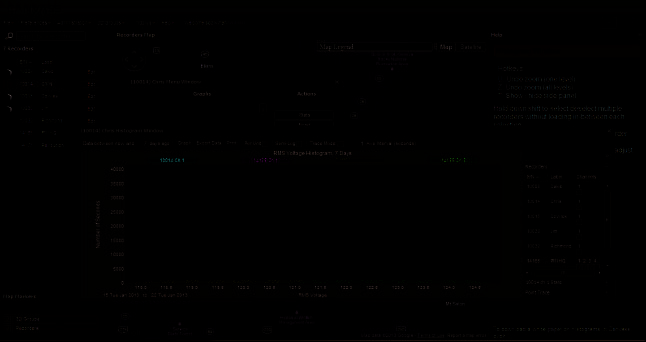
Canvass is PMI’s web-based database and data analysis package. With Canvass, the user can view voltage, current and power strip-charts, histograms, and daily profile graphs for every data point that the device has registered to the PMI Canvass data warehouse (see Figure 3). When used with the Canvass cloud system, the Boomerang collects data on a one-second basis. Every few minutes, one-second values are sent to the PMI data center. With this system, all data collection is performed continuously; no data is stored in the Boomerang, and there is no recording download operation required by the user. All historical data is available in a web browser, and is accessible through powerful graphs and reports. Canvass can fine-tune a CVR system to analyze voltage trends and regulator responses over geographic regions, and can also be configured to send e-mail and text messages based on Boomerang events for immediate action outside the user’s SCADA system.
Conclusion
After examining the various types of monitors in the Boomerang family, one can see the wide variety of form and function needed to meet any user’s monitoring needs. Whether they need to monitor a transformer on a pole or an important piece of industrial equipment in a major industrial area, a Boomerang unit will fit the situation.