Abstract
Most PMI recorders include waveform capture, and the Revolution optionally includes a high-speed microsecond-level transient capture system. Although PMI waveform capture and transient capture seem very similar on the surface, they are best used for different types of events, and the triggering mechanisms are fundamentally different. This whitepaper illustrates their similarities and differences and gives some best practices for each.
Transient Capture Basics
The Revolution features optional transient capture ability. This includes a voltage input range of +/-5000 Volts (that is, 10 kV peak-peak) on the same voltage inputs used for regular monitoring. The voltage is sampled at 1 MHz on each channel, giving 1 microsecond per sample. This is 65 times more resolution than regular waveform capture. The current inputs also have high-speed sampling – 250 kHz on each channel, or 4 microseconds per sample.
Triggering for transient capture is very simple. A single peak voltage threshold exists for each channel. Transient capture is triggered by exceeding the peak voltage threshold on any voltage channel. If the instantaneous voltage (e.g. one or more 1 microsecond samples) exceeds the threshold, a transient capture is triggered. The threshold is bipolar: if the voltage falls below the negative of the threshold, a transient is also triggered. For example, a threshold of 1500V will cause a transient trigger if a single 1 µs voltage sample exceeds 1500V, or is below -1500V.
Another important transient setting is actually a waveform capture setting – waveform capture cross-triggering. In the Cross-Triggers section of the Waveform Capture wizard page, a checkbox for “Transient Capture” is shown (Figure 1). If this is checked, a transient capture trigger will also trigger a waveform capture.
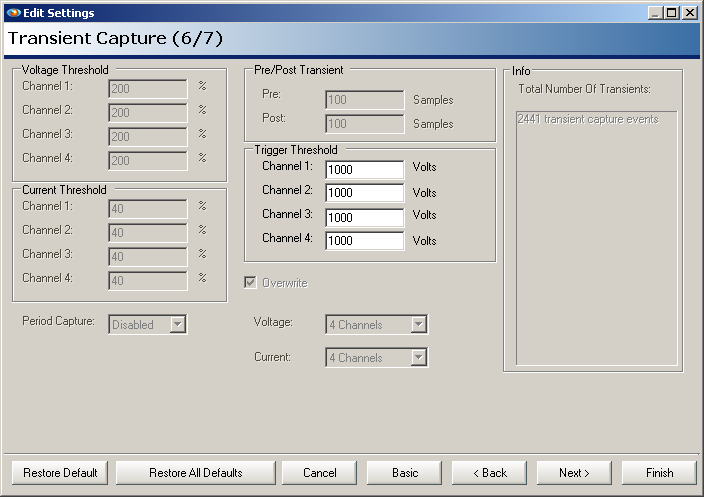
When a transient is triggered, a 1000 sample transient waveform is captured for all voltage and current channels. With a 1 MHz sampling rate, 1000 samples is a 1 millisecond time period. This is long enough to capture most high-speed impulse transients; but if the event still exceeds a threshold after 1 millisecond, another transient capture will trigger immediately.
Waveform Capture Basics
In the Revolution, the 1MHz high-speed samples are fed to the transient capture system, then filtered and downsampled to form the 256 samples/cycle data streams used by regular waveform capture, RMS and power calculations, etc. Other recorders sample the inputs directly at 256 samples/cycle. In any case, all waveform sampling is on a timescale that’s roughly 65 times slower than transient recording. The captured waveforms themselves are much longer than those in transient capture – typically several 60Hz cycles, with very long captures in the dozens or hundreds of cycles.
All waveform threshold triggers work on the same principle. For each trigger, there’s a parameter measured every 60Hz cycle. Each cycle the value is compared to the previous cycle’s value: if the difference exceeds the threshold, the trigger is fired. For example one trigger parameter is RMS voltage with a threshold defaulting to 5V. With this setting, if the RMS voltage changes from one cycle to the next by more than 5V (either higher or lower), then the trigger condition is met and a waveform is captured. If the change in RMS voltage was less than 5V, then the new RMS value is saved for the next cycle, when the comparison is performed again. Thus, the voltage could theoretically change by up to 4V per cycle and not trigger a waveform capture. The intent is to trigger on changes that represent discrete events on the power line, not slow changes in line conditions (usually caused by an aggregate of many loads, not a specific event). The waveform capture settings screen is shown in Figure 2. There are many more choices than with transient capture, reflecting the broader spectrum of problems waveform capture may be used for.
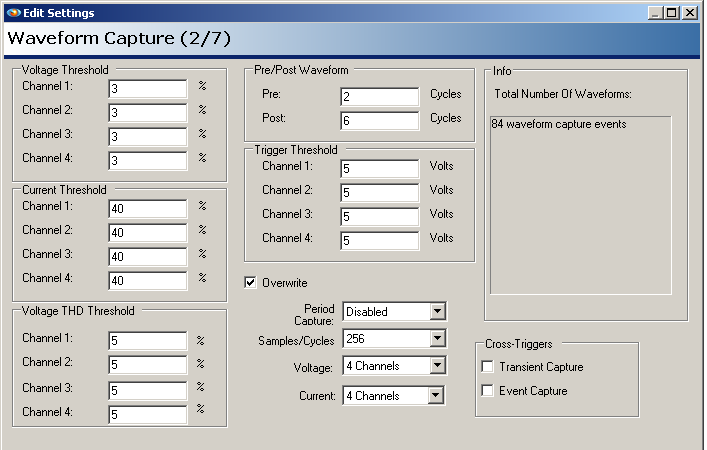
In addition to voltage triggers, waveform capture may be triggered on RMS current or waveshape (as measured by a change in THD). A waveform may also be cross-triggered automatically from transient capture or event capture, and can also be configured to auto-trigger on a periodic basis.
When a waveform capture is triggered, the waveform samples from the triggering cycle are recorded for all channels, and at least one pre and post-cycle. The pre and post lengths can be adjusted up to several hundred cycles each to capture very long or complex multi-cycle (or even multi-second) disturbances.
Using Waveform Capture vs. Transient Capture
To illustrate the differences between what’s recorded for transient capture and waveform capture, a pulse generator was used to produce a standard 1.2/50µs pulse, as described in IEC 61000-4-5. This pulse shape is designed to simulate high-voltage transients commonly found in CAT III or CAT IV locations. It’s defined by a fast 1.2 microsecond rise time, and a 50-microsecond decay time, with a 2-ohm source impedance. The Revolution was connected to 120VAC through the pulse generator, and the generator configured to deliver a 1 kV transient superimposed on the 120VAC waveform. This event was captured with transient and waveform capture.
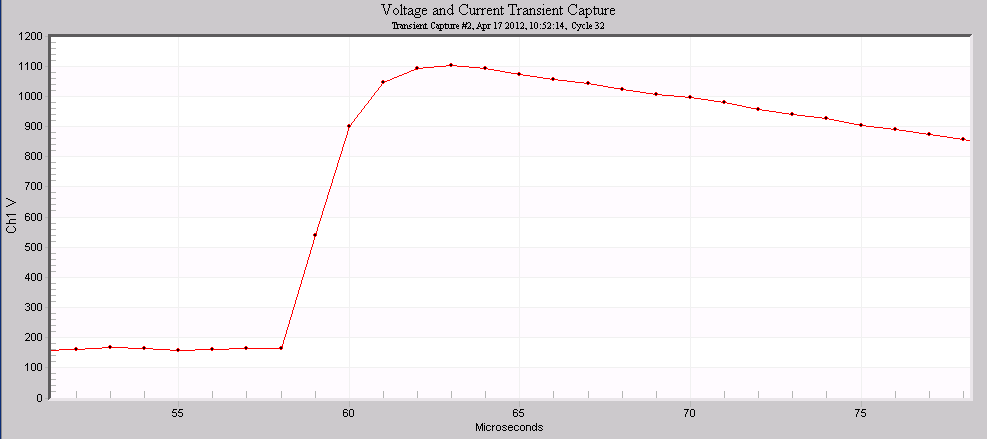
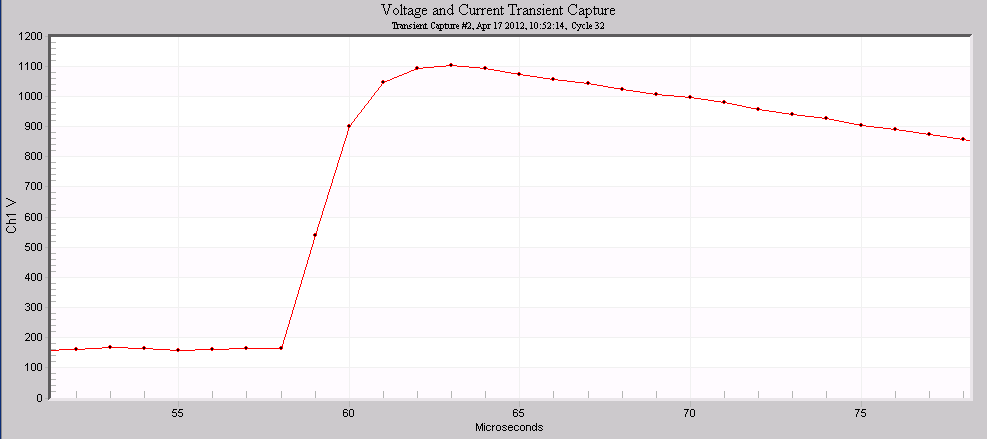
The transient graph in ProVision (Figure 3) shows the full peak voltage. Here we see a peak to over 1100V (the nominal 1 kV pulse plus the peak of the 60Hz waveform), followed by the slower decay. Zooming in and enabling data point markers (Figure 4) shows the very fast rise time – the full voltage is developed in just a few microseconds.
The waveform capture display in ProVision shows the transient (Figure 5), but with much coarser time resolution. Due to the slower 65 µs sample width (from 256 samples/cycle), the peak voltage of the transient is not fully realized. The peak is just under 500V in the waveform capture recording – this is due to the very fast 1-2 microsecond peak being averaged into a 65 µs standard waveform capture sample.
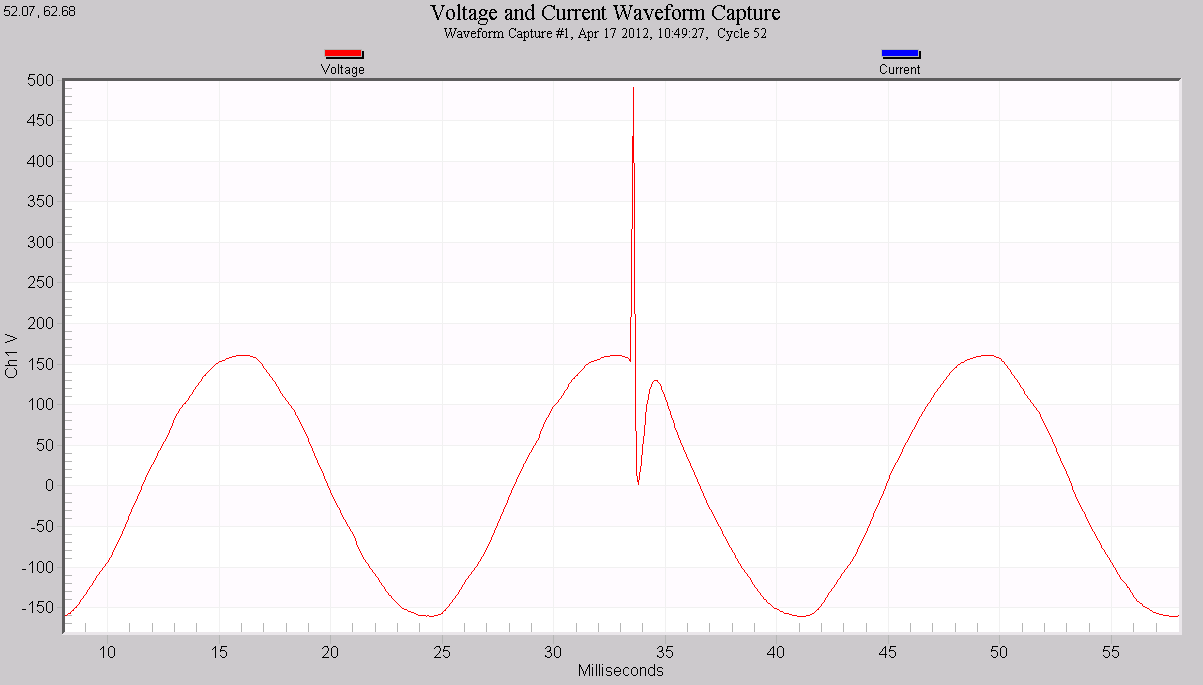
Since transient capture sampling is 65 times faster than regular waveform capture, 65 transient capture points occupy the same time period as a single waveform capture point. In the plot above, 65 transient capture points are shown. This entire sequence is averaged into a single data point in regular waveform capture.
However, it is useful to see the entire 60Hz waveform, and the slower undershoot and recovery is well characterized by the waveform capture, most of which is too slow to be captured with transient capture. This is an example where transient capture cross-triggering can provide detailed information with high speed sampling, and more broad information with a waveform capture.
Recommendations
Fast transients are often caused by high-speed events such as lightning strikes or arcing from switches (e.g. cap bank or tap changer operations). These are termed “impulsive transients”, and can occur in just hundreds or even tens of microseconds. The peak value of such transients can exceed thousands of volts, even if just for a few microseconds. Another high-speed transient type is a local medium-frequency resonance, in the 5–500 kHz range (as defined by the IEEE). Figure 6 shows an example of a transient captured during a 3 phase motor start. The scaling on channel 3 voltage (left axis) is much less than the others (including the ground), indicating an unbalanced event. Since the 2000V spike is only a few microseconds long, the sinusoidal portion of the waveform appears nearly flat at this timescale.
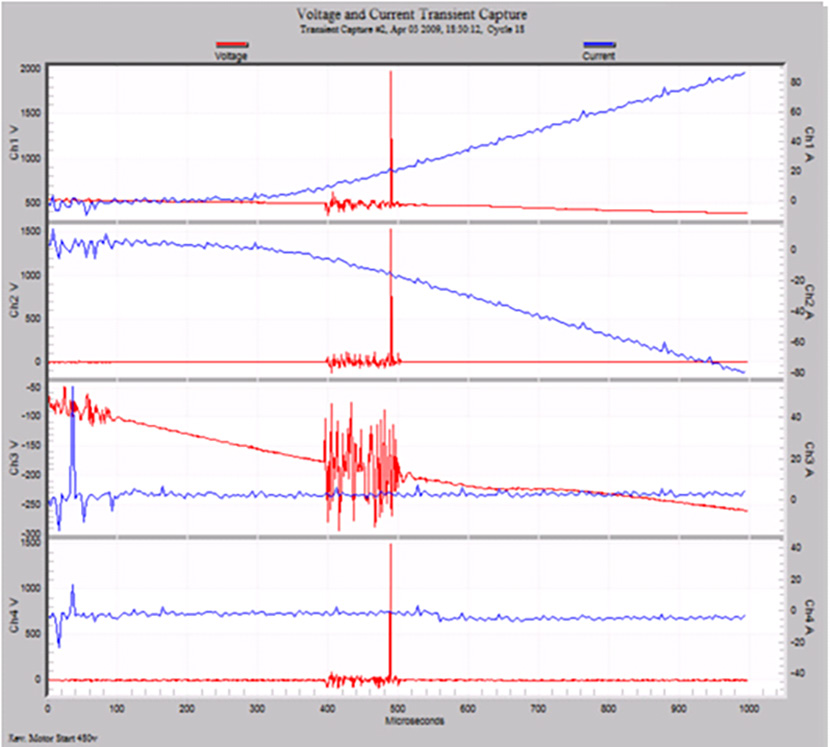
The high-speed nature of these transients implies a high frequency, wide bandwidth characteristic. Since the power line system attenuates high frequencies, these transients are typically localized – the further away from the source, the lower the peak voltage, and slower the transient becomes. Consequently, it’s important to place the recorder as close as possible either to the service entrance, to the most sensitive equipment, or to the suspected transient source, depending on the monitoring goals. For example, if a particular piece of equipment is experiencing unexplained resets or failures, monitoring right at the equipment disconnect is best. If the voltage feed to a customer is being assessed, monitoring at the service entrance, or point of common coupling is best. Or, if a capacitor bank or voltage regulator is suspected of generating switch noise or arcing during operation, monitor as close as possible to it. A distance of a few hundred feet can significantly reduce the peak voltage of a high frequency transient, so the recorder location is important in characterizing or even detecting these events.
With impulsive transients, often the peak voltage is the most important parameter involved, or the volt-seconds product (which is a measure of how energetic the impulse was). Equipment damage is often the main concern with dealing with impulsive transients, and an accurate peak voltage a key parameter to measure. For this, high-speed sampling with a very high input range is required.
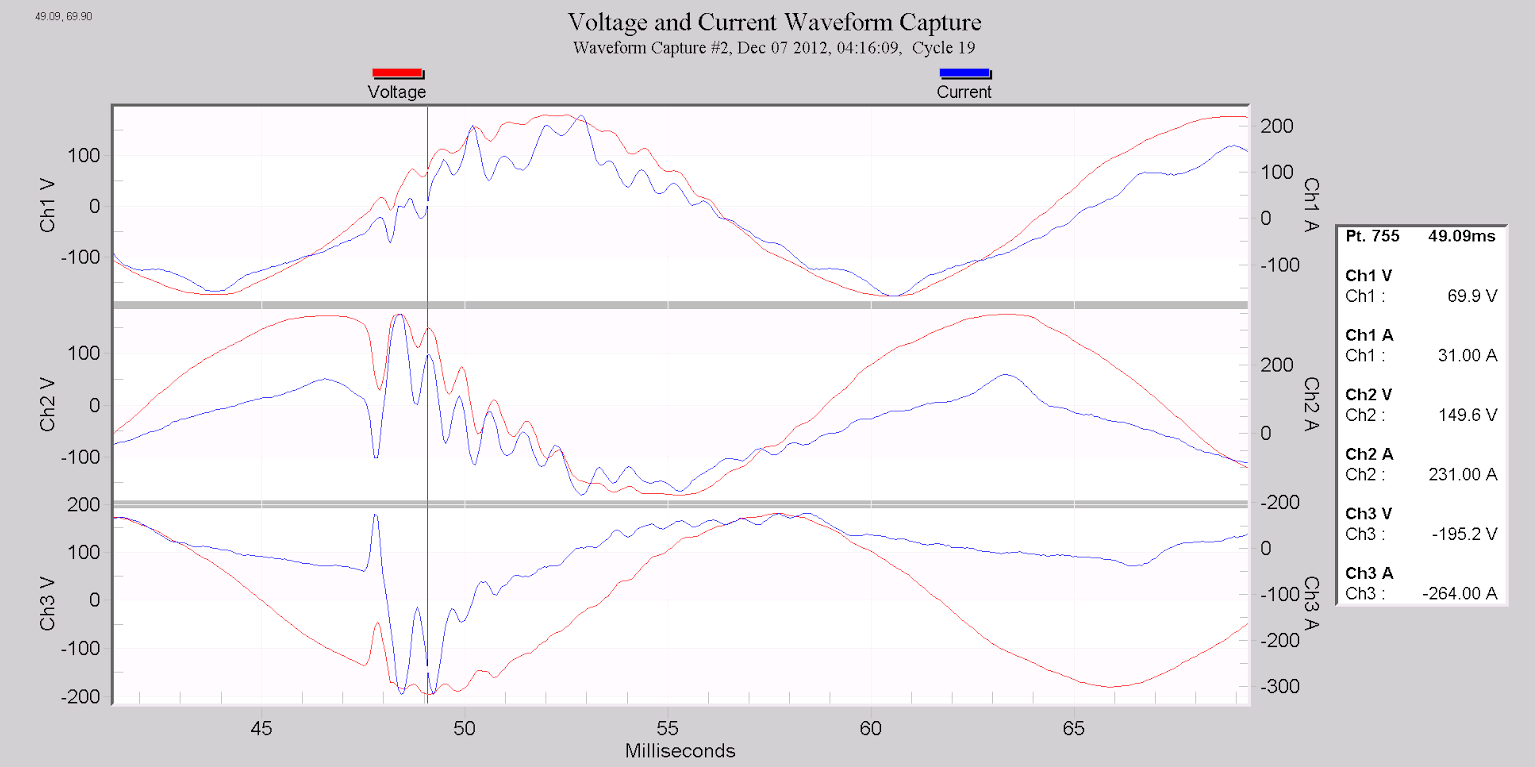
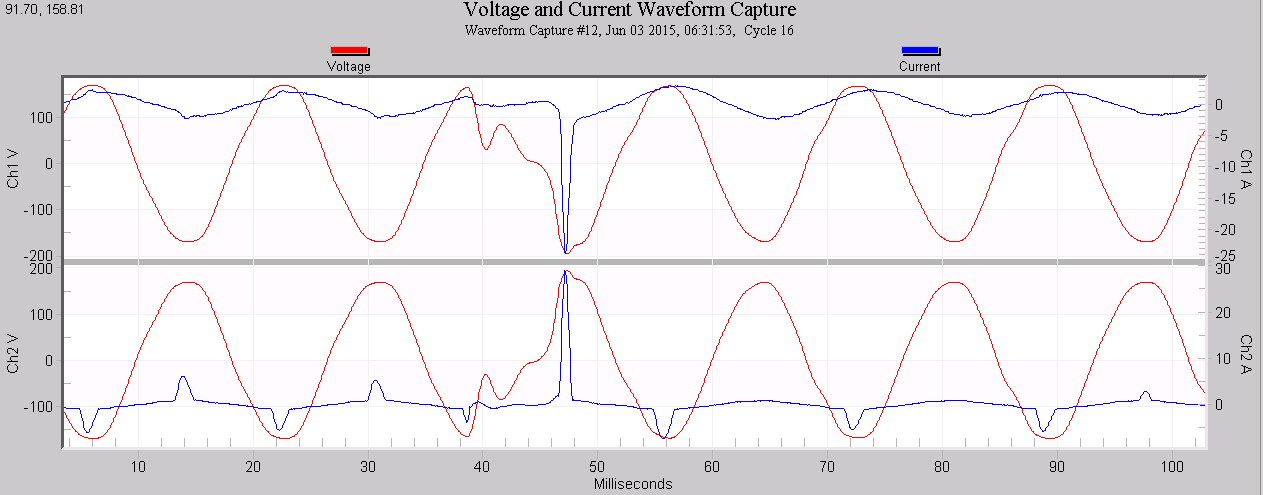
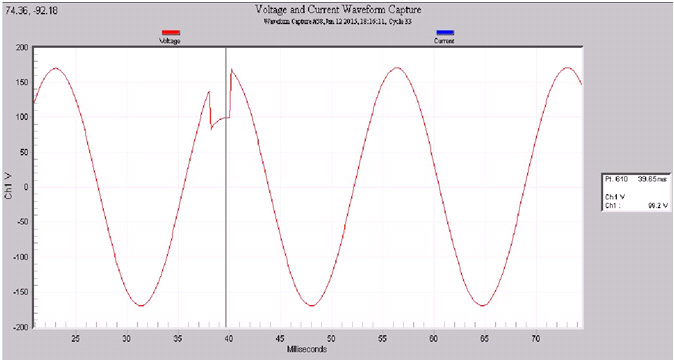
Waveform capture is designed for a wider variety of slower, but more common events. Depending on the nature of the event, the volt-seconds product, waveshape, missing area from a voltage notch, ringing frequency, etc. could all be important factors gleaned from the waveform. Often just characterizing the event from the waveform shape is the key job. Figure 7 shows what appears to be a line-line fault on a single-phase service, possibly caused by insulation breakdown. In Figure 8, a ringing low frequency resonance is graphed, with the point table being used to compute the resonance. This could aid in filtering out a troublesome harmonic. Figure 9 shows a deep voltage notch. These are usually caused by commutating loads such as VFDs, which only draw current during small portions of the waveform. There are many different types of waveforms possible, making this graph an important general-purpose tool, with a much wider focus than transient capture.
Conclusion
Transient and waveform capture are both triggered by changes in voltage or current, and both record a time series of raw data samples. However, they are used for different purposes, and capture different types of events. Transient capture in the Revolution is essential if impulsive, high-voltage events must be recorded and accurately measured. Although waveform capture data can indicate a possible transient problem, high-speed sampling is needed to see the true voltage peak. On the other hand, waveform capture samples at a rate more suitable for the much more common, wide variety of disturbances found at a slower, but still sub-cycle timescale. Insulation breakdown, ringing, notching, and other events have characteristic waveform shapes identifiable in the graph, and are better triggered with the waveform mechanisms than with the transient peak-voltage method. Be sure to check both transient and waveform capture for important clues in each power quality investigation.