Abstract
During President George W Bush’s administration a congressional bill was enacted in December of 2007 called the Federal Independence and Security Act (H.R 6), which called for a ban on manufacturing the standard incandescent light bulb, originally patented by Thomas Edison in January 1880. The bill was designed to reduce our dependence on low efficiency light bulbs and the power demand they required and resulted in the phasing out of the standard 100W incandescent light bulbs in January 2012, followed by the 75W in January 2013 and finally the 60W & 40W bulbs in 2014. What this act promoted and demanded was higher efficiency lighting, and lower power demand using technology to reduce our energy dependence. What we subsequently saw was an increase in the use of Compact Fluorescent Lamps (CFL) and Light Emitting Diode (LED) to replace the standard Incandescent Light. This paper illustrates some of the consequences of using these lights and the potential effect on our electrical distribution system.
Initial Conditions
A test procedure was conducted using a standard domestic 100W incandescent light bulb purchased from a local store. Also purchased was a 23W Compact Fluorescent Lamp (CFL) and a 2.5W Light Emitting Diode Lamp (LED). All three lights were connected, individually, to a PMI Vision power monitor and switched on for a 1 hour period, to record the overall voltage, current and power parameters. Also recorded were VA, Var, Power Factor and the level of Harmonic Distortion.
Review of Evidence
One of the undeniable facts about low energy lighting products is they do reduce dramatically the power demand and typically most manufacturers quote a 75% reduction in the Watts required to provide the same degree of lighting. However, what is not often specified and quoted are the methods used to achieve this significant reduction, such as reducing the current flow during each frequency cycle by charging and discharging capacitor switching which as a consequence, induces a higher level of harmonic currents into the neutral line and adds an increased level of Current Total Harmonic Distortion (THD).
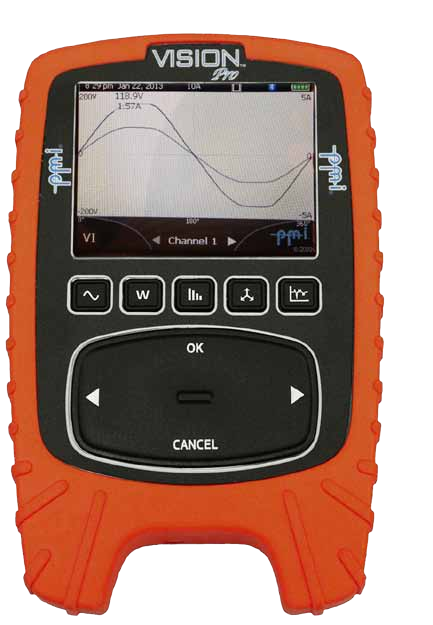
What follows are three examples of a single cycle standard voltage and current waveform from a 100W incandescent lamp, a 23W CFL and 2.5W LED, respectively. What are significant are comparisons of the Current Total Harmonic Distortion from each lamp, and especially a comparison of their related Power Factor during the 1 hour recording. Figure 1 shows a waveform generated by a standard 100W incandescent bulb.
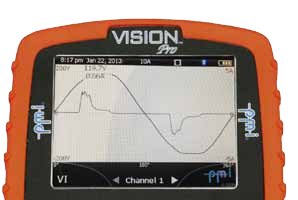
What is evident looking at these waveforms is the clear non-linear wave shape of the current waveform in Figure 2 with the CFL lamp as the load. It is heavily distorted– to achieve the lower W specified it’s necessary to “chop” every cycle and conduct for a much shorter time period, and thus reduce the demand for current. However, what this also will do is induce a higher level of harmonic distortion and create a condition that will decrease the power factor significantly. The overall effect for most residential customers is the saving of Watts by using this method. For the utility provider, it means increasing their delivery of Var to compensate and added capacitance to improve the overall power factor. What this means is any customer who may be billed on VA or Power Factor, could face an increase of costs rather than a lowering. Along with the added harmonic content into the neutral cables, that will flow towards the substation transformers. If those transformers were never designed to accept elevated harmonic content it could mean premature failures over time, due to the increased heating effect of those harmonics.
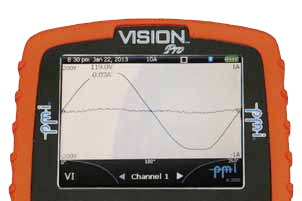
The test using the LED as seen in Figure 3 had such a small amount of current flow it had a negligible effect on the overall loading and power factor was maintained at 0.95, whereas the CFL reduced the power factor to around 0.65.
Conclusion
There is no doubt that using the low energy lighting of today can and does reduce the overall watts consumed by us all with our lighting demand; however as engineers we have discovered an increased level of harmonic conditions and a reduction of the Power Factor. This is a direct consequence of using this type of technology and we must also consider the overall effects of this increased harmonic condition on the existing cables and electrical distribution network across our cities.
Our present kW demands are already straining our electrical infrastructure, and adding more and more non-linear loads will only add to this concern. However, the LED technology is developing into a suitable product for us all to reduce our kW demand and as these lamps become less expensive to make, demand for them will make them a more practical choice, to reduce our carbon emissions.
As the Federal Energy and Independence Act of 2007 becomes law, the depletion of balanced loads will only add to our demand as the standard traditional incandescent lamp is slowly extinguished forever.