Abstract
PMI’s line of power quality (PQ) monitoring tools can provide insightful information that can be used to detect industrial and residential power disturbances such as sags, swells, transients, waveform distortions, and service interruptions. Frequently, power disturbances go unnoticed and silently contribute to malfunctioning and/or the premature failure of electronic equipment. This article will discuss the basic tools, symptoms, and evaluation techniques needed to identify power quality problems so that you can begin improving your on-site power quality.
Safety
Before any power monitoring job begins, it is best to evaluate the safety procedures and equipment that you will be using to protect yourself during the job. Many of the test instruments manufactured by PMI requires installation in areas where dangerous energized conductors are present. Only properly trained persons with adequate protective equipment should attempt these types of installations. The Plug-in Boomerang and the Eagle 120 products are non-invasive monitoring devices that plug directly into standard residential style wall outlets. The same level of caution needs to be taken with these devices as when plugging in or removing any other residential electrical device.
What Is Power Quality Monitoring?
PQ monitoring is the process of collecting, analyzing, and interpreting measured electrical data from AC power circuits. Electrical measurements are collected at one or more locations on the consumer side of the power distribution system over a period of time. Depending on the type of disturbances that are observed, the information can be used to correlate with equipment that was in operation at the time of the event.
PQ monitoring often takes place as a request to investigate observed problems regarding power quality. Documentation of the site layout, equipment in operation, and PQ device placement are captured early in the project for later reference. During the PQ collection phase, observed events are written down while data is simultaneously being captured by the monitoring equipment. Used in this manner, PQ monitoring can be considered a reactionary tool helping isolate the problems.
PQ monitoring can also be used as a proactive tool to establish an electrical signature for future comparison when problems arise, to discover hidden electrical problems, or to identify failing equipment. Collecting baseline data before problems occur can be useful in isolating problems when changes are made to equipment or electrical delivery on site. Waveform distortion and low voltages can cause heating in equipment and increased power consumption. Periodic review of PQ data can also reveal equipment that is degrading and ready to fail. For example, a motor winding that is beginning to fail may produce short circuiting conditions detectable by PQ equipment but is otherwise unobservable to its operators and maintainers.
Identifying the Need for Power Quality Monitoring
Depending on the quality of construction of the electronic device and the sensitivity of the components, voltage disturbances can cause devices to malfunction or fail. In a residential setting for example, power quality issues may cause lights to flicker, audio amplification devices to hum or click, and televisions to have distorted display patterns. In industrial settings, power quality issues can cause equipment to shut down, operate at abnormal speed, build-up excessive heat, or other undesired characteristics. Since each device reacts differently to the electrical disturbances present on the line, symptoms may be hard to predict. In general, Table 1 is a list of things to look for that might indicate a need for a PQ inspection.
| Table 1. Indications of a need for a PQ inspection |
|---|
| Electronic controllers not operating as expected |
| Excessive heat in electrical motors |
| Equipment stops working intermittently |
| Electronics burn out |
| Audio/Video interference |
| Undesired operation of radios, televisions, and monitors |
| Variable Frequency Drive controllers shutting the motor down |
| Motors that reach or exceed their peak thermal rating even though their duty cycle and load characteristics are not exceeded |
| Sags and intermittent power issues can cause computers to freeze and other electronically controlled switches to open |
| Circuit boards in devices stop working or have noticeable burns on traces or components |
Types of Disturbances
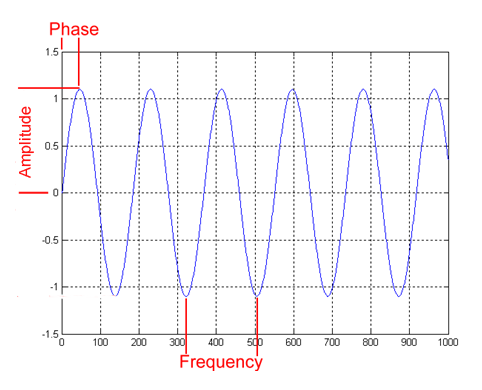
The A/C voltage that is produced by electrical utilities has amplitude and shape characteristics that can be approximated by the formula v(t) = Vpeak * sin(wt) where v = voltage, t = time and w is the frequency of angular rotation. This equation produces a sinusoidal shape (Figure 1) with Vmax and Vmin as the maximum and minimum peak voltage of the function. This “ideal” sinusoidal waveform is rarely delivered to consumers due to factors in the power grid and the wide variety of nonlinear loads that can be attached by adjacent consumers. Disturbances are measured deviations in shape or amplitude of the voltage and can be described by the terms in Figures 2-5.
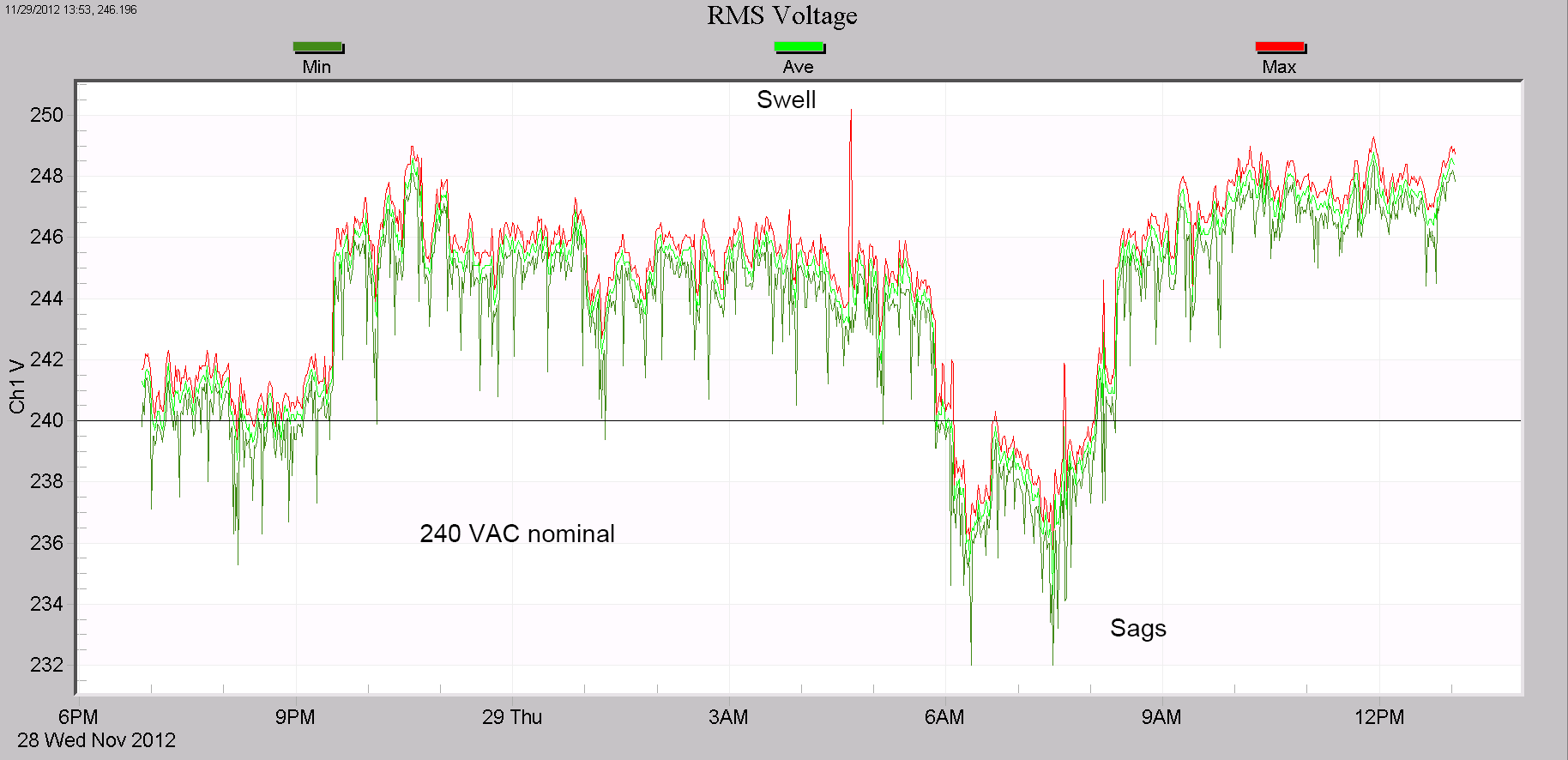
Description: Momentary increases and decreases in voltage that are outside of the operating range. Typically this range is ± 5% of the nominal voltage.
Cause: Starting/stopping of large motors, arc welders, peak consumer demand hours.
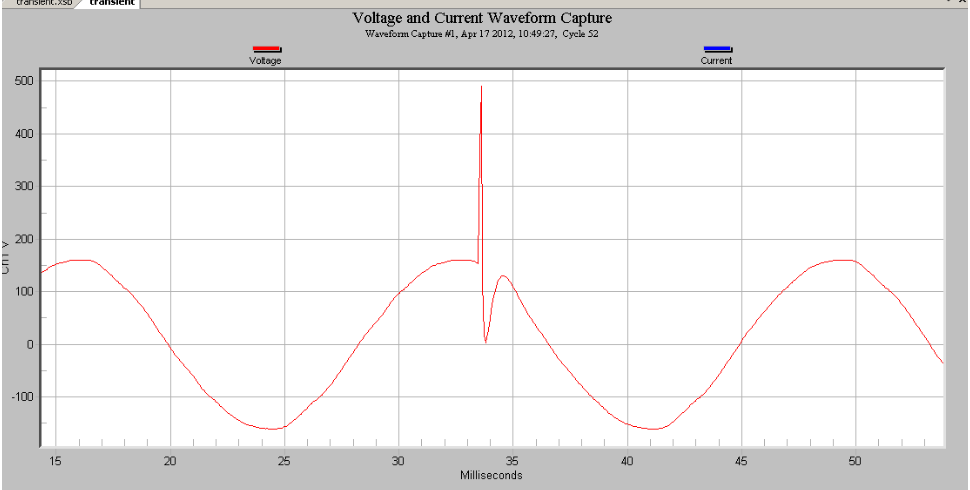
Description: Spikes in the voltage that last less than one cycle.
Cause: Capacitor bank switching, short circuits, failing equipment, lightning strikes.
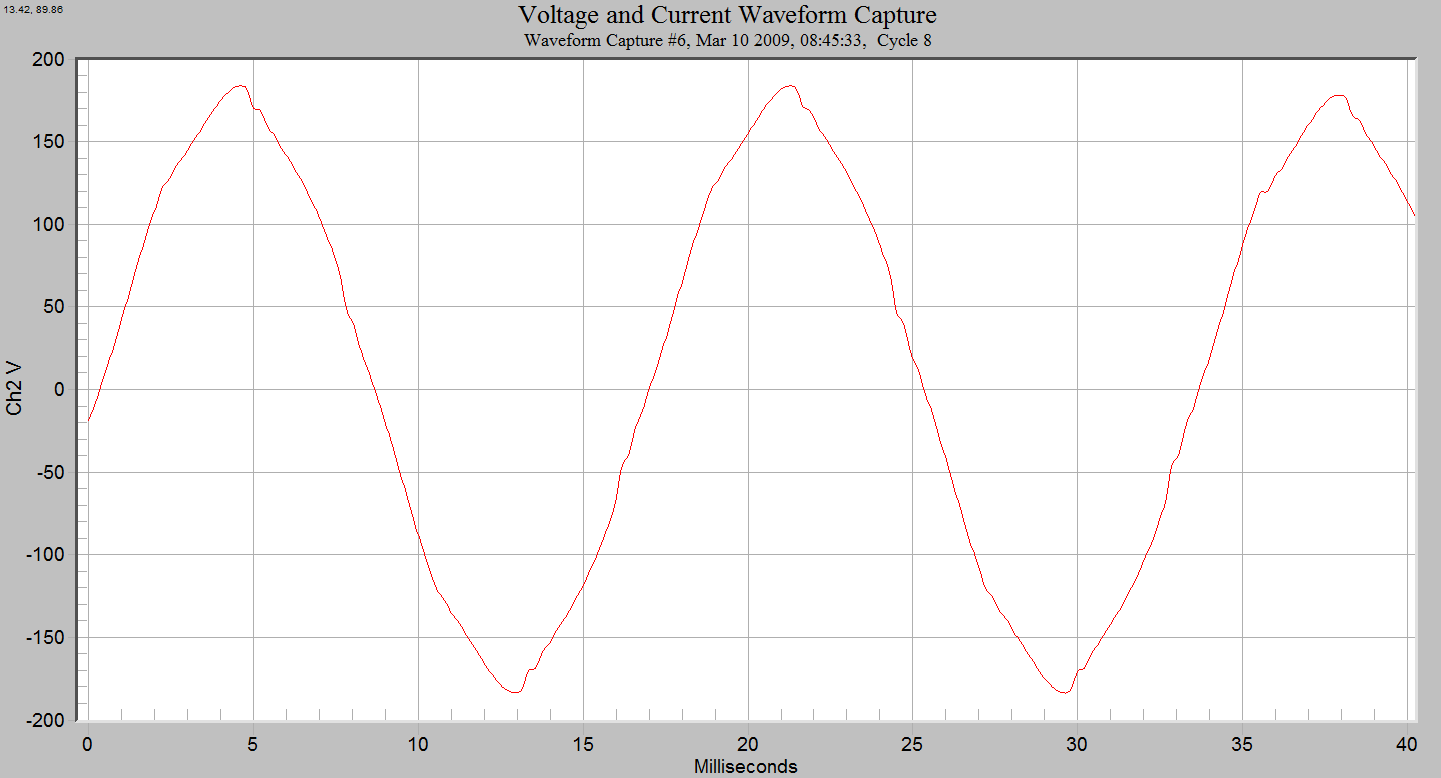
Description: Deviations from the sinusoidal wave that can occur because of harmonics, squaring, or sharpening of the waveform (depicted).
Cause: Switching power supplies, compact fluorescent lamps.
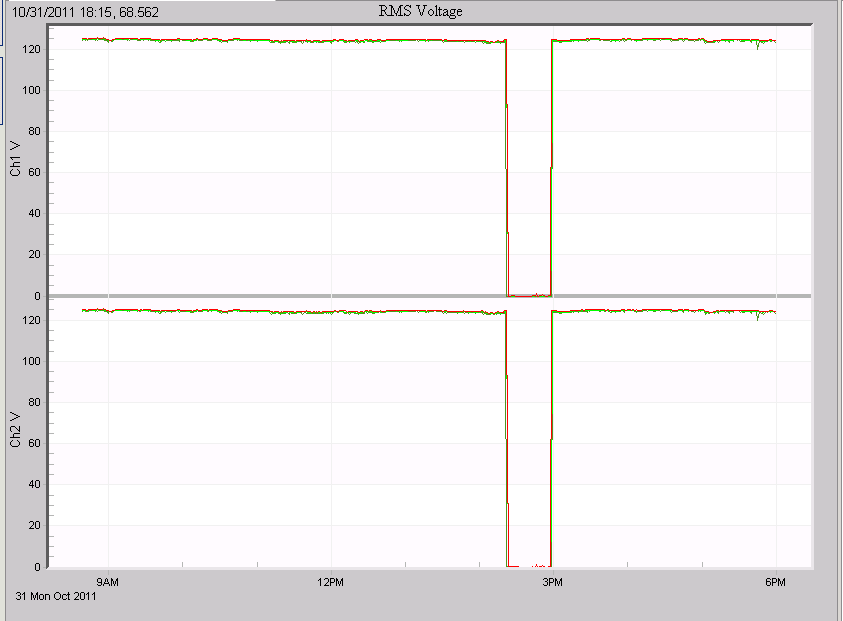
Description: Supply voltage (and current) drop to zero.
Cause: Distribution problems, circuit breakers, fuses, ground fault current interrupters.
Power Quality Standards
Standards established by the Institute of Electrical and Electronics Engineers (IEEE) can be used to help classify the PQ disturbances listed above. Some of most common standards relating to PQ are IEEE 519, IEEE 1453 and IEEE 1159. IEEE 519 discusses harmonics and harmonics control within power systems. Flicker, a rapid fluctuation in the voltage, is described in IEEE 1453. IEEE 1250 provides a reference on momentary voltage disturbances and their effects on computers and solid state equipment. These documents are a good starting point to understanding and assessing the predominant issues in PQ.
In addition to these traditional disturbances, PQ engineers should be aware of new trends that are affecting the electrical grid. Utilities are receiving an increasing amount of power from solar panels and wind turbine sources. The synthetic AC waveform output by power inverters can cause harmonic and frequency problems. These sources also create problems when trying to regulate steady-state voltage. When the weather conditions change, energy production changes creating additional challenges for electrical utilities to manage.
Matching Test Equipment Features to the Job at Hand
Power monitoring tools can be classified by four aspects which, once understood, can save you time and money by choosing the right equipment for the intended application. You will need to know: What types of events and information the device can monitor, how many inputs and the voltage ranges that can be measured, and how the data is collected and reported. The fourth aspect, device connection style, is not discussed explicitly and is instead left for the on-site engineering team.
Basic PQ monitoring requires the ability to measure voltage, and ideally current. All of the PQ products in the PMI product line are capable of measuring and reporting this data. Input voltage is used to detect swells, sags, service interruptions, overvoltage, and undervoltage conditions. Depending on the device model and settings, events can be sent via email or SMS messaging indicating when voltage, current, or frequency has moved outside of threshold values. Otherwise, these conditions can be reviewed in graphs that visualize power conditions at a glance or detailed reports based on specified criteria.
The next step is choosing the input capabilities of the PQ device to be used for the job. This depends on the type of equipment to be monitored and the voltage requirements. The Eagle 120 allows for simple setup and monitoring for single channel 120V applications. These devices are simple to use and install due to their non-invasive plug-in design. In industrial settings, more input channels are required for analysis and isolation of problems where higher voltages, complex electrical disturbances, and polyphase equipment are predominant. The Eagle 220, 330, 440 and Revolution offer 2, 3, and 4 channels of measurements allowing advanced troubleshooting and diagnostics.
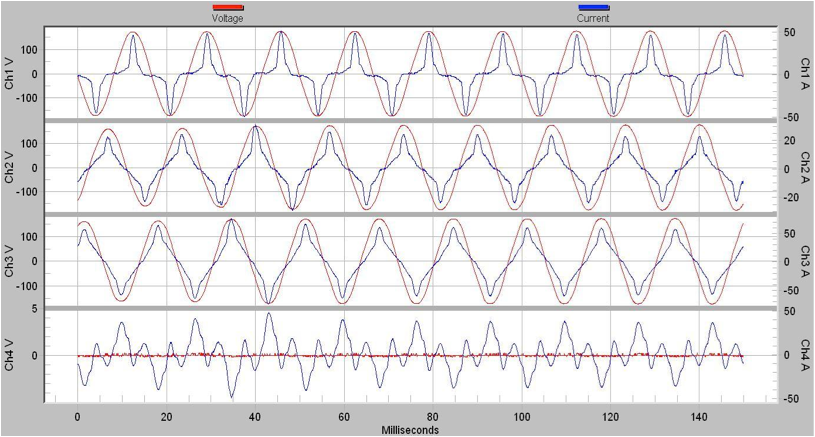
Not all monitoring applications require the same amount of detail in order to be effective at solving the problem. PMI’s Eagle and Revolution products are capable of waveform capture allowing detailed analysis of voltage waveforms and measured current. Access to this type of data allows detailed analysis of the interactions and how voltage and current behave when devices are in operation. Furthermore, these details provide the ability to perform harmonic analysis of waveforms and detailed views of events, as seen in Figure 6. The Revolution has an optional transient capture feature for high-speed, high-voltage capture.
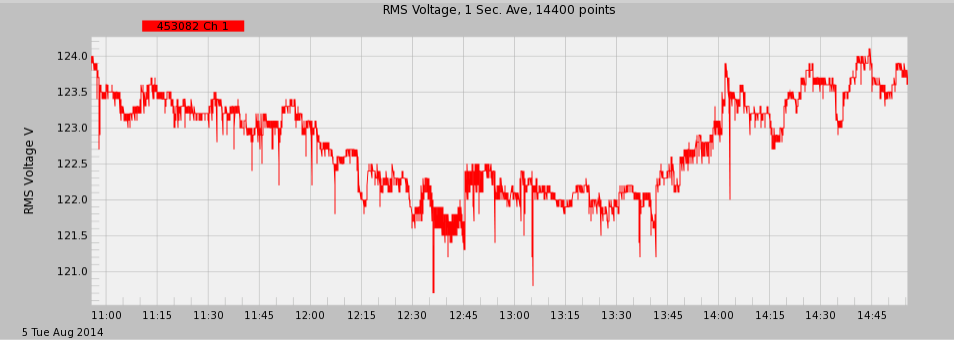
Waveform analysis requires large amounts of data to be captured and stored and may be more than what is needed for the job. Sometimes simply knowing the steady-state voltage or power consumption for a location or electrical device is all that is needed. The Boomerang product line reduces data requirements by averaging the power measurements over 1 second intervals while still providing the capability of sending alerts immediately when specified events occur. The averaged data can be displayed in strip-chart graphs (Figure 7) that allow quick analysis of voltage and current over a specified period of time. Although not a full PQ device, the Boomerang can be used for voltage regulation issues, end-of-line monitoring, and other situations where a 1 second average is sufficient time resolution.
Conclusion
Power quality monitoring can be a useful tool for isolating problems where symptoms of poor power quality can be observed. Additionally, it can be used as a proactive tool for discovering hidden problems in both industrial and residential applications. Choosing the right device for monitoring power quality issues depends on the types of disturbances of interest and the number of inputs for the device. PMI provides a full product line of PQ devices that are perfect for detailed analysis and isolation of complex problems or for more simple voltage monitoring.