Abstract
A common specification in power quality recorders such as PMI’s Revolution, Guardian, or Eagle products is the sampling rate of the device. Users know this is an important number and often know that a higher number is better. This white paper will explain what the sample rate refers to and will also discuss its importance.
Background
Power quality recorders are microprocessor controlled devices based in the digital realm. Voltage or current waveforms are continuously changing values over time based in the analog realm. While digital devices are perfectly suited to work with on/off signals or true/false conditions they need to utilize external components or dedicated inputs to read analog signals. Many modern microprocessors already incorporate the necessary inputs in the form of analog to digital converters (ADC). The ADC is used to read analog input values that are proportionate to the magnitude of the incoming signal (voltage or current). The proportionate value can then be used to calculate the actual voltage or current present based on the design and calibration of the device. A single reading of the input yields an instantaneous value of voltage or current present at the time of the reading, but to be truly useful the input must be read continuously on a timed basis. In theory, reading the inputs infinitely fast will replicate the analog waveform precisely. Of course, in practice, this is impossible so the inputs are read at a finite speed with an equal time period between each sample. The samples must be frequent enough to gather sufficient information about the analog waveforms. Figure 1 shows a graphical representation of this concept.
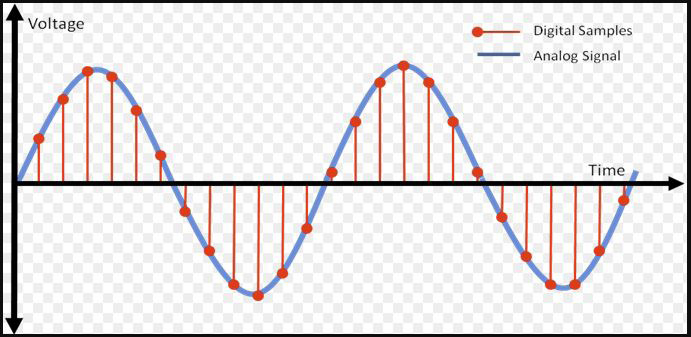
Signals Sampled Over Time
Power line waveforms are examples of continuous-time signals. A continuous-time signal is defined as a varying quantity whose domain is a continuum. In this case, the varying quantity is the amplitude of the waveform and the domain is time. The signal will have some measurable value at every instant in time. As noted in the previous section, it is not possible to read the signal infinitely fast at every instant in time. The process of reading a continuous-time signal at evenly spaced intervals of time creates a discrete-time signal. A discrete-time signal is a time series consisting of a sequence of quantities and when it is obtained at uniformly spaced intervals, it will have an associated sampling rate. The Nyquist theorem is applicable when working with discrete-time signals and it states that the highest frequency component available in sampled data is half the sampling frequency. Loosely translated this equates to reading samples at a higher rate for more available information. Therefore, with a power line frequency of 60Hz (60 cycles per second) and sampling occurring on a per cycle basis, the number of samples per second (sampling frequency) must be quite large for power quality analysis purposes. For a closer examination of this concept and the related math, see WP248 Adjusting Waveform Capture Sampling Rates.
The Sample Rate
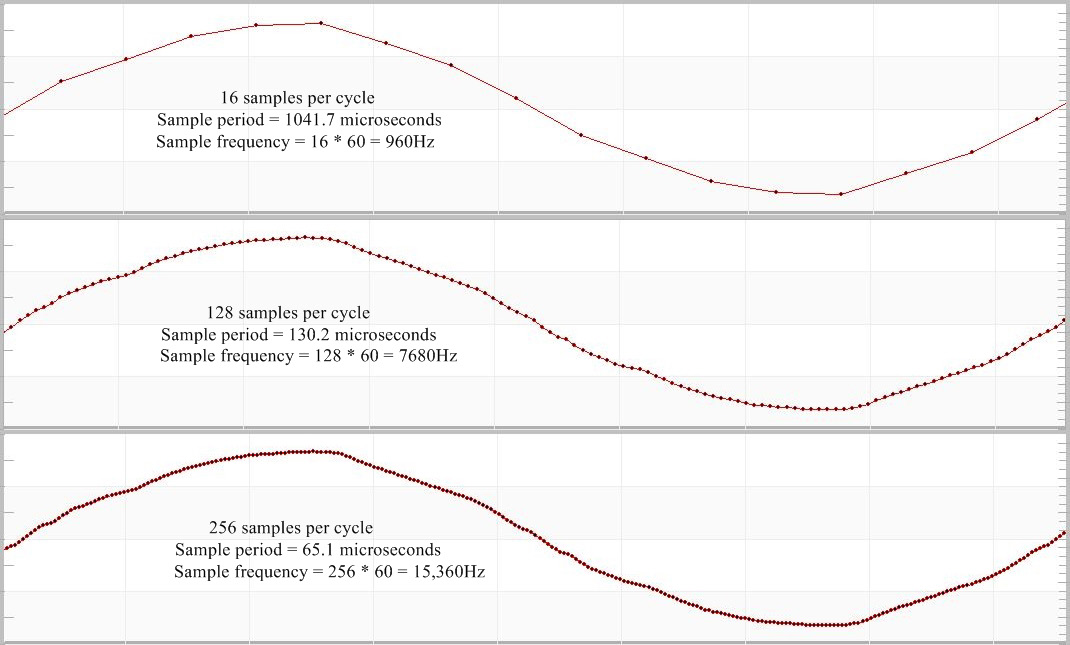
The sample rate is the number of times an instantaneous value (described above) is read per cycle of the sine wave inputs. This process is known as digitizing or digitization of the signal. It creates an approximation of the analog input (sine wave or complex wave) in digital form as a series of integers representing the individual instantaneous values. The samples taken are always evenly spaced in time and a high sample rate will require a more capable microprocessor than a lower sample rate. This is not only true for keeping up with the continuous nature of the input but also for the calculations being done with the resultant digitized waveforms. The sampled data can be used to create a visual representation of the waveform as well as for calculations to extract information about the waveform. Figure 2 shows three waveforms depicting 16, 128 and 256 point sampling rates respectively. The associated time between samples for each of these is 1041.7 microseconds, 130.2 microseconds, and 65.1 microseconds. Note the spacing of the data points as the rate increases and the time between samples decreases. Also, note how each captures the waveform shape when the data points are visually rendered. However, mathematically, there is more information available from the 256 point sampled waveform.
Waveform Data
A key piece of data from the waveform is, of course, the RMS value. Even at a lower sample rate, the RMS value will be fairly accurate. Other data available at a high sample rate will be missed or not available at lower sample rates. This data will include higher numbered harmonics, oscillatory transients, narrow notches in the waveform, frequency resolution and RMS precision. This loss of information is why a higher sample rate is necessary for power quality investigations. PMI power quality recorders all operate at a rate of at least 256 samples per cycle, or greater. These recorders allow for the ability to store captured waveforms at a lower number of samples per cycle but this is for economy of storage. The actual sample rate of the inputs is always 256 samples per cycle or greater.
PMI’s Revolution Power Quality Recorder
The Revolution is unique among PMI’s product lineup in that it can capture high-speed transients down to microsecond resolution. This requires sampling at a rate equivalent to over 16,000 samples per cycle (1 MHz). After the transient analysis has been completed the samples are then processed to create the equivalent 256 samples per cycle for all other waveform processing. As stated previously, sampling at ever higher rates requires a more capable microprocessor and the Revolution has it. In addition to high-speed transient detection, it can also perform the calculations needed for producing inter-harmonic data along with all of its other power quality measurements.
Conclusion
A reasonably high sample rate is needed to acquire the necessary information for power quality analysis. It must be high enough to capture relevant data but not so high as to adversely affect the cost and performance of the device. All of PMI’s power quality recorders sample input data at a rate of 256 samples per cycle or greater. This allows for the same available power quality data across all recorders in PMI’s product line. The Revolution samples even faster in order to capture high-speed transients and is able to calculate inter-harmonic content as well. The high sample rates and capabilities of PMI’s Revolution, Guardian, and Eagle products allow for in-depth power quality investigations to meet every need.