Abstract
Interharmonics are produced when loads draw current
asynchronously to the utility voltage. Traditional loads include arc furnaces, welders, and AC-DC converter systems where the loads are fed from DC supplies. Historically troublesome
interharmonic loads were limited to large industrial
customers, but the advent low-cost electric power
semiconductors has resulted in a new class of devices in
residential locations. These interharmonic loads produce large amounts of flicker and are difficult to quantify with existing PQ standards.
Phase Angle Fired Space Heater
The humble plug-in space heater is ordinarily an ideal load from a utility perspective. Purely resistive, the heater has a perfect power factor, introduces no waveform distortion or flicker, and is 100% efficient. A load designed for a standard 15 amp branch circuit can draw up to 12 amps continuously, resulting in a 1500 watt consumption. Traditional heaters may have two heating elements, allowing for three power levels. A modern twist on the space heater is a continuously variable heat output rather than a few fixed levels. This is accomplished with a single full power resistive element and a high power electronic switch. The element is switched off and on with a specific duty cycle, so the average power output is any desired level between zero and 1500 watts.
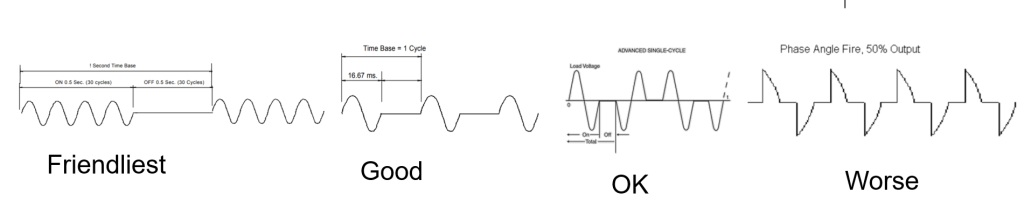
There are more and less PQ-friendly ways to accomplish this switching. Figure 1 shows several methods. Ideally the element is switched for integer 60 Hz cycles – turning on and off at the voltage zero crossing. The duty cycle is determined by the ratio of whole cycles on vs. whole cycles off. The worst methods
involve shorter on/off cycles, with the worst switching on during the middle of a voltage cycle (low cost switches such as SCRs or TRIACs inherently switch off at zero crossing). This “phase angle fired” method switches the element on every cycle, and the duty cycle variation is within each individual cycle.
Because the current switches off at zero crossing, the switch-on point is the point that moves to adjust the duty cycle. This produces current asynchronous to the AC voltage, resulting in interharmonics. The fast timing of this method also guarantees that the interharmonics are the worst possible band to produce light flicker.
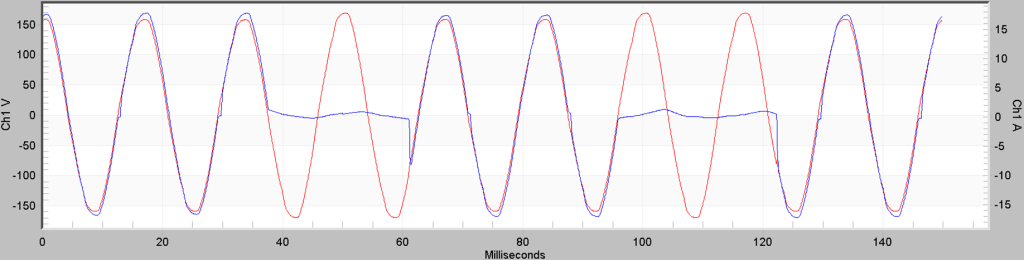
Example waveforms from one space heater are shown in Figure 2. Red is the 120V receptacle voltage, and blue is the current from the heater. At this particular point, the 12A element is on for 40 ms, off for 20 ms. Note that the two consecutive on-switches are at very different points in the voltage
waveform.

A longer waveform capture is shown in Figure 3. Here just the current is graphed, and various changes in switch timing are indicated in orange. This switching pattern is not synchronous with the power line frequency – guaranteeing interharmonics.
Interharmonic Content
Interharmonics are measured per IEEE 519 with a 12 cycle window. A Fourier transform turns the 12 cycle time series into 5 Hz wide frequency bins, from DC to 3 kHz. Any non-synchronous energy falls into these 5 Hz bin. The bins that are between the multiples of 60 Hz are interharmonics. IEEE 519 groups these bins in to harmonic and interharmonic subgroups. The 3 bins centered around a harmonic (e.g. 175 Hz, 180 Hz, and 185 Hz for the 3rd harmonic) are combined to form a harmonic subgroup reading; this is threshold as harmonic distortion in 519. The 45 Hz regions between these harmonic subgroups are called interharmonics subgroups. There are no explicit limits on interharmonics subgroups in IEEE 519 – it’s focused on synchronous (that is, harmonic) distortion.
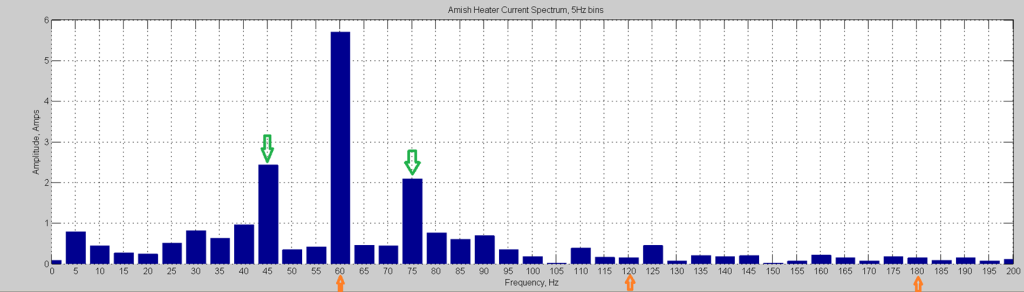
The interharmonics spectrum of the heater waveform from Figure 3 is shown in Figure 4. The nominal 12 A load is decomposed into 5.7 amps at 60 Hz, 2.4 amps at 45 Hz, and 2.1 amps at 75 Hz. Several other interharmonics frequencies are noticeable, and all exceed the actual harmonic levels. The two highest harmonics are the 2nd and 3rd. The 2nd harmonic actually exceeds the 3rd harmonic, but are
significantly below many of the interharmonics levels.
The Total Harmonic Distortion (THD) , measured per IEEE 519, only includes harmonic subgroups. Using that method, the distortion for this heater is only 10.8% If we include all interharmonics, the value is 143%. This simple space heater is actually a complex load that is not well characterized by existing PQ standards.
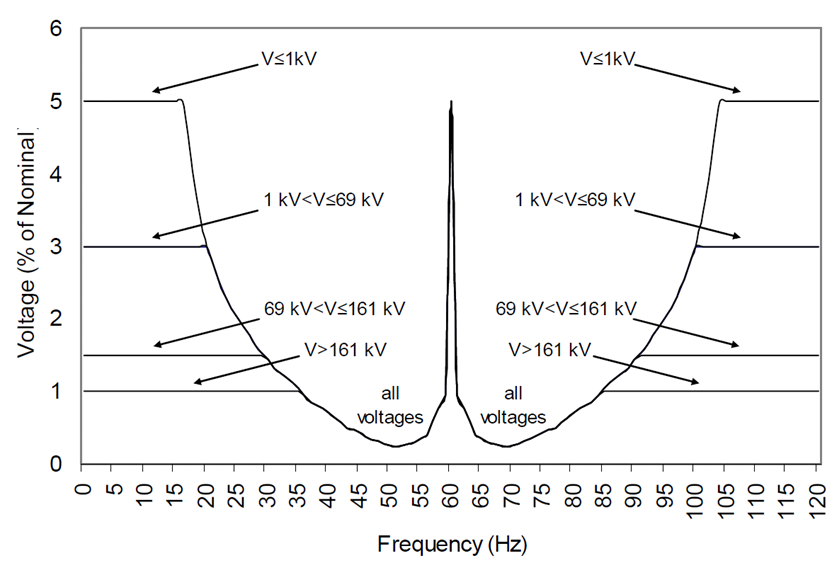
IEEE 519 does provide one guideline for interharmonics limits in the range of DC to 120 Hz. These suggested limits are based on non-synchronous voltage variations causing light flicker. Figure 5 shows the limit in 519, based on keep the flicker Pst below 1.0. Note that the worst case frequencies (those with the smallest limits) are around 50 and 70 Hz – very close to those produced by this heater.
Interharmonic Loads and Flicker
Interharmonic loads produce flicker by introducing continuous variations in current, which translate to
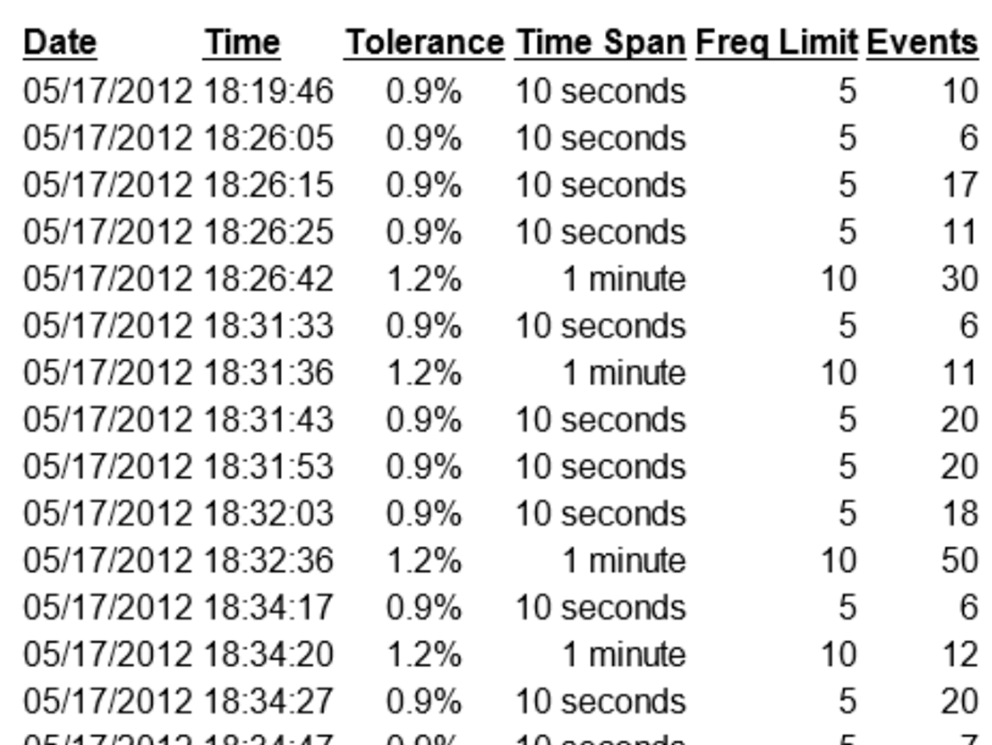
continuous variations in voltage. A 1500 Watt load normally could not produce large amounts of flicker, but this type of phase angle fired load introduces interharmonics at the worst possible frequencies, where only tiny changes in voltage (less than 0.4%) can exceed the threshold of irritability. A flicker report for this load shows severe flicker on the 120V leg powering the heater (Figure 6). It may not be surprising that the leg powering the heater is affected, but even the other singe phase leg shows excessive flicker. Even though the peak current is just 12 amps, the interharmonics at the sensitive frequency will affect everyone on the single-phase transformer secondary, not just the house with the heater.
Conclusion
In addition to space heaters, this type of phase-angle fired heating is increasingly common in kitchen counter-top cooking appliances, such as burners and sous vide devices. When responding to a residential flicker complaint, the traditional offenders such as heat pumps with bad starting capacitors, loose neutrals, and tankless electric water heaters are still possible root causes. Now utilities must also consider formerly innocent lower power plug-in loads. Be sure to ask if the flicker happens when using a space heater, or during cooking periods, and keep in mind that a neighbor on the same transformer secondary can also produce flicker for everyone else. As modern loads become increasingly complex, the PQ issues increase.