Abstract
In this modern world of power we see more and more desire to improve efficiency and reduce costs, which leads to decisions on what equipment to choose to meet these goals. In a recent case, a California Municipal Golf Course decided to convert all their traditional electrical golf cart chargers to inverter type chargers, that are powered by numerous single pole 20 amp circuits from the cart buildings 120/208V service panel and subpanels. Unfortunately this decision produced dire consequences and this case study examines this incident which initiated an investigation of the cause using power monitoring equipment.
Initial Conditions
This municipal golf club is a popular Par 72 course for local golfers, and was constructed in 1959. The utility service consisted of a bank of 3 x 37.5kVA transformers and a 4/0 quad-plex service drop with a 1/0 neutral conductor, which had been updated since the original construction. The utilities solution after the incident was to upgrade the transformer bank to 3 x 50 kVA transformers and combine two runs of 4/0 quad with 4/0 neutrals. The solution was a shot in the dark since the utility didn’t quite fully understand the cause of the failure until contacting a Power Quality Specialist. The course has 77 chargers that draw 8.5Amps each.
Cart & Charger Replacement Program
The Golf Course made a decision to upgrade and replace the older style carts and cart chargers. To improve charging times and to reduce their kW burden, an inverter type charger was installed to charge each golf cart. A Power Quality Study was conducted using a PMI Eagle 440 monitor connected to Sub Panel and additional equipment connected at the main service disconnect panel.
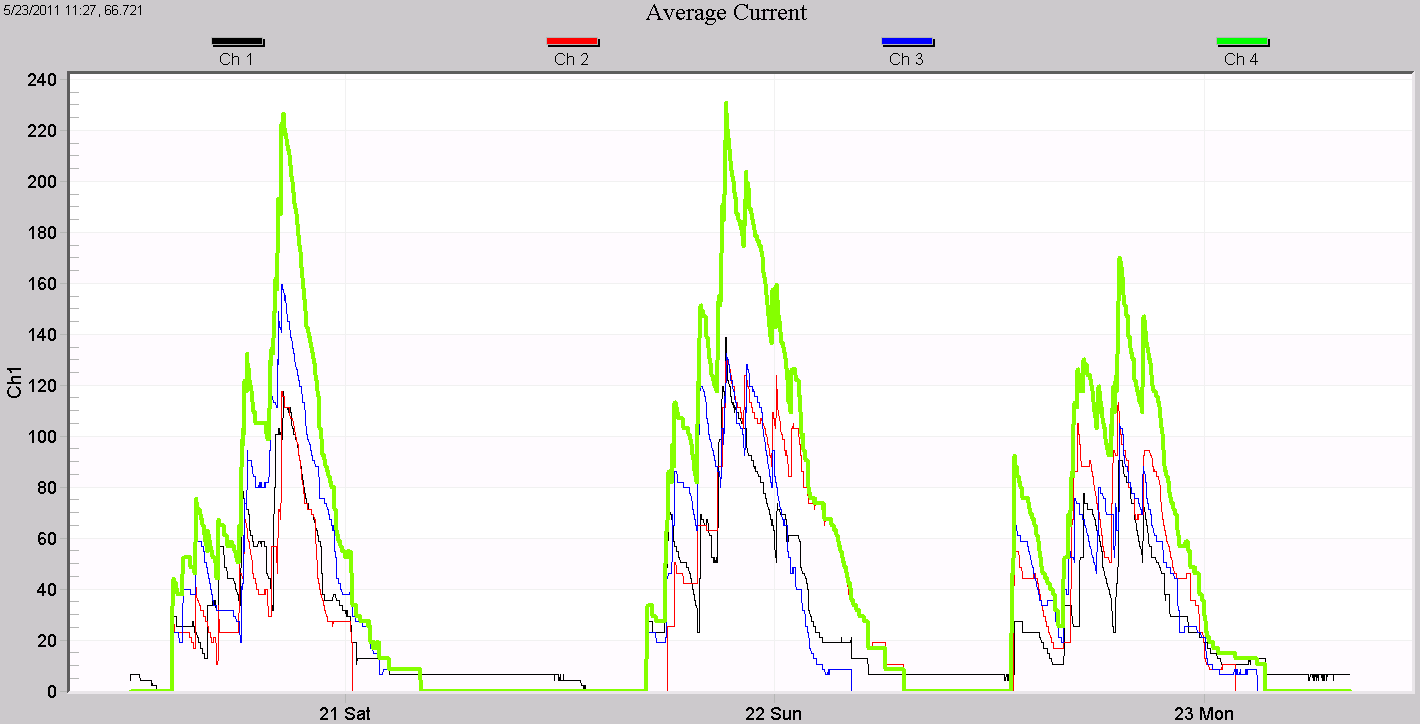
Figure 1 shows an excessive amount of neutral RMS current and a third harmonic condition that is being generated by the single phase inverter power supply loads, thus creating a condition of “Triplen Neutral Harmonics” where each odd harmonic, rather than cancelling each other out across the 3 phases, in fact has a summation effect. The result of this is a condition called “skin effect” which contributes to the overheating of the conductor beyond its original rating.
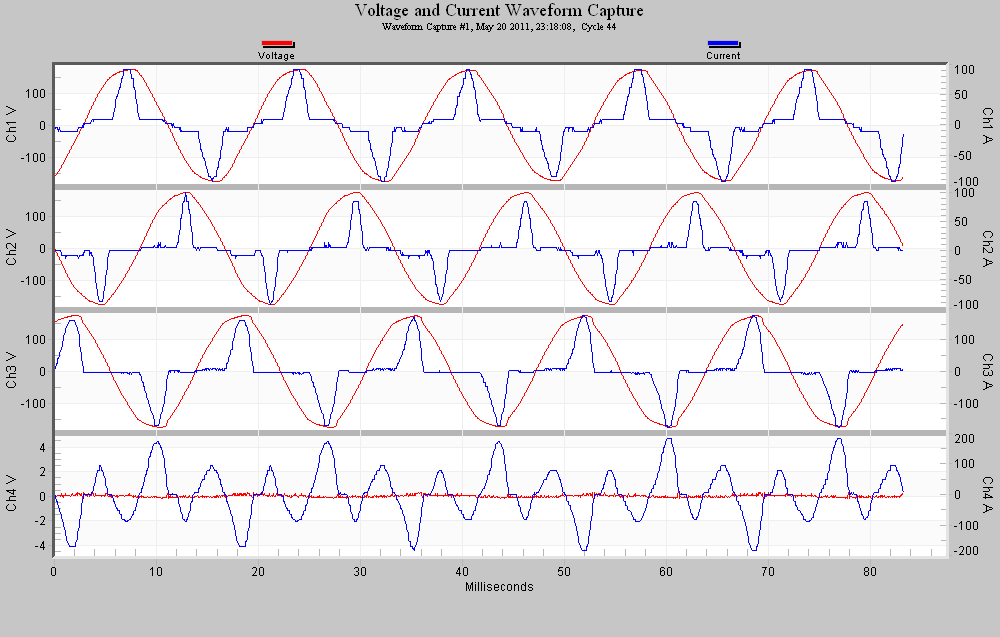
Under this condition, with these levels of currents, the neutral conductors are placed under excessive strain and a potentially dangerous condition exists.
Using additional recorders to capture data both at the sub panel location and the main service disconnect it was determined what the current profile and loading maximum exposure was to the vulnerable existing neutral conductor installed years ago. The vast majority of loads were considered “linear” and so presented a more balanced effect to a 1/0 overhead service neutral.
Main Panel Service Drop Neutral
Figure 2 below shows the min, max and average magnitudes of the neutral loading during the charging duty cycles.
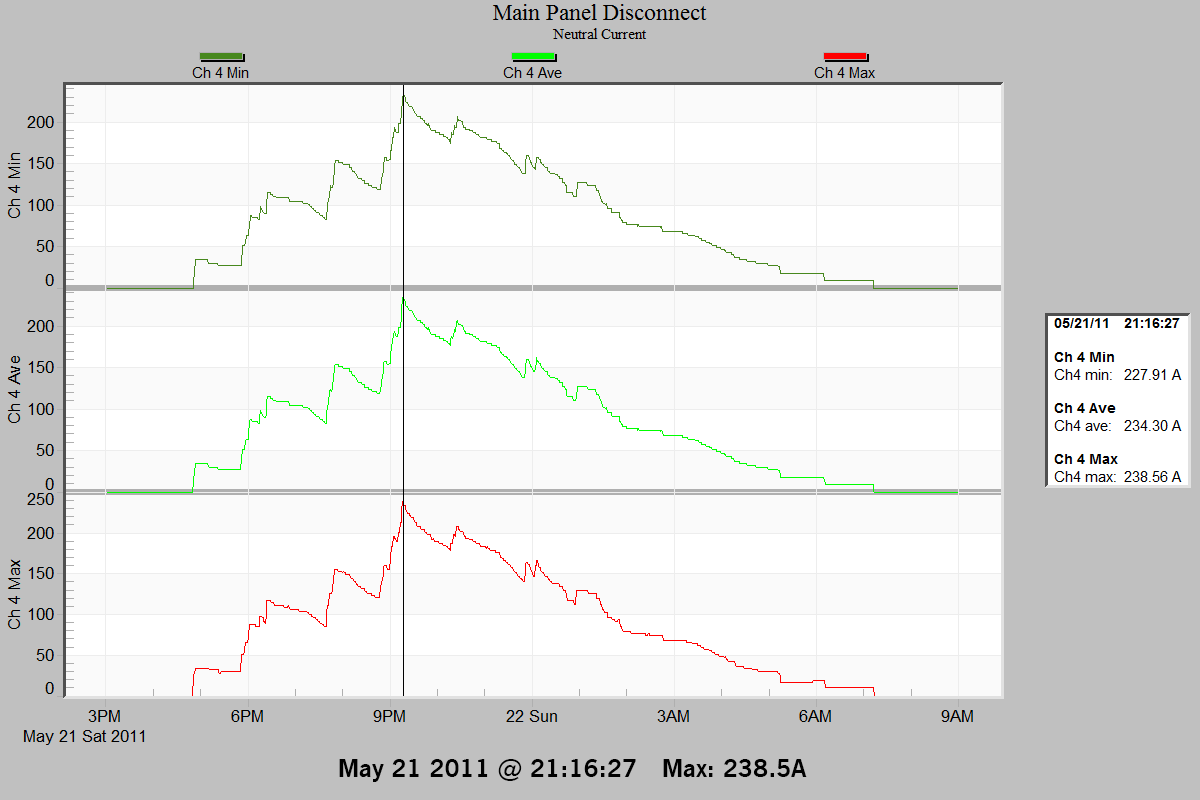
With this magnitude of current on the 1/0 neutral conductor of the quad-plex service, the aluminum neutral melted and shorted all the phase conductors together. The molten aluminum then dropped to the ground and started a brush fire at the base of the pole. The pole then caught fire, burnt all the support and then the pole with the 3 phase bank of transformers fell onto the cart charger building, collapsing the roof and damaging a number of golf carts, shutting down the business.
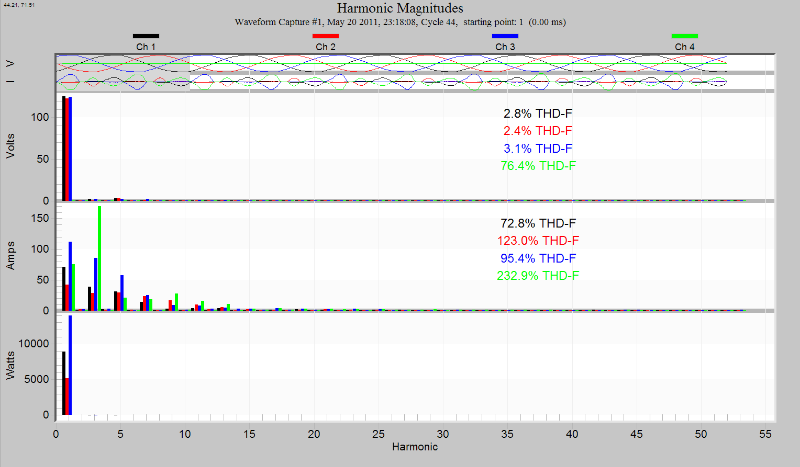
Figure 3 illustrates the extent of the total harmonic distortion (THD) and magnitude that can generate the heat inside conductors, such as the neutral where the most dominant harmonic is the 3rd at a frequency of 180Hz. The high content at 233.1% THD-F at 158 amps is telling in this case. Figure 4 shows the extent of the harmonic levels generated by this type of load. Channel 4 is the neutral current (Green Trace) and exceeds all the 3 phase currents significantly.
Conclusion
Many golf courses nationwide are switching to inverter type chargers in their goal to reduce costs and improve efficiency. In this case after the utility provider had upgraded the service drop and transformers, the golf course still experienced burnt neutrals within their own distribution as a result of a common practice of wiring circuits with a shared neutral. This was predicted, however they had failed to heed the warning signs.
In addition, the utility servicemen were using averaging current clamp type meters and didn’t really see the actual ‘true rms’ load values. The initial service panel was 400A and as a result of overloading, the service panel was increased to 800A, with dedicated neutrals for each circuit. In conclusion, a major overloaded and overheated neutral caused this catastrophic incident. As a preventative measure performing a simple Power Quality Study would have saved an expensive triple-bogey in the long run.