Abstract
A 2½ Element WYE Configuration uses 3 current phases and 2 voltage phases to calculate what is on the third voltage phase in order to measure the total power on all three phases. The voltage on all three phases must be closely balanced for the total measurement to be accurate. Blondel’s theorem does not apply to 2½ Element WYE as it does to 2 Element Delta measurements, so under unbalance conditions, some errors can occur.
2½ Element Configuration
The main reason that a 2½ Element configuration is sometimes used is because this method requires one less Power Transformer or PT. Since PTs in HV and EHV systems and PTs themselves are relatively expensive, sometimes utilities use the 2½ Element approach to cut the cost of having a third PT. In such cases, it is likely that the voltage will be in balance because the source impedance is extremely low when located that high in the transmission system. In industrial applications such a factory with several 3 phase motors that by design provide a well-balanced load to all legs of the system, a 2½ Element WYE works extremely well. For other applications, where the loads are not as well-balanced, the 2½ Element WYE is not recommended, especially if accurate power measurements and power quality measurements are required. PMI does not recommend using the 2.5 Element WYE with its devices except as a last resort. PMI recorders are not only used to monitor voltage, current or power, but the overall power quality, and for power quality measurements the more inputs that are available the better the results.
The 2½ Element configuration is also used in some electromechanical type watt meters. The typical way the older electromechanical meters operate is with a device referred to as a z-coil. The “A” phase to Neutral z-coil and “C” phase to Neutral Z-Coil Voltages are connected internally to the coil windings around a common iron core so that the voltage that is produced on the secondary winding is exactly equal to their vector-sum. If, and only if, the voltages are balanced, the Z-Coil will produce a potential that should be close to equal to the “B” phase-to-neutral voltage. When the meter has all three line-to-neutral voltages, and the A, B, and C phase currents connected normally, it will be able to measure the total power as if it was connected to a conventional three-element meter. Since the meter has three current pickups, as long as the voltages are balanced, the meter should read power accurately.
Several of PMI’s recorders support the 2½ Element WYE configuration. To properly hook up a PMI Revolution, connect Channel 1, the black input to phase “A”, Channel 2, the red input to phase “B”, Channel 3, the blue input to phase “C”. Hook Channel 4, the yellow input to the system’s ground and connect the Common, the white input to the system’s Neutral.
Wiring Diagram for the 2½ Element WYE is shown in Figure 1. As noted in the above diagram, when using a PMI recorder in the 2½ Element WYE, channel 2 voltage input is not used for the power calculations at all. The power is derived mathematically, ignoring the voltage on the Channel 2 input completely. The phaser diagram in Figure 2 shows a method for deriving Channel 2 voltage.
If, however, a customer has a need to make a voltage measurement, channel 2 voltage input is free to do so and the voltage on channel 2 can be recorded. It should be noted that even though the total power calculation may be very close when voltages are well balanced, there could be some serious power quality monitoring implications.
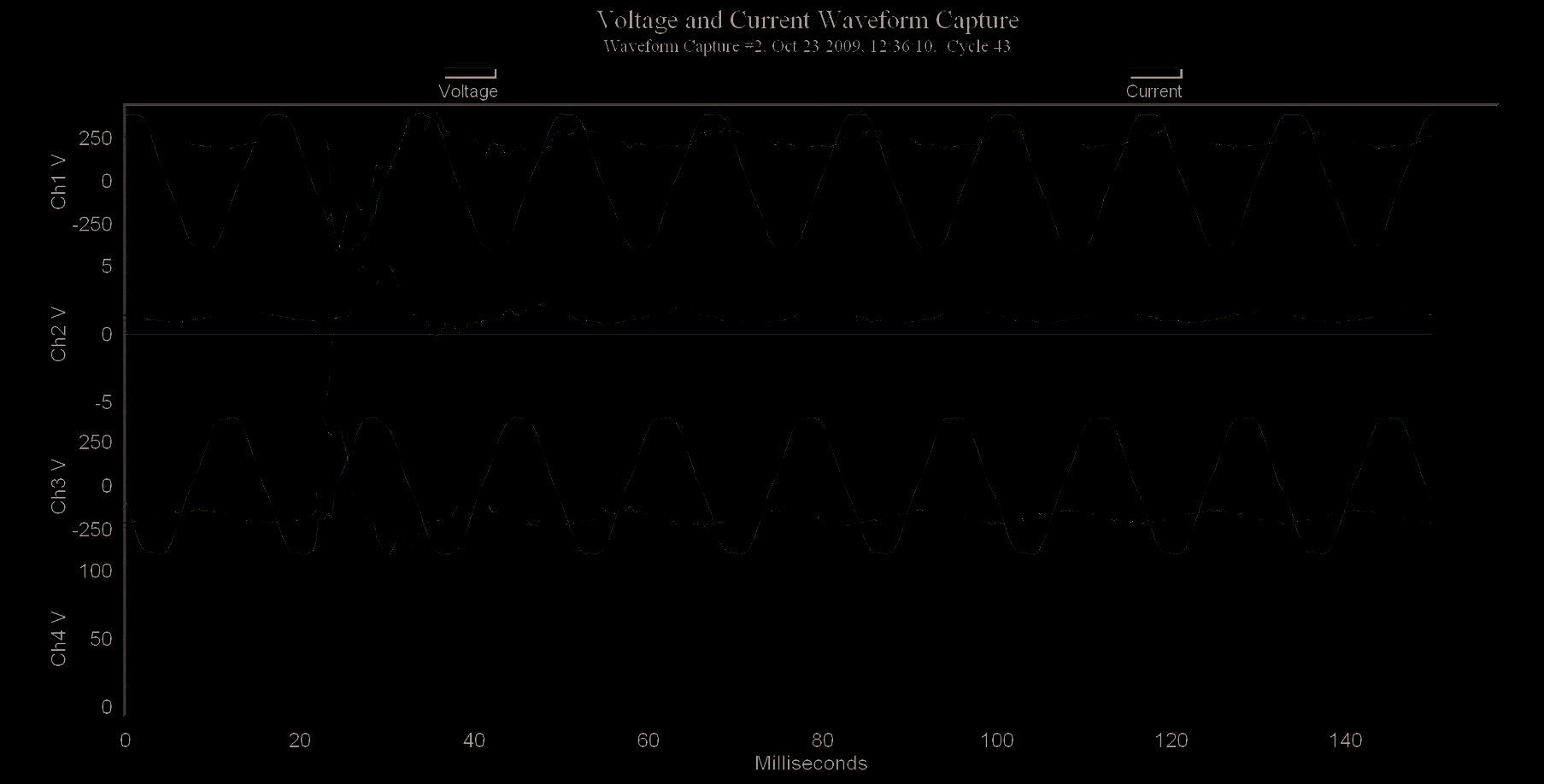
Figure 3 shows a waveform capture taken with a 2½ Element WYE. Here it would have been much more informative from a power quality point of view to have access to the phase B voltage. The capture shows a huge current spike on phase B and phase C, but with the 2½ Element WYE there is no way to see the effect on the voltage on phase B. From a power metering standpoint, this connection may have been adequate, but from a power quality standpoint, this is much less desirable. It leaves the technician wondering what the voltage is doing on phase B during this rapid current transition. This is a prime example why not to use a 2½ Element WYE for Power Quality observation.
The following are just a few concerns to note when using the 2½ Element WYE configuration:
- Single-phase sags are unavailable on the missing B voltage – if there are any single phase loads connected, that may have caused B to sag, they aren’t visible.
- Phase B THD is not available – this could conceal differences if there are single phase loads only on that phase.
- Can’t get a true picture of voltage unbalance – just a few percent may not matter for power calculations, however, this can be a power quality problem in itself.
- Upstream distribution line faults, etc. on phase B can’t be seen.
- Difficult to distinguish line-line events that may involve B from single phase events on A or C. For example, an A-to-B fault could look like an A-to-neutral single phase fault if you can’t see the B waveform.
Conclusion
The 2½ Element WYE measurement system should not be confused with the 2 power transformer delta system which is accurate even if the two loads are not balanced. In a delta system VAB + VBC + VCA = 0 and IA + IB + IC = 0 must always be true regardless of the state of balance.
In a 2½ Element WYE system, one missing line potential may be calculated from VAN + VBN + VCN = 0 by knowing any two of the vectors, but only when the voltages in all legs are balanced. So there are always two restrictions inherent in the 2½ element application:
The system must be in voltage balance on all three phases to be accurate and the connected system has only two PTs connected line to neutral.
The 2½ Element WYE system can save some expense of having the third PT and performs well for making power measurements as long as all 3 voltage phases are balanced. Because of this, it is not an advisable technique to be used where there is a high likelihood of voltage variation between phases or where highly accurate power measurements are needed. In this case, it might be better to invest in a 3rd PT. The extra expense will give you peace of mind that your measurements are accurate even if the system does become slightly unbalanced. In general, the 2½ Element WYE is not recommended for power quality studies, and should only be used as a last resort.