Abstract
This white paper discusses some of the reasons that PMI’s power quality analyzers may differ with the exact amount of power indicated by a power company’s revenue meter.
There are many types of power revenue meters and depending on the technologies used, under certain load conditions revenue meters will vary in measurements with one another and with PMI power quality analyzers. There are a broad range of possible reasons why this happens; this white paper will cover how a PMI recorder may vary in power measurements with regard to two of the more common revenue meter types, the electromechanical induction meter and the electronic power meter. Understanding how different power meters work and how PMI recorders work is important to understanding why these power readings can vary.
Electromechanical Induction Meters
One of the most common types of electricity meters is the electromechanical induction watt-hour meter. The electromechanical induction meter operates by counting the revolutions of an aluminum disc which is made to rotate at a speed proportional to the power used. The number of revolutions is directly proportional to the amount of energy used. It consumes only a small amount of power, typically around 1 to 2 watts.
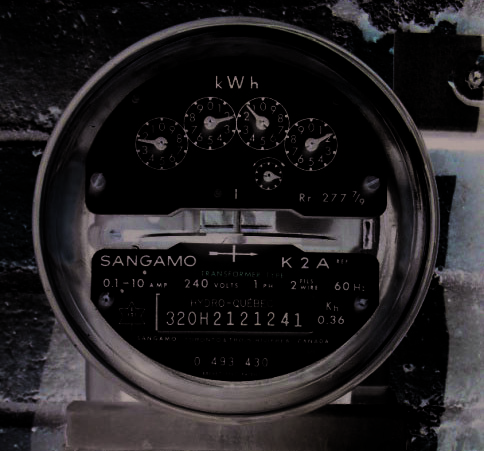
The metallic disc is acted upon by the magnetic field generated by two coils. One coil is connected in such a way that it produces a magnetic flux in proportion to the voltage and the other produces a magnetic flux in proportion to the current. The field of the voltage coil is delayed by 90 degrees using an inductor. This produces eddy currents in the disc and the effect is such that a force is exerted on the disc, the Lenz’s force, in proportion to the product of the instantaneous current and voltage. A permanent magnet exerts an opposing force proportional to the speed of rotation of the disc. The equilibrium between these two opposing forces results in the disc rotating at a speed proportional to the power being used. The disc propels a register mechanism which integrates the speed of the disc over time by counting the number of revolutions, very much like the old analog odometer used in a car. This allows the total energy to be used over a period of time to be measured. Due to the construction and how these meters operate the electromechanical induction meters roll off the higher frequencies, and can only respond to power going up to only about 5 harmonics of the line rate. This fact alone leads to measurement errors due to poorer frequency response as compared with the more modern electronic meters and with PMI recorders, especially when the load is not purely resistive. Another issue with some electromechanical meters is a phenomenon called meter creep. This happens when the meter disc rotates continuously when potential is applied to the meter without a load connected to the meter.
Electronic Meters
Electronic meters usually display the energy used on an LCD or LED display. Electronic meters operate by continuously measuring the instantaneous voltage and current, finding the product of these to give instantaneous electrical power in watts which is then integrated against time to give energy used in kilowatt-hours. Meters for smaller services can be connected directly in-line between source and end user or load. For larger loads, more than about 200 ampere, remote current transformers (CTs) are used, so that the meter can be located other than in line with the service conductors. The electronic power meter has a power supply, a metering engine, a processing and communication engine consisting of a microcontroller.
The metering engine is connected to the voltage and current inputs and has a voltage reference, samplers and quantizers followed by an analog to digital converter section to provide the digitized equivalents of all the inputs. These inputs are then processed using a digital signal processor to calculate the various metering parameters such as power and energy usage.
The largest source of long-term errors in the electronic meter is drift in the preamp, followed by the precision of the voltage reference. Both the voltage and current preamp and voltage reference can vary with temperature. Characterizing and compensating for these is a major part of a well designed electronic power meter.
Of these two typical types of revenue meters, PMI recorders more closely resemble electronic revenue meters than electromechanical induction type meters; so it should be no surprise that data from PMI Recorders would agree more closely with the electronic revenue meter in most situations.
The typical electromechanical induction revenue meter measures harmonic power only up to the 5th harmonic, while electronic revenue meters and PMI recorders can give an accurate estimate up to the 51st harmonic. In the worst case scenario, this can result in a relatively large error because electromechanical induction meters do not include the power in the harmonics above the 5th. When measuring a non-linear load that will likely have distortion of the line voltage, and consequently harmonic power generation, the electronic revenue meter can give a much more accurate result.
Because PMI’s Revolution and Vision products measure power much like an electronic revenue meter, in most cases the values they read will closely correspond to those of the electronic revenue meter.
A well designed revenue meter may measure power more accurately than a PMI recorder for a number of reasons. The revenue meter is designed for a precise voltage and current range which is not as broad as what PMI recorders are designed to cover. If the revenue meter is designed to cover voltages from 192 to 288 volts it would have much more resolution than a recorder that is designed and configured to measure from 0 to 600 volts. The same idea applies for the current range and resolution. A class 2 revenue meter is designed to measure 0.3 to 200 amps, where a recorder with a CT could be configured to measure from 0 to 1000 amps.
PMI recorder current ranges are configurable; if the current range is not configured properly, it can limit the unit’s resolution. If the 5000 amp range is used on a 200 amp service for example, the recorder’s measuring capabilities would be greatly compromised. Also, when measuring the current with a PMI recorder, it is very important to install the CTs properly. Even when this is done correctly, a 1.5% positioning error can occur. In a dedicated revenue meter, the exact placement of the CTs is governed and controlled by the basic meter design. This also allows any accuracy differences in the placement of a CT to be calibrated out. For the best resolution on a 200 amp service, use a TLAR with the recorder set to the 200 amp range. If the current is 100 amps or less, use the appropriate Flex CT and the 100 amp range.
Other differences may occur because not all electronic revenue meters are created equal. Design differences such as sample frequency and input bandwidth that may limit the ability of the meter to measure the higher harmonic power. It is also possible that some power revenue meters have a more temperature stable voltage reference and input voltage preamp which are key components in most if not all electronic revenue meter’s design.
Summary
It is not surprising with all of the different variety of revenue meters and technologies used today that PMI recorders may sometimes measure power consumption slightly differently. There are many variations of revenue meters however there are two main types, electromechanical inductive meters and electronic meter designs. PMI recorders fall into the electronic meter design type. A properly designed electronic meter, the newer of the two technologies, does not suffer from as many issues as older electromechanical inductive meters do, such as meter creep, lower frequency response to harmonically induced power, and more frequent calibration cycle to stay within specification. PMI recorders are designed to be accurate with frequency response of up to the 51st harmonic and accurate over a wide temperature range.
Some of the reasons a revenue meter may measure power differently than a PMI recorder are as follows:
- Resolution. Revenue meters are designed for a precise voltage and current range that is not as broad as the range that PMI recorders are designed to cover. Revenue meters are designed for a very specific purpose and therefore narrower voltage/current conditions, while PMI recorders are designed to operate over a much broader range and have many other functions.
- User configuration. PMI recorders are software configurable by the operator. The current range the operator picks can impact the recorder’s ability to measure power consumption accurately.
- CT placement. Because CTs are not a fixed part of the recorder, it is impossible to calibrate out some of the accuracy errors due to improper CT placement.
- Frequency response differences. Older electromechanical induction revenue meters roll off above the 5th harmonics of the line frequency causing them to read lower power consumption on non-resistive loads.