Abstract
This white paper explains the basic elements that make up a PV system– including the different types, how they work, and what impact they have on both the grid and power quality. Currently, an installed PV system costs between $2.50 to $4.00 a watt, with about 30% of that being installation cost. In the last decade, the cost of a PV system has dropped drastically from $9 per watt to the current average of approximately $3 per watt. This break in cost, along with government tax incentives, has caused the break-even point to drop enough to make sales skyrocket. With this current trend in PV systems, it is important to realize that solar power is here to stay and figure out how this paradigm shift would affect the grid.
Photovoltaic Cells
PV is short for photovoltaic, which is a physical effect that describes how electricity is generated from light. PV cells, sometimes referred to as solar cells, are the fundamental element in all PV systems. A very simple explanation on the theory of how a PV cell operates is as follows: The photons that make up the sunlight hit the solar panel, and are then absorbed by the semiconducting material (usually silicon) that makes up the solar panel. The photons then knock loose the negatively charged electrons from the semiconductor’s atoms, allowing the electrons to flow through the semi-conductive material in only one direction, thus producing electricity. An individual solar cell only generates a small amount of voltage (just a little over 1/2 a volt). When placed together in series on a panel, they can generate much higher voltages, and while wired in parallel, they can generate a higher current capacity.
The amount of sunlight energy that actually reaches any given location on the earth varies, but it can be estimated to be a little over 1kW per square meter maximum, in ideal conditions. Inefficiencies in the PV system reduce the amount of actual electrical energy produced from that incident solar energy. Currently, most commercial-grade PV panels are in the 14 to 25% efficiency range in converting sunlight into electricity; so this equates to about 140-250 watts of maximum electrical power per square meter of PV cells. Currently, there is work being done to boost the PV cells to have an efficiency of up to 32%, which was considered the theoretical ceiling of efficiency, known as the Shockley-Queisser Limit. There is even work being done to exceed this limit (some claim over 40%), but this is mainly for PV cells used for satellites and spacecraft, where weight and real estate is at a premium. In many cases, the more efficient PV panels are, the higher the price tag. Sometimes it may be more cost-effective to use PV panels that have a total efficiency slightly lower than the panel’s real estate. As discussed earlier, the individual cells are wired together in the panels for more power, and the panels themselves are placed together with a device known as a combiner.
Combiners
Since combined panels produce much higher power levels than individual cells, they require a combiner that is fused to limit the current. This is in case there is a fault in the system. The power from the combiner is subsequently fed through a DC power switch to the surge protection circuitry (such as an MOV), and then to a DC ground fault interrupter. The ground fault interrupter feeds a DC to AC power inverter. Since solar panels produce an unregulated DC voltage, their raw output must be converted to 60Hz AC by a DC-AC inverter for consumption by standard loads, or connected to the electrical grid.
The Basic Types of PV Electrical Systems
There are two basic types of PV power systems. There are those without battery backup (Figure 1), and those with battery back-up (Figure 2), but both use a power inverter to convert DC to AC. Each system has its own advantages, which need to be considered, depending on the individual requirements of the system.
The PV power system without batteries is typically set up to use power from the grid. This is in order to supplement the load’s power needs when larger loads are required than what the PV system is capable of. Due to not having batteries to maintain, this is the less expensive system. Because of this difference in price, more of these systems are being installed simply due to economics. The power being produced at any given time by these systems can vary, due to weather, clouds, time of day and time of year, since the amount of sunlight varies during these periods. During intervals of high sunlight and light loads, occasionally the PV system produces more power than the load requires. With some systems this excess power can be distributed back to the grid, and in most cases, net metering is incorporated.
What Is Net Metering?
Net metering is a billing mechanism that credits solar energy system owners for producing a surplus of electricity, which is then added back to the grid. For example, if a residential customer has a PV system, it may generate more electricity than it uses during daylight hours. If the home is net-metered, the electricity meter will run backwards to provide a credit against what electricity is consumed at night or other periods where the home’s electricity use exceeds the system’s output demand. In this case, the customers are only billed for their “net” energy use. On an average PV system, only 20-40% of a solar energy system’s output ever goes into the grid. This exported solar electricity is usually distributed to nearby customers’ loads.
PV Charge Controller
A controller will be needed to prolong the battery life of a PV System. The most basic function of a controller is to prevent battery overcharging. If the batteries are allowed to routinely overcharge, their life expectancy will be dramatically reduced. A controller will sense the battery voltage and reduce or stop the charging current when the voltage gets high enough. This is especially important with sealed batteries, since it is impossible to replace the water lost in them during an overcharging event. The only exception to the use of a controller in a PV system is when the charging source is very small and the battery is very large in comparison. If a PV module produces 1.5% of the battery’s total current capacity or less, then no charge controller is needed.
Unlike hydro or wind system controllers, PV controllers can open the circuit when the batteries are full without any damage to the modules. Most PV controllers restrict or simply open the circuit between the battery and PV array when the voltage rises to a set point. After that, as the battery absorbs the excess power and the voltage drops, the controller will turn back on. Some controllers have these voltage points factory-preset and are non-adjustable, while others can be adjustable. Controllers are rated by how much current they can handle. National Electric Code regulations require controllers to be capable of withstanding 25% over-current for a limited time. This allows the controller to survive the occasional edge-of-cloud effect, which is when sunlight increases dramatically.
Exceeding the current ratings on the controller can destroy it. Using a controller with more current capacity than the system can generating will allow for future expansion as well. A PV controller also prevents reverse current flow at night. This is the tiny amount of electricity that can flow backwards through PV modules at night, discharging the battery, but this loss of power is insignificant, however. Only with larger PV systems is this significant, but almost all charge controllers deal with backflow automatically.
Power Inverter
It would be hard to cover all the possibilities of every PV system’s configuration, however all power inverters convert DC power into AC power. There are three basic types of power inverters associated with PV Systems– stand-alone, grid-tie, and battery backup inverter.
Stand-Alone Inverter
When the PV system is completely isolated from the grid, even sometimes used for remote locations completely off the grid, a stand-alone type inverter can be used. This inverter does not have to deal with phase locking to the grid’s exact frequency and matching cycle phase rate and is not required to have anti-islanding protection since no power is being added or net-metered to the grid. Usually the stand-alone inverter also incorporate an integral battery charger in the case when a customer still is getting some of their power from the grid to replenish their batteries during times when there is not enough power being provided to keep the batteries charged via PV panels.
Grid-Tie Inverter
For residential PV systems tied to the grid, many more considerations are needed to allow a harmonious and safe transfer of energy. The Grid-tie inverter is responsible for meeting these requirements. One of the first requirements, a major safety feature is a grid-tie inverter has to incorporate anti-islanding. Anti-islanding circuitry detects when the power from the grid is no longer present and immediately shuts down power production going to the grid. Another concern is the ability to generate a clean sine wave, harmonic free, and sync that sine wave up to the line’s frequency and phase before going on line. One disadvantage of this type of system is that due to this anti-islanding shutdown feature, when the grid goes down, there is no backup power either. This is where the next type of inverter is needed, the battery backup inverter.
Battery Backup Inverter
The battery backup inverter is an inverter that draws power from a battery storage system that allows the capability of providing power to some loads during a power outage. In some cases, these inverters can even provide power to the grid when surplus power is generated, but must also have anti-islanding protection so not to back feed the power lines during power outages.
PV Systems and the Grid
PV systems are by no means a steady source of power to the grid such as normal power generating plants. They have large power output variations. For example, clouds don’t only have the normal effect of causing the power output of a PV system to decrease due to shading; sometimes as the clouds just start to pass over, the opposite effect happens. If the sun is clear of clouds itself, but surrounded by certain types of clouds, those clouds may glow slightly from solar radiation being re-radiated inside the cloud, adding extra solar energy to the panel. As clouds move past the sun, the PV panels cool, and when the sun is again exposed (with adjacent clouds), the cool panels plus the extra cloud radiation can cause up to an extra 25% boost, even above the panel’s rated output. This usually lasts for a very short time followed by the clouds shading dropping the power output abruptly. This effect is localized and may be averaged out with many PV systems contribution; however it is a very rapid change in power output that could cause power quality issues, such voltage surges, sags, changes in line frequency, phase and harmonic generation.
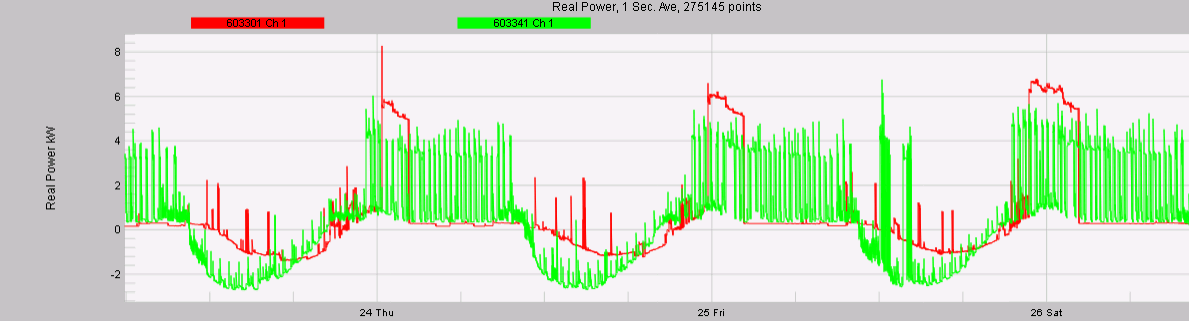
Two residential PV system outputs are shown in Figure 3. Here, two Boomerangs are used for PV monitoring. The green and red traces are two different residential locations in the same neighborhood, but with different power output profiles. The daily negative power due to the PVs are seen, but the green trace produces more power, and earlier in the day than the red location. This may be due different panel orientation at the two locations.
Conclusion
In the past the price for a PV system for residential use has been very high compared to the few cents per kWh directly off the grid. For most consumers, it did not make sense to invest in solar technology unless they were completely isolated, making power from the grid impossible or very expensive. With the huge drop in the price for an installed PV system with net metering, the government incentives, and the rising cost of conventional fuel prices, there will be more residential PV power customers contributing their surplus power to the grid. Since this solar power is not a continuous steady source due to weather and time of day, some of this power will come at times when the grid may not need it, or could drop out quickly during cloud cover putting a rapid demand on the grid to make up the surplus power. When there is a sudden change in power output from a contributing source to the grid, either more power or less, this can and will add some instability in the power system that will need to be handled quickly in order for the system not to have sags causing brown outs, or spikes in voltage. These rapid changes in power production will also try to change the line frequency of the other online generators if they are not stiff enough to handle the instantaneous power fluctuation. At this time, for the most part the grid has ample capability to compensate for the small amount of the total power fluctuation contributed by residential PV customers, but with the current trend, this may be an issue that needs to be addressed for the sake of power quality in the near future.