Abstract
This paper, the first of a multi-part series, covers the fundamentals of electric vehicle charging stations, charge modes, plug configurations, levels, and basic operation. Electric vehicles, although very efficient, are non-linear and introduce harmonics into the system. This paper also touches on how EV charging systems are affecting the power grid.
Charging Modes
Although the term “charger” is used for the external station that connects to the power grid and plugs into the car, in many cases they aren’t actually considered “chargers”. Usually the electronics housed within the car itself convert AC power into the DC power that is needed to charge the battery, while also performing any needed power factor correction, power consumption adjustment, and so on.
There are two types of charging stations – AC and DC. AC chargers supply raw AC line voltage (120V, 208V, or 240V) to the car and to the signaling and control circuitry. The actual battery charging electronics are completely contained within the car itself, as shown in Figure 1. Most residential and light commercial “charging” stations are of this type.
DC chargers, also known as “fast chargers” contain a rectifier and charge circuitry in the external charging station, and supply a DC voltage directly to the car. Here the actual battery charging electronics are outside the car, in the charging station. These systems tend to be higher power, and are often specific to a brand of car.
On some electric vehicles, it is possible to simply swap out the battery instead of charging it. Battery “swap stations” house charged batteries and utilize an automatic or manual system to quickly remove a depleted battery and swap it out for a fully charged one. The Tesla claims that a fully charged battery can be swapped in their Model S sedan in a mere 90 seconds, about half the time it takes to fill up a car with gasoline. Now several other EV manufactures are following Tesla’s lead by introducing their own battery swap technologies. This may lead to the proliferation of battery swap stations along with charging stations.
Wireless Charging Stations
There are also aftermarket wireless charging systems for some of the more popular EV models, such as the Nissan Leaf and Chevy Volt. One such system is called the Plugless L2 made by Evatran, who has signed an installation and distribution agreement with Bosch Automotive Service Solutions to support the installation of the Plugless Level 2 EV Charging System. This plugless system claims to charge as quickly as the EV’s system will allow. This system works by using inductive power transfer technology. This allows the EV to charge automatically when parked over the inductive coupling platform without having to plug it in. Although these are level 1 or 2 systems from a power consumption standpoint, there are electronics in the charging station required to convert the raw AC voltage into a suitable form for inductive transfer. This adds to the nonlinear loading of the car’s charger.
Plug Types
There are four standard power plug types.
- Type 1: Single phase vehicle coupler using the SAE J1772 standard
- Type 2: Single three phase vehicle coupler using the VDE-AR-E 2623-2-2 plug standard (See Figure 2)
- Type 3: Single and three phase coupler with safety shutters using the EV Plug Alliance standard
- Type 4: Fast charge coupler, for use with special systems such as the CHAdeMO
Charge Mode Types
There are four charge modes defined by the International Electrotechnical Commission (IEC).
- Mode 1: Slow charging from a regular electrical socket either 1 or 3 phase
- Mode 2: Slow charge from a regular socket using an Electric Vehicle specific protection assembly such as the PARVE system
- Mode 3: Fast or slow charging using a multi-pin EV socket with protection and control functions, such as SAE J1772 or IEC 62196
- Mode 4: DC for a fast charge, using a special charger technology like the CHAdeMO type
SAE J1772 Standard
The North America standard for the electrical interface is the Type 1 plug, or the SAE J1772 for conductive charging systems to charge electric vehicles. This standard covers the physical dimensions of the charging connector, electrical connections, and the communication protocol required for proper charging. The primary focus of this paper is the type 1 plug standard since it is the most popular in the US.
With modes 1, 2, and 3, the actual charging electronics are usually located in the car, rather than the “charging” station. With these, raw AC line voltage is supplied to the car, and this can vary from 120V to 240V, depending on the building’s electrical service. Mode 4 chargers rectify the line voltage into DC, and in that case some charging electronics are in the external station.
Safety First
The SAE J1772 standard takes in consideration safety first, to protect the user from being shocked especially in wet conditions. The contact pins are physically isolated on the interior of the connector to ensure no human contact with the pins while connecting the vehicle to the charging station. When the vehicle is charging, the charging station and power plug is designed with a control pilot and proximity detection pin, and will disconnect first, de-energizing the power control relay or contactor so that power does not continue to flow to the vehicle’s power station power plug. When connecting the vehicle to the power station, the un-energized power plug is mated before control pilot proximity detection pin makes contact ensuring no power will flow until the plug is completely mated and no powered contacts are exposed.
The charging system is designed to detect when the car is plugged in via the plug proximity circuit. This is a very important feature as it keeps the vehicle from driving away while it is still connected to the charging station.
The actual charging circuit, the electronics that convert the 240 or 120 volt AC to the DC power that charge the battery, is located in the vehicle itself, so it is misleading to call the EVSE Box the charger.
There are at least three levels of charging, however only levels 1 and 2 are commonly used. Level 1 is utilized when plugging into an ordinary single phase household outlet. This will allow a charge of 120 volts and up to 16 amps of peak current or 1.96 kW. Level 2 chargers allow single phase 240 volts and 32 amps of peak current or 32 amps at 7.68 kW. Level 2 chargers also work with 208V 3-phase services – in this case, two of the phases are used. A type 2 charger is shown in Figure 2. DC fast chargers that require 480 volts and draw 125 amps are sometimes referred to as Level 3 chargers. These allow an EV to charge to 80% of full charge in as little as 30 minutes.
Effects on the Power System
EV chargers create a very nonlinear load to the power system. As is the case for any nonlinear load, power quality is affected adversely due to harmonic generation and poor power factor. Electric vehicles, although very efficient, require relatively large charge currents for extended periods of time, placing a high demand on the power distribution system providing the power to the charging stations. As demand grows for efficient, pollution-free transportation, more charging stations will be required to meet the growing demand, and it will become even more critical to monitor the power at strategic locations to quickly identify power quality issues as they occur.
Charge Levels Types
The J1772 standard defines three charging levels:
| Voltage | Phase | Max Current | kW | |
|---|---|---|---|---|
| AC Level 1 | 120 V | Single phase | 16 A | 1.92 kW |
| AC Level 2 | 208 V or 240 V | Split phase | 32 A (2001) / 80 A (2009) | 7.68 kW / 19.20 kW |
| AC Level 3* | 480 V | 60 kW |
*Tesla Super Charge can load Level 3 480 V @ up to 250 A for a total of 120 kW.
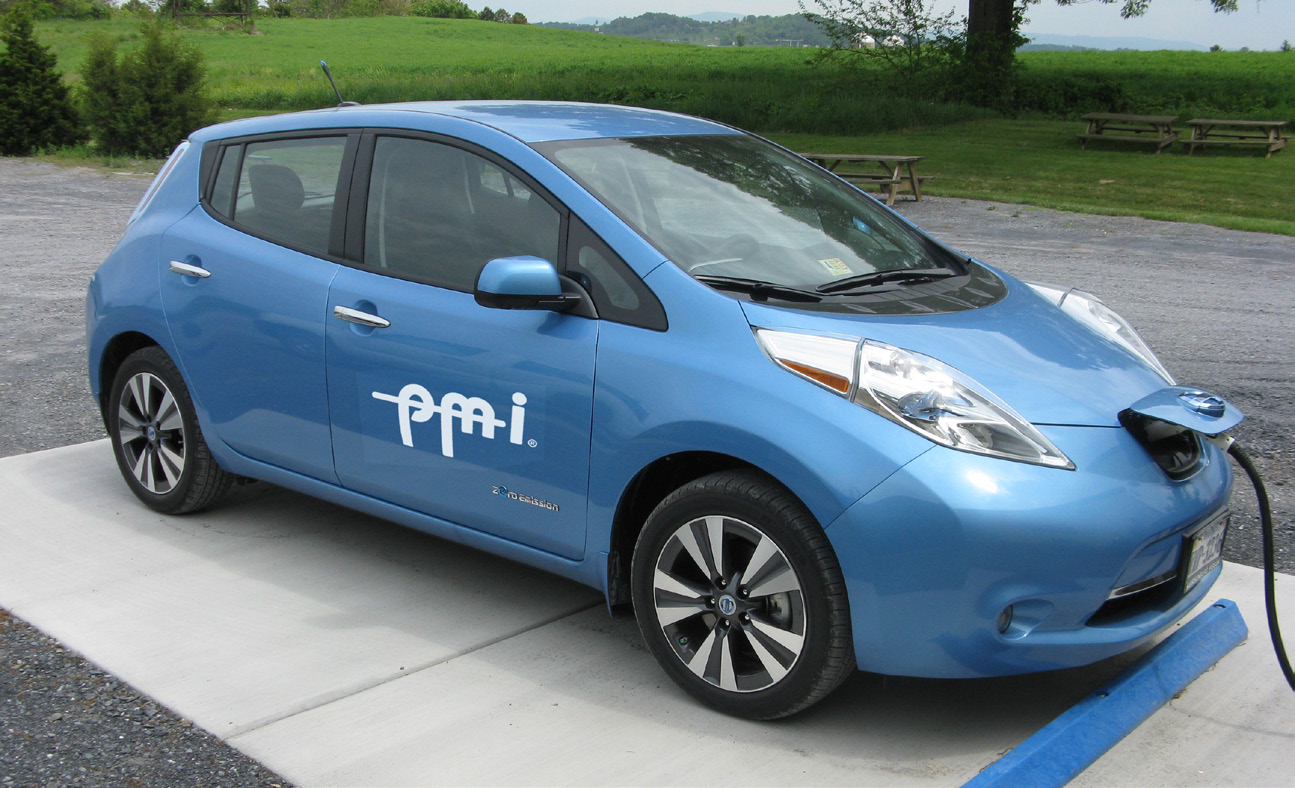
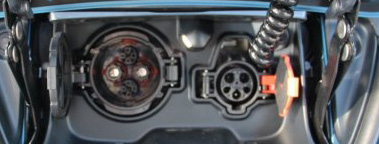
A typical charging system is shown in Figure 3. The Nissan Leaf has 2 sockets; the left socket is for Level 3 charging; the socket on the right is for charge modes 1 & 2.
Smart Charging
By 2024, it is projected that as many as 50% of all vehicles will be EV. If that projection holds true, the aging electrical infrastructure will be strained and have significant difficulty supporting this type of load, especially during times of peak demand. V2G, Vehicle to Grid allows a way of controlling the charge rate. During peak demand periods, the vehicle charge rate can be throttled back and during times when the grid has a surplus the charge rates can be increased. Also, most of the EV chargers have a way of powering up at random times after a power outage, and allow for the gradual ramping up of the charging load that is presented to the distribution system.
On the Nissan Leaf, it can take as little as 4 hours to charge on 240 volt charger and up to 21 hours on a 120 volt charger. On the Leaf with the SL option, a higher-powered 480 volt, 125 amp DC charger can charge up to 80% in just 30 minutes using the CHAdeMO protocol! This of course has a negative effect on the battery’s life as compared with a slower charging rate. The range of the Leaf is about 80 miles which varies depending on terrain and how aggressive the driving is. It has an 80 kW electric motor, roughly about 107 HP, so it has some get up and go, but at the expense of the car’s range. The top end is around 93 mph.
Summary
Here the fundamentals of the Electric Vehicle Charging Station, the different plug types used, charge modes, levels, and the operational basics were covered. There are several established wired systems and some of the newer developments in plugless or wireless charge systems that are now hitting the aftermarket to complement the many popular EV models. Understanding the different types of charging systems will help in making recommendations to customers, and dealing with the impacts of widespread EV adoption across the distribution system.