Abstract
This white paper describes what Bluetooth is and identifies what PMI products use Bluetooth technology. It also covers how to increase the range of a Bluetooth system and improve data rates when necessary by adding a higher gain antenna.
Bluetooth Overview
Bluetooth is a short range RF wireless technology using frequency-hopping spread spectrum operating between 2.402 GHz –2.48 GHz in the unlicensed ISM (Industrial-Scientific–Medical) frequency band. Bluetooth is used mainly to exchange data between fixed and mobile electronic devices. Bluetooth uses a packet-based protocol and comes in 3 power classes:
Class 1: Used were maximum range is needed. Maximum permitted power of a class 1 transceiver is 100 mW or 20 dBm. This has a range of around 100 meters however this is very dependent of the antenna used and the surrounding environment.
Class 2: Used for medium range applications. Maximum permitted power of a class 2 transceiver is 2.5 mW or 4 dBm. Class 2 has a range of around 10 meters.
Class 3: Used for very short range applications of around 1 meter. It is sometimes used in small devices that have a small internal battery and still require a long battery life. Class 3 is limited to 1 mW or less or 0 dBm.
The name “Bluetooth” was inspired by the Danish King Harald Blatand who ruled during the 10th century. Bluetooth is the anglicized version of the nickname Blatand, a name the king likely inherited because of his fondness for blueberries. King Herald was a major player in uniting the dissonant Danish Tribes of Scandinavian Europe. Bluetooth technology performs a similar function with communications protocols, uniting them into one universal standard. The Bluetooth logo is a stylized combination of the ancient Scandinavian runes that make up the king’s initials.
Bluetooth and PMI
Bluetooth is used as a secondary and in some cases a primary communication mode between a user’s computer and many PMI products. PMI’s products that use Bluetooth for communication are as follows:
- Revolution – Class 1
- Eagle 120 – Class 1
- Eagle 220, 330, and 440 – Class 2
- Guardian – Class 1
- Field PC – Class 2 Opt. Card Class 1
- Vision – Class 1
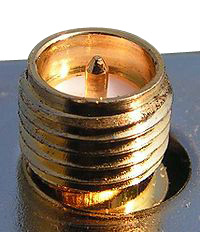
PMI sells a Class 1 USB Bluetooth Adapter that can be used with a laptop to download and communicate with their Bluetooth products. The adapter comes with a small antenna that usually performs well in most cases. If there is a need for longer range communication, a higher gain Bluetooth antenna can be purchased and installed to the Bluetooth adapter via the Reversed Polarity SMA connector sometimes referred to as an RP-SMA. On most Bluetooth and Wi-Fi equipment a RP-SMA is used, (shown in Figure 1). Bluetooth uses this connector and distinguish it from the cell phone antennas that operate on a different frequency. Do not confuse the two connectors. Trying to mate the wrong connectors together can damage both connectors. A cell phone antenna would not perform well on the Bluetooth frequencies regardless, due to the antenna’s design.
High Gain Antennas
One of the most common ways to communicate with PMI’s Bluetooth devices is via a USB Bluetooth adapter and a laptop. There are many varieties of the USB Bluetooth adapters. Some adapters can provide much more usable range than others. Using an adapter with a RP-SMA connector and high gain antenna will usually improve range and performance.
NOTE: Before adding a high gain antenna to your Bluetooth transceiver, please make sure to read and observe all FCC rules for power limits. Pay special attention to FCC regulations Part 15.247(b) if you are using a high gain antenna with a Class 1 type device.
Using a remote high gain antenna has at least 3 advantages over an internal antenna:
- Higher gain on receive reduces noise from unwanted sources and can improve data rate on a marginal signal
- Higher gain on transmit helping to overcome noise at the receiver’s end.
- The antenna is positioned further away from computer generated noise.
A higher gain antenna on a transceiver works in both the transmit and receive directions. It allows the Bluetooth receiver to limit the receive area thus limiting the received noise of the system. The gain of the antenna over a built in antenna also raises the received strength of the signal. On transmit, higher gain allows more of the transmitted power to be directed toward the device rather than into empty space. Every 6 dBs of antenna gain theoretically doubles the usable communication distance. A laptop computer or PC almost always generates some radio frequency interference (RFI) even at 2.4 GHz. A remote antenna moves the RFI farther away, reducing the interference or noise that may enter into the system via the antenna.
Omni-Directional Antenna
A high gain omni-directional antenna such as a vertically mounted whip has the advantage of picking up gain by reducing the angle of radiation but not restricting the direction or azimuth of the communication. The disadvantage of this antenna is that it will pick up unwanted signals and noise equally well in all directions except for up.
To increase communication range farther, a high gain directional antenna may be a better solution over an omni-directional antenna. The most common antennas for this application are the yagi, corner reflector, or dish type antennas.
Corner Reflector Antenna
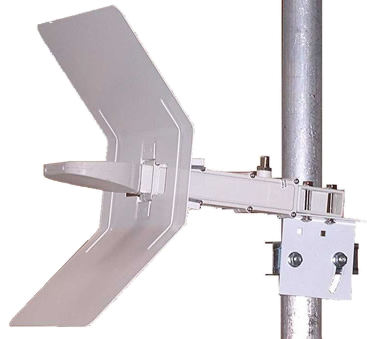
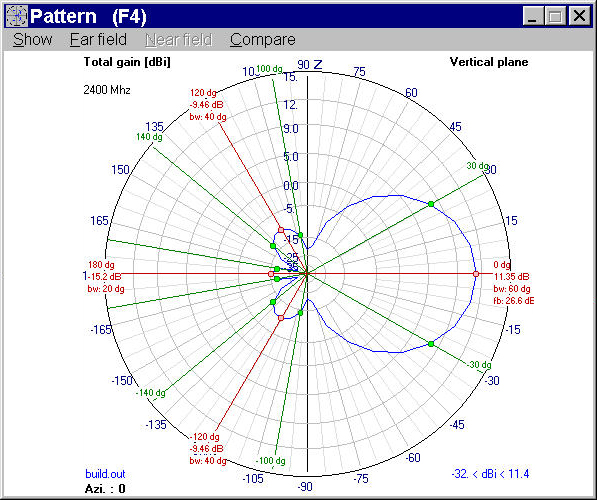
A well designed corner reflector antenna (as shown in Figure 2) has a typical gain of 11 to 12 dBi. One of the main advantages of a corner reflector is it has a very high front to back ratio typically around 15 to 20 dB with a moderate 30 degree 3 dB beam width. The high front to back ratio blocks noise and unwanted interfering signals originating from behind the antenna (as shown in Figure 3).
Yagi Antenna
A well designed yagi antenna (Figure 6) will have gain directly proportional to the boom length as shown in Figure 4. As yagi gets longer and gain increases, the overall beam width will decrease. Depending on the yagi’s design there are trade-offs between forward gain, impedance match and front to back gain ratios for a given antenna’s boom length.

Parabolic Dish Antenna
Parabolic Dish Antenna (Figure 7) can give some of the highest gains and smallest beam widths of any type of antenna. As with most antennas, the gain of a parabolic dish is directly proportional to its aperture. The aperture or area of a dish (A) is equal to πr² where (r) is the radius of the dish or 1/2 of the dish’s diameter. To calculate the gain of a dish, use this formula:
Gain in dBi = 10 log10(η(πD/λ)²)
λ is wavelength and is equal to the speed of light (c) divided by the frequency (f), or c/f = λ. For an approximate value of the wavelength in inches, divide the frequency in Megahertz by 498. For the Bluetooth frequency of 2.425 GHz or 2425 MHz the wavelength would be about 2425/498 or 4.87 inches.
η (n) is the efficiency of the antenna and is a result of how well the dish is illuminated by the antenna’s signal feed system. A well designed dish can have efficiencies as high as 80% but a more typical and reasonable number is around 55%.
By evaluating the above gain equations, it becomes clear that the three major factors that determine the gain of a dish antenna are the size of the dish, the efficiency of the feed system and the frequency. As the size, frequency of operation or efficiency increases so does the gain of the dish. A 30" dish on the 2.4 GHz Bluetooth frequencies can yield a gain of better than 23 dBi or 200 times the EIRP. This could increase the operating distance by over 8 times under ideal conditions over an isotropic radiator or a typical gain on an internal antenna.

All of the PMI products that have Bluetooth technology utilize internal antennas that are omni-directional so that the exact orientation of the unit is not critical for maximum range. Any metal that is close to the Revolution’s internal antenna will have some effect on the pattern. Due to the physics of designing such a compact device with an internal antenna system, it is impossible to obtain a truly omni-directional pattern. Some gains may be achieved in certain directions while slight losses will be experienced in other directions. Since antennas are very environment dependant devices, it is extremely hard to predict exactly what pattern you may have in a particular location.
The pattern shown in Figure 7 is the antenna being used in the current Cell Revolution®. This is what the pattern would look like in free space not affected by surrounding metal under ideal conditions. The Revolution would be laying on its back on a non conductive surface to correspond to the pattern above.
Summary
Bluetooth is a very good option for linking devices together when extreme data rates and range are not needed. Most of PMI’s product line is taking advantage of using the Class 1 standard to allow maximum range and higher data rates. A self contained omni-directional antenna is used on all of PMI’s devices that have Bluetooth capability. This allows for the maximum safety to the installer and also allows the installer not to worry about the exact placement or orientation of the PMI device. To take advantage of Bluetooth’s full data rates and extend the range, an external high gain antenna can be used at the computer end via a USB to Bluetooth adapter. When installing an external antenna to the USB to a Bluetooth adapter, be careful to make sure that the antenna is designed for the correct 2.4 GHz Bluetooth frequency band and it is equipped with the proper mating RP-SMA connector.