Abstract
In this whitepaper, the term undervoltage is explained, some typical causes of undervoltages are given, and the effects of undervoltage on customer loads is described.
IEEE 1159-2009, IEEE Recommended Practice for Monitoring Electric Power describes the term undervoltage as “a drop in AC RMS voltage in an electrical power system, typically 80% to 90% of its nominal value or lower, at the normal line frequency lasting for at least a minute”. This is not a voltage sag, which is a much shorter duration voltage event, and not an interruption that occurs when the voltage goes to zero. Undervoltages can be an intentional or unintentional drop in voltage.
Brownout, a slang term, is sometimes used to describe an undervoltage condition. The brownout term is associated with the dimming of incandescent lighting in the past from an undervoltage condition. This is likely where the name brownout came from due to the change in the intensity and the brownish color of the light. IEEE discourages the use of the term “brownout”, and the more precise “undervoltage” should be used when describing power quality issues.
Causes of Undervoltages
Undervoltages can be broken down into two different groups. Intentional undervoltages are caused by utility operations or other planned or intentional actions. Unintentional undervoltages, the most common type, are unplanned and unexpected.
Intentional undervoltages, sometimes called voltage reductions, are usually a last resort to prevent system failure from severe overloading. The voltage reduction is intended to produce a reduction in power load without having to go to the next step of a rolling blackout. Intentional voltage reduction to 90% or below is a drastic step in times of severe loading, but can be done selectively to certain feeders or circuits. The undervoltage is a last resort before disconnecting power completely, or risking an uncontrolled system protection operation or equipment failure.
Unintentional undervoltages usually results from a system failure of some type, such as a recloser malfunction when a fault becomes present on the line. Some examples of these faults include downed power poles and lines, a transformer failure, voltage regulator malfunctions, switches and sectionalizer shorts, or even a sudden increase in load that was not anticipated and temporarily exceeds the grid’s capacity. Switching large capacitor banks off can sometimes result in an undervoltage condition, if the power factor at that point is poor without them.
Reclosers are designed as a failsafe – a way of disconnecting a short-acting or temporary fault such as lightning strikes or sudden current surges due to a transmission switch. Reclosers usually will cycle closed several times, allowing time for a limited-duration fault to dissipate and allowing the power to be restored. After a predetermined number of tries by the recloser, an upstream sectionalizer should stay open to isolate the section of faulty line. This allows the downstream recloser to re-energize the circuit up to the open sectionalizer, while minimizing undervoltages during the reclose period for other customers. If for some reason the sectionalizer malfunctions (or there is no sectionalizer) and the recloser fails closed, thus the fault stays present on the line, undervoltage conditions may occur.
Fault currents are not the only cause of undervoltage. A typical cause of a localized undervoltage can be due to corrosion where joints are made. For example, the main service entrance connection, a corroded circuit breaker or poor circuit design that does not have a low enough resistance to carry a heavy load without a large voltage drop can result in undervoltage during periods of high, but “normal” load current. Corroded, loose or undersized neutrals can also cause undervoltage issues.
Undervoltages are usually more common in the summertime during hot weather, when air conditioners are pulling large loads due to the higher heat, which also cause higher line and transformer losses. Other weather phenomena such as thunderstorms, high winds and in the winter seasons, ice and snow, can result in downed power lines and transformer issues that result in blackouts and sometimes undervoltages. Also, less frequent space weather such as solar flares and CME can cause issues in the Earth’s magnetosphere inducing DC currents into the power lines causing transformers to saturate and line efficiencies to be reduced, thus lowering voltages. These are referred to as GIC, short for geomagnetically induced currents.
An improperly wired generator can also cause an undervoltage, in addition to a dangerous energized line condition. A generator without a transfer switch can back feed a distribution feeder. Apart from the danger presented to utility lineman who may be working on that feeder, the back-feeding generator will typically not be able to maintain the feeder above undervoltage levels.
Undervoltages can reduce lifetime on some loads, while extending the lifetime on others. Many simple resistive loads have a longer life with lower voltage. For example, an incandescent light bulb designed for a 120V nominal will run cooler and produce a bit less light at 90V. However, the bulb lifetime will increase. Other resistive loads, such as electric water heaters and ovens controlled by thermostats, will draw less current, but stay energized for longer periods to reach their set points.
More complex, modern loads react differently to undervoltage. A switch-mode power supply, common in electronic devices, will actually draw more current at 90 Volts than at the nominal 120 Volts. These power supplies are designed to maintain a fixed voltage output even if the input voltage varies. They are effectively constant-power loads, increasing the current demand in response to a lowering of AC input voltage. Most switch-mode power supplies that are used in computers are designed to run most efficiently at the nominal line voltage close to 120V. Sustained undervoltage will result in increased current, increasing heating and decreasing power supply life. Variable frequency drive controllers are also in this load class.
Motors are also affected by undervoltage, typically by increased heating. If the motor is loaded during startup, it tends to draw higher current than after it has spun up to its nominal rotational speed. If the voltage is low and the motor is under a load, it may not have enough torque to get up to nominal and most efficient rotational speed, so it will begin to heat up. The relationship between the motor’s output torque is related to the square of the applied voltage to the motor. This means a 25% reduction in the motor’s nominal operating voltage, from 120 Volts to 90 Volts can result in approximately 56% reduction in torque. This can be illustrated by the following, 90 Volts is 75% of nominal 120 Volts, or 0.75 × 0.75 = 0.5625 or 56.25%.
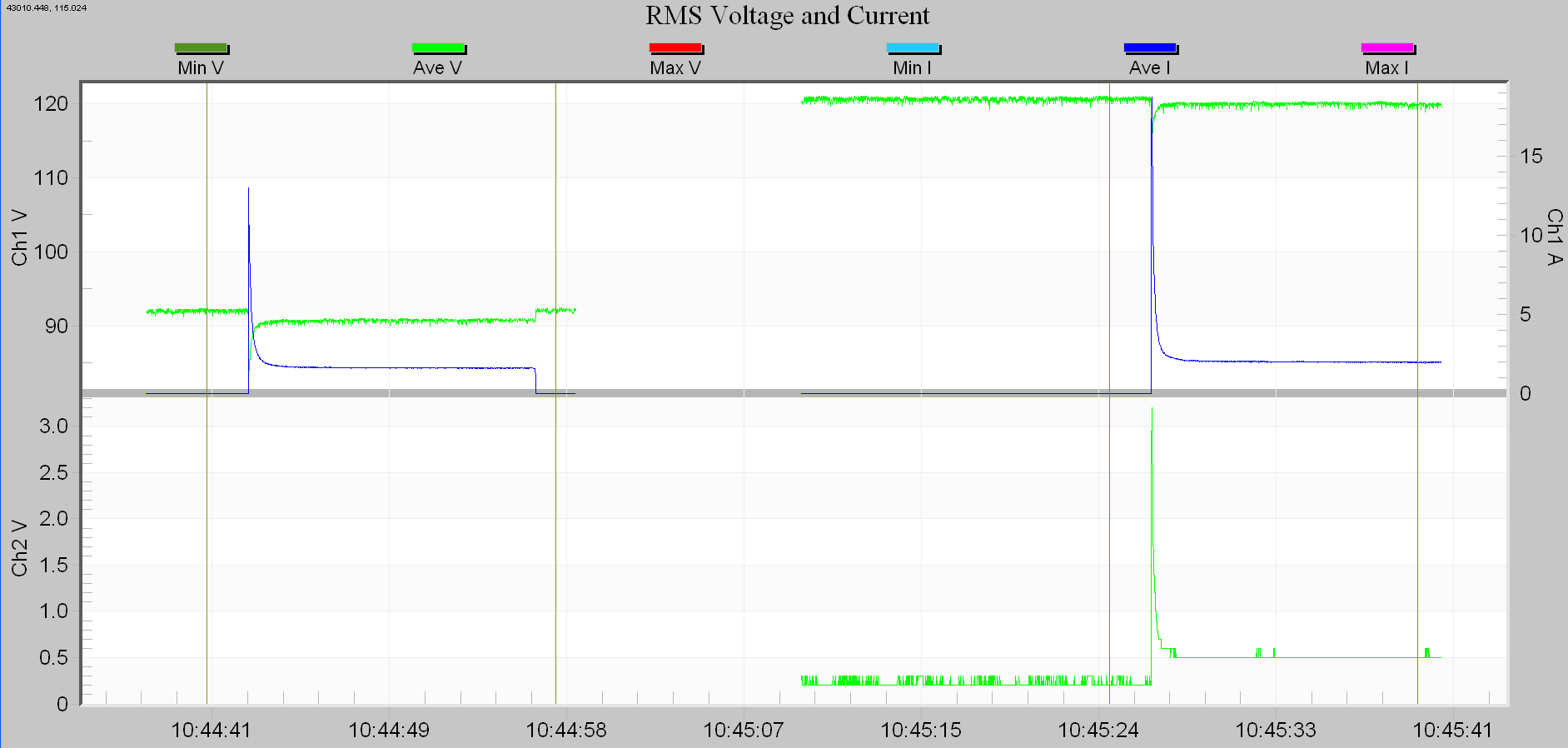
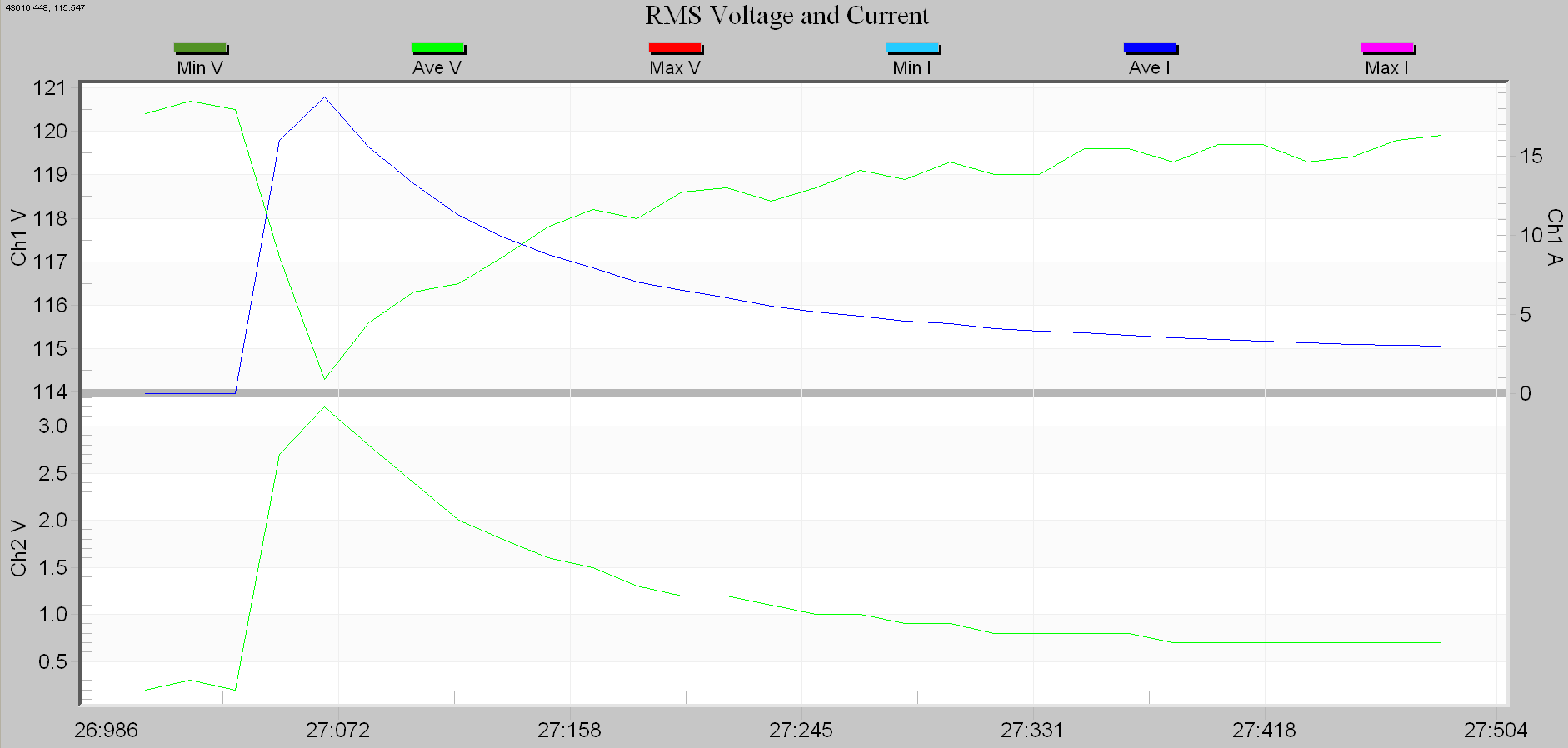
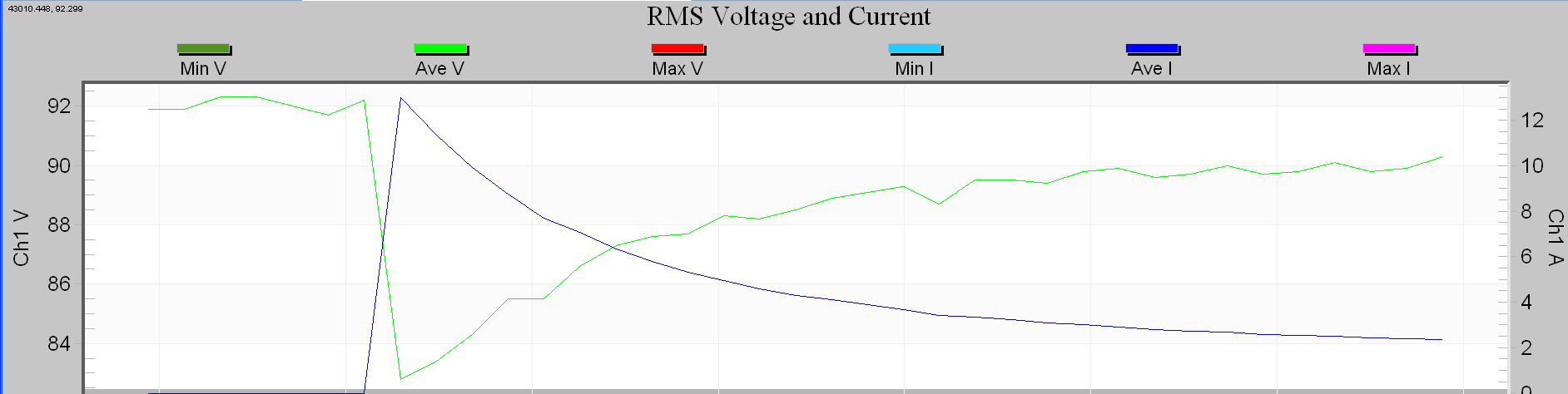
The increased heating will reduce the winding insulation lifetime. If there is no thermal cut off switch built into the motor, in some cases, the motor’s temperature can increase to the point of where the winding’s insulation breaks down. In some cases, an undervoltage can actually cause a motor to run backward. Motors are designed to operate most efficiently in a nominal voltage range. Typically a motor under load will draw more current at a lower voltage than at their designed voltage. Some larger motors have contactors or relays that need to be within a certain voltage range, say 90% before the voltage is passed to the motor protecting the motor from extreme low voltage conditions. Without the protection of a contactor, motors can pull excessive current leading to the tripping of circuit breakers. Usually, on smaller motors that don’t have the inline low voltage contactor installed, the real motor killer is when the voltage is so low that the motor no longer has enough torque to start yet it does not pull enough current to trip the breaker. This can cause the motor to overheat quickly. Larger motors used in many HVAC systems come with a series contactor installed, so if the voltage is below a certain level, no power gets to the motor to prevent this from happening. In this case, the motor is protected from an undervoltage condition. If the voltage deviates either high or low from this nominal range, efficiency is usually reduced. The longer the motors are run outside their design voltages range especially under a heavy load, the higher chance of it overheating and a premature failure.
Motors and switching power supplies are not the only voltage sensitive devices in a home or factory. Any device that incorporates a magnetic device such as a transformer, relay or solenoid is subject to possible damage by high or low voltage extremes. Sometimes however, overvoltage is more damaging than low voltage. It is very common for a low voltage line condition to be followed by a higher than normal condition.
Detecting Undervoltage
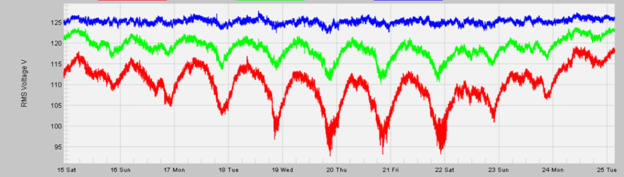
Undervoltage is steady-state RMS voltage issue. One cycle min and max RMS values, important for voltage sags and other PQ investigations, are too fast for this problem. Instead, slower 1 second or 1 minute averages can be used to separate steady-state RMS readings from much faster PQ events. A PQ monitor such as the cell Guardian or cell Revolution can provide instant notification of just about any PQ event, as well as RMS voltage exceedances. The Boomerang, designed for steady-state voltage monitoring, is the best tool for continuous, permanent monitoring. The Boomerang may be installed in Form 2S residential locations, as well as 3-phase locations, or in a substation. The DNP3 interface allows polling or unsolicited alerts to a SCADA system through a cell network. Cloud-based Canvass may also be used both for instant email or SMS notification, as well as historical or engineering analysis. The figure below shows a Canvass graph from a 3-phase Boomerang. Phase A (red) show severe undervoltage during times of peak load during hot summer days, with voltage dropping below 95V. Phase B (green) shows the same pattern, but the undervoltage is not as severe. Phase C (blue) shows virtually no undervoltage at all. This graph reveals both voltage unbalance issues and undervoltage. Likely rebalancing the residential loads on this feeder will help address both problems.
Conclusion
It’s best practice for loads sensitive to undervoltage to include safeguards such as contactors to disconnect the load when voltage is too low. From a utility perspective, good voltage regulation and monitoring is essential to provide some headroom when system loading is heavier than expected. Active voltage monitoring allows for immediate detection of undervoltage conditions due to faults or equipment failures, thus avoiding customer equipment damage. This may be accomplished with devices such as the Boomerang working in a SCADA system, or with the Boomerang sending alerts to PMI’s cloud-based Canvass system, which can then issue text message or email alerts.
In ProVision, some useful reports to keep track of undervoltage conditions are the Voltage Out of Limits Report, Significant Change Report, and Abnormal Voltage Report. PQ Canvass is another great tool for being alerted when an undervoltage event is taking place.