Abstract
The dramatic proliferation of Distributed Generation (DG) deployments began before power quality (PQ) standards were in place to ensure compatibility in the grid. IEEE 519-2014, a recommended practice for limiting harmonic distortion, was frequently used, despite its focus as a load standard. Today, two newer standards are in place, and IEEE 519 has been modified to clarify when it applies, or the others to DG sites. These standards are outlined here, along with guidelines on how and when to use them.
Distributed Generation and Power Quality
The rapid rise of DG in the utility grid is an unprecedented and fundamental change in the electrical aspects of grid operation. The DG growth has outpaced the standards and engineering knowledge of how this new type of generation may interact with the existing grid, other DG sites, and utility customer loads. New standards were quickly drafted; these are being revised as more field experience is gained.
One primary concern with DG, especially early on, is waveform distortion in the form of harmonics. DG is mostly composed of inverter-based generation (Inverter-Based Resources, or IBRs). These nonlinear devices use electronic switching techniques to convert raw DC voltage into phase locked 60 Hz current to inject into the grid. This process can introduce harmonic distortion, creating voltage distortion for other customers on the circuit. Consequently, IEEE 519-2014, the recommended practice for controlling distortion, was one of the initial standards to be applied to DG.
As more field experience was gained with DG, other PQ issues were identified. Voltage regulation is a serious challenge with the variable nature of DG, especially overvoltage when existing regulation schemes are not sufficient. Voltage imbalance is common with significant single-phase DG. VAR flow control and optimal capacitor bank placement is difficult when DG is configured to only produce real power, with all corresponding reactive power flowing from the substation. Light flicker due to rapid voltage changes from inverter operation is another prevalent issue.
Today there are three IEEE standards that apply to DG: 519, 1547, and 2800. These are discussed here.
IEEE 519
The focus of IEEE 519 is to limit one utility customer’s effect on voltage distortion from affecting other utility customers. This is accomplished by establishing limits on customer harmonic current distortion, and utility voltage distortion, as measured at the “point of common coupling”, the closest point electrically upstream from a customer where other customers are attached to the grid. The voltage and current limits are sized so that if customers meet their current distortion limits, then utilities, with reasonable system impedances, can meet their voltage limits. IEEE 519 is intended as a load standard, applicable to customers using nonlinear loads such as variable frequency drives, fluorescent lights, or other power consumption equipment that draws harmonic currents. The original 519, published in 1992, did not reference DG or IBRs.
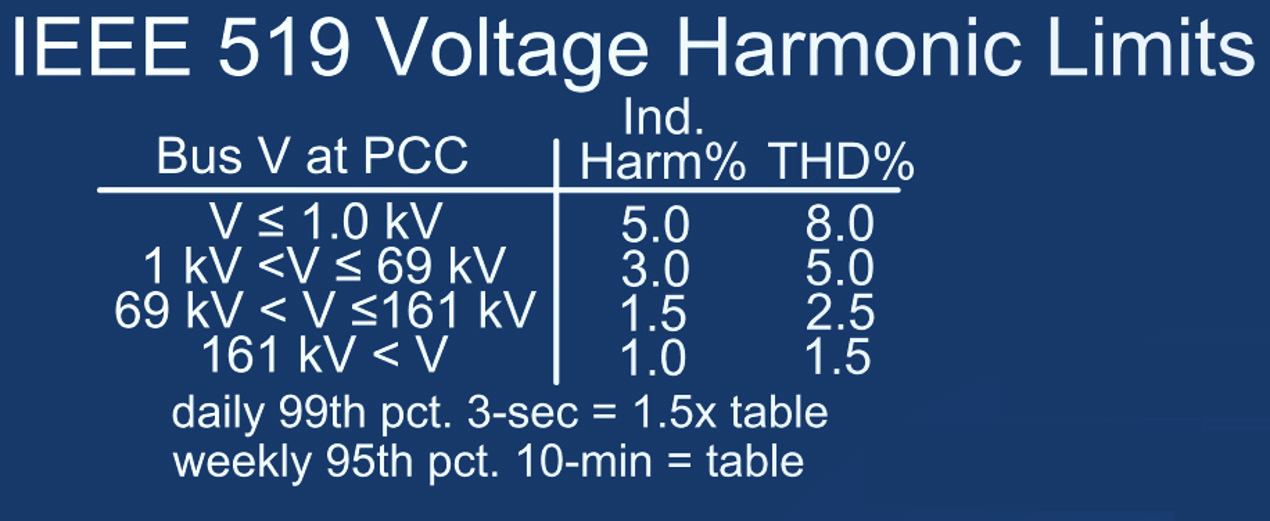
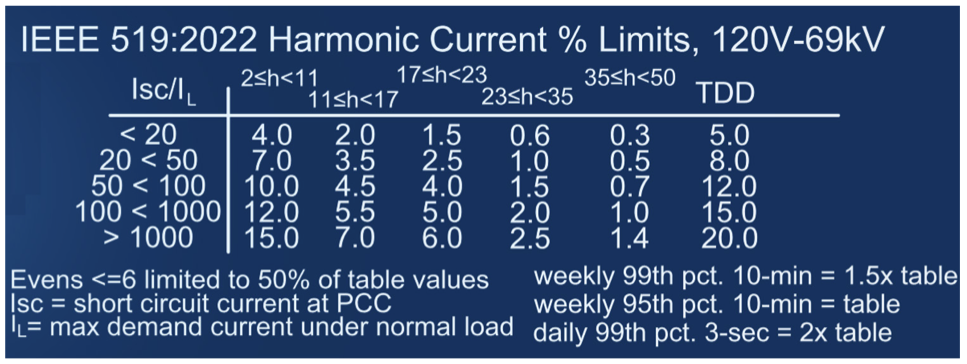
The standard was heavily revised in 2014, with more modern measurement techniques and rigorous thresholds. These are shown in Figure 1 for voltage and current, as listed on the PMI PQ ruler. In 2014 there were no other published PQ standards for DG, and the only reference in 519-2014 is a note that if the customer has local generation, the most strict harmonic current limits must be used in the applicable table (note “c” in the current table).
IEEE 519 was most recently revised in 2022. Since 2014, two newer standards have emerged that specifically cover DG. Now IEEE 519-2022 provides guidance on which standard applies in the presence of DG. In keeping with 519’s scope as a load standard, the guidance is to use IEEE 519 if DG/IBR total rated generation is < 10% of annual average load demand at the site. Note that this is rated generation, not actual generation, and the “average load demand” is not a thermal max demand, or “max demand load current” as used elsewhere in 519. The intent is that if the customer is primarily load, use 519. If the total rated generation is 10% or greater, then IEEE 1547 or 2800 should be used instead.
IEEE 1547
IEEE 1547-2018, IEEE Standard for Interconnection and Interoperability of Distributed Energy Resources with Associated Electric Power System Interfaces, covers DG connect to distribution systems. The first edition was released in 2003, when DG systems were relatively small and uncommon. This edition covered systems under 10 MW, and was primarily focused on ensuring that DG was safe, and would not interfere with existing utility voltage regulation and protection schemes. Although flicker and harmonic limits were present, the bulk of the standard discussed disconnect requirements to prevent islanding and interference with the grid.
Due to the rapid evolution of DG, 1547 was amended in 2014, creating 1547A. This revision allowed voltage regulation by the DER and modified the voltage and frequency requirements.
IEEE 1547-2018 is a complete overhaul of the original, expanding from 26 to 138 pages. At this point, DER penetration is large enough to affect system inertia and stability. The 10 MVA limit was removed. Detailed requirements were added for voltage regulation, watt/VAR generation, response to faults and anti-islanding requirements, and communications. The power quality requirements were expanded to include more detailed harmonic and interharmonic limits, flicker, and rapid voltage change limits.
The main sections of IEEE 1547 include:
- Performance Requirements
- VAR/Power/Voltage Control
- Power Quality
- Islanding
- Secondary grids/spot networks
- Test & verification requirements
Although somewhat dated, the IEEE 1547.2 Application Guide is still available and a useful reference. This was released in conjunction with 1547-2003, and includes “Tips, techniques, and rules of thumb”, along with some background material on DG and power quality.
The power quality requirements in 1547 cover DC injection, flicker, harmonics, overvoltage, and peak voltage. The DC limit is simply 0.5% of the full rated current output. The flicker contribution (emission) must be under 0.35 Pst, and 0.25 Plt. MV rapid voltage changes are limited to step changes of 3%, and ramps of 3% per second averaged over 1 second. The limits at LV are 5%.
There is no limit for voltage distortion, but current harmonics are limited to values similar to 519-2022, with two significant differences:
- Harmonic measurements are relative to the DER rated current capacity, instead of the max demand load current in 519
- TDD from 519 is replaced by TRD – Total Rated Distortion, which includes interharmonics to the 51st, and is scaled by the rated current capacity.
RMS overvoltage is limited to 138% of nominal for a duration of 1 cycle. An instantaneous transient overvoltage is specified as a graph showing an acceptable and non-acceptable region. The absolute max allowed is 2.0X the nominal peak voltage, for up to 1.6 ms. The curve has further breakpoints at 1.7X / 3 ms, 1.4X / 16 ms, and 1.3X / 166 ms. These are cumulative limits over a 1 minute window.
IEEE 2800
IEEE 2800, IEEE Standard for Interconnection and Interoperability of Inverter-Based Resources (IBRs) Interconnecting with Associated Transmission Electric Power Systems, is the standard for transmission-connected IBRs. Unlike 1547, IEEE 2800 only applies to electronic inverter generation, not traditional rotating generation. It also applies to VSC-HVDC (voltage source converter), but not to LCC-HVDC (line commutated converter) systems. In situations where 1547 or 2800 may apply (e.g. certain subtransmission systems), generally the utility may select which to use. Highlights of IEEE 2800 include:
- Interconnect requirements
- Reactive power control requirements
- Frequency requirements
- Response to sags, frequency deviations
- Power quality limits (voltage fluctuations, harmonics, overvoltage)
- Protection requirements
- Test and Verification requirements
- Several informative annexes – voltage stability, system strength, protection settings, modeling, etc.
The PQ requirements are similar, but not the same as 1547. The rapid voltage change limit is 2.5% for frequent events, and 88% retained voltage for up to 4 cycles, and 90% retained voltage for up to 2 seconds. The Pst and Plt contribution limits are identical to 1547.
The harmonic limits are similar in structure to those in 1547, using TRD and max rated current. The specific limits are similar, but not identical to the HV limits in 519. The overvoltage limit structure is also similar to 1547, but a bit stricter.
Using the Standards
Each of these standards provides limits for utility customers that limit their ability to adversely affect grid operations:
- IEEE 519-2022: a load standard, use if local DG is < 10% of annual load
- IEEE 1547: DG in distribution, both IBR and rotating generation
- IEEE 2800: DG in transmission, IBR only
| Standard | 519-2022 | 1547-2018 | 2800-2022 |
|---|---|---|---|
| Scope | DG < 10% of average load | Distribution DG | Transmission IBRs |
| Voltage Harmonics | Yes | No | No |
| Current Harmonics | Harmonic subgroups, based on short circuit current and max demand load current | Yes, includes interharmonics and TRD | Yes, includes interharmonics and TRD |
| Flicker | No | Yes | Yes |
| Rapid Voltage Change | No | Yes | Yes |
| RMS Overvoltage | No | Yes | Yes |
| Instantaneous Overvoltage | No | Yes | Yes |
The scope and requirements are summarized in Table 1. However, none of the IEEE PQ standards are required by law or regulatory agencies. The best way to give “teeth” to these standards is to include them as requirements in the customer tariff agreement. In many cases, the standards are newer than most tariffs, however new customers and in particular new DG sites should be included.
A key decision when specifying 519, 1547, and 2800 into the tariff is which version to use. There are several choices:
- Don’t specify a specific edition, e.g. “IEEE 519”
- Specify a certain edition, e.g. “IEEE 519-2022”
- Reference the latest edition, e.g. “The most recent edition of IEEE 519 at the time of connection”
There are advantages and disadvantages to #2 and #3 in any case the choice should be intentional rather than accidental.
Demonstrating compliance includes commissioning or witness testing, and periodic or even permanent continuous monitoring. Compliance may worsen as the DG site grows, inverter technology evolves (even from firmware updates or settings changes), and the grid impedance and inertia change. These standards provide a mechanism for utilities to force DG operators to mitigate problems they create on the grid.
Conclusion
The three standards discussed in this paper, IEEE 519, 1547, and 2800, provide crucial power quality limits for distributed generation at various points in the electric grid. Adherence to these standards is paramount for maintaining grid safety, stability, and voltage quality. Ensuring compliance necessitates both initial and ongoing monitoring, coupled with the ability to enforce standards through inclusion in utility tariffs. Given the rapid evolution of both standards and technology in this domain, staying abreast of developments on both fronts is imperative. This paper provides a concise overview of the current standards, aiming to equip readers with a foundational understanding of their significance and application.