Abstract
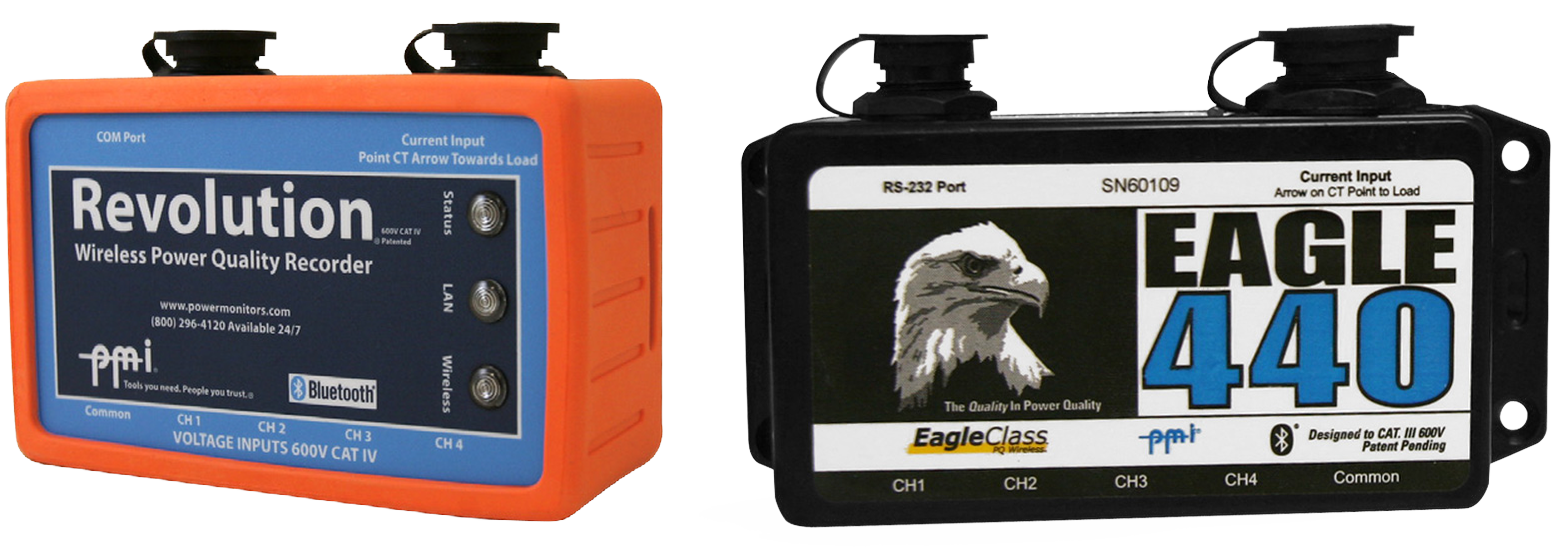
PMI manufactures several stand-alone power quality analyzers that are designed to fit in tight enclosures and wirelessly transmit recorded data. This paper outlines the differences between two of those devices, PMI’s Revolution and the PMI Eagle 440.
Similarities
Housing
The Revolution and Eagle 440 are both enclosed in NEMA 4X rated housings that are less that 5 inches wide and 2 inches deep. Each unit weighs less than a pound.
Power Supply Requirements
Both units are powered via channel 1 voltage at 47-63 Hz.
Communication
Both units come standard with USB and Bluetooth® connectivity.
Functions
Both the Revolution and Eagle 440 measure four channels of RMS voltage at 0 to 600 VAC and four channels of RMS current data from 0 to 5,000 amps. Both can measure harmonics to the 51st. The Revolution and the Eagle 440 each come standard with the ability to measure real power, apparent power, reactive power, phase angle, power factor, displacement PF, and phase angle.
Both have the same voltage accuracy specs:
- Voltage: ±0.33% of full scale
- Current: ±1.0% of F.S. w/o probe
- Power: ±1.0% of F.S. w/o probe
- Phase Angle: 1.0° w/o probe
- Power Factor: ±0.02 w/o probe
- Displacement PF: ±0.02 w/o probe
Differences
Housing
While both units are designed to be pocket-sized, the Revolution has a rubber boot and is a bit bulkier– approximately a half an inch wider than the Eagle. The Revolution has several indentations along the perimeter of its detachable boot that allow an external, magnetic mounting clip to be attached. The Eagle has a mounting bracket molded into its housing; like the Revolution bracket, it was designed to be fastened into place with zip-ties or fasteners, but it is not magnetic.
Communication
Both units have Bluetooth capability, however, the Eagle is equipped with standard Class 2.0 Bluetooth, and the Revolution comes equipped with Class 1.0 Bluetooth. Bluetooth 2.0 rating has power outputs up to 2.5 mW; the Class 1.0 Bluetooth has power levels up to 100 mW, making it more ideal for downloading large amounts of data.
This indicates that the Revolution’s RF power output is up to 16 dB higher than an Eagle’s which equates to a communication range increase, assuming the same antenna gains of 6.32 times farther on the Revolution as compared with the Eagle.
In addition to Bluetooth and USB, the Revolution can be delivered with ethernet and/or a cellular modem installed. The cell modem-equipped Revolution is currently built with a dual band Wavecom 3G modem with a Coilcom chipset. This modem utilizes the 850 and 1900 MHz CDMA cell phone bands, and Verizon is the service provider. The maximum output power is 350mW CDMA. All command and control functions including fast recording downloads, and even real-time viewing are available via a cellular connection when the Revolution is equipped with this option. The cell modem-equipped Revolution is unique in its ability to allow the operator to control and download a variety of power quality metrics remotely.
Safety Rating
The Eagle carries a CAT III safety rating, the Revolution has a higher rating of CAT IV.
Power Consumption
Maximum power consumption is lower on the Eagle. It consumes 1.5 watts versus the 5 watts typically consumed by the Revolution.
Calibration Standards
The Revolution has a traceable calibration report for every measurement with each unit, the Eagle has a basic accuracy report available at extra cost.
Clock
The Revolution has a high accuracy clock, under 10 parts per million drift; the Eagle has a standard accuracy clock.
Memory
The Eagle 440 comes standard with 8 MB memory; the Revolution comes standard with 16 MB and is upgradable up to 128 MB, 512 MB or 1 GB.
Functions
One of the most notable differences between the Revolution and the Eagle 440 is sample rate. The Revolution uses a voltage channel sampling rate of 1MHz, 16,666 samples per cycle to detect and measures voltage transients up to 5kV peak magnitude. Current channels are sampled at 250 kHz or 4,166 samples per cycle. The Eagle utilizes a sample rate of 256 samples per cycle and 15,360 samples per second/channel and measures 0-600 VAC. The Revolution’s faster sampling rate allows it to respond more quickly to instantaneous changes in voltage and current, which requires the Revolution to generate larger files when compared with the Eagle for the same amount of time, necessitating its larger memory capacity.
Transient Capture
ProVision supports the transient capture function on the Revolution because it has a high enough sample rate, or resolution, to capture transient events and spikes. Transients and spikes are very brief periods of extreme voltage usually resulting from adverse system conditions such as crossed transmission lines, lightning strikes or switching faults. Harmful transients can be very fast, changing voltage values measured in millionths of a second. The Eagle 440 does not support the transient capture function.
A faster sample rate makes transient capture possible for a number of reasons. Powerline voltage, or analog voltage, must be converted into a digital format for recording. This process, which uses an analog to digital converter, takes a snapshot of the voltage for each sample– very much like a camera taking a picture of a fast moving object. The faster the shutter speed of the camera, the more pictures of the event are captured thus more detail. If the shutter speed of the camera is too slow, the whole event could be missed completely. The sample rate of an A/D converter is very similar and is one of the driving factors behind the design of the Revolution and the incorporation of transient capture capability.
Options
While the Eagle 440 is part of a series of units designed to measure 1, 2, 3, and 4 channels of voltage and current respectively, the 440 itself is not customizable. The Eagle 220, 330, and 440 are basically identical to each other except for the number of voltage and current channels that are available. The Eagle 220 has two voltage and two current inputs; the Eagle 330 has three voltage and current inputs; the Eagle 440, like the Revolution, has four. The Eagle 200, which is also part of this series, is different in that it measures 0 to 300 VAC and is used primarily in 400 amp residential meter-base applications. In addition, the Eagle series includes the Eagle 120 which was designed to plug into a normal 120 VA household-type socket and has a receptacle for a load device. It works continuously with AC voltage inputs from 60 to 140 VAC and measures instantaneous voltages from 0 to 240 volts. The Eagle 120 only measures and records 1 channel of voltage and current information. It measures just 15 amps continuous but will measure spikes up to 80 Amps RMS.
The Revolution is not part of a series, instead it is offered as a base with expandable features. The Revolution can be upgraded with memory– 128MB, 512MB or 1 GB, communication options including ethernet and cell modem, and transient capture capability.
More detailed information on each product’s specifications is available in Table 1.
| Revolution | Eagle 220, 330, 440 | Eagle 200 | Eagle 120 | |
|---|---|---|---|---|
| Channels | 4 channels | 2, 3, or 4 channels | 2 channels | 1 channel |
| Inputs | ||||
| AC Voltage | 0 to 600 RMS continuous per phase (±5 kV peak transients) | 0 to 600 VAC | 0 to 300 VAC | 0 to 240 VAC Peak; 60 to 140 VAC RMS Continuous; Neutral-Ground 0-75 VAC RMS |
| AC Current | 0 to 5000 amps | 0 to 5000 Amps with CT probes | 0 to 1000 amps | 0 to 80 amps RMS (15 amps continuous) |
| Sample Rate | 1 MHz Voltage (16666 samples/cycle); 250 kHz current (4166 samples/cycle) | 15,360 samples per second/channel; 256 samples per cycle per channel | 15,360 samples per second/channel; 256 samples per cycle per channel | 15,360 samples per second/channel; 256 samples per cycle per channel |
| Measured Quantities Per Cycle | ||||
| Volts, Amps, Watts, VAs, VARs, Degrees, Watts/VA, cos (phase angle) | ||||
| Power Usage | kWh, kVARh, kVAh | kWh, kVARh, kVAh | kWh, kVARh, kVAh | kWh, kVARh, kVAh |
| Accuracy | ||||
| Voltage | ±0.33% of full scale | ±0.33% of full scale | ±0.33% of full scale | ±0.33% of full scale |
| Current | ±1.0% of F.S. w/o probe | ±1.0% of F.S. w/o probe | ±1.0% of F.S. w/o probe | ±1.0% of F.S. w/o probe |
| Power | ±1.0% of F.S. w/o probe | ±1.0% of F.S. w/o probe | ±1.0% of F.S. w/o probe | ±1.0% of F.S. w/o probe |
| Phase Angle | 1.0° w/o probe | 1.0° w/o probe | 1.0° w/o probe | 1.0° w/o probe |
| Power Factor | ±0.02 w/o probe | ±0.02 w/o probe | ±0.02 w/o probe | ±0.02 |
| Displacement PF | ±0.02 w/o probe | ±0.02 w/o probe | ±0.02 w/o probe | ±0.02 |
| Harmonics | Up to the 51st | Up to the 51st | Up to the 51st | Up to the 51st |
| Communications | Bluetooth® 2.0 Wireless, USB 2.0 Cell Modem | Bluetooth® Wireless, USB | Bluetooth Wireless, USB | USB; Bluetooth® Wireless (optional) |
| Information Storage | ||||
| Interval | 128 MB (Standard); 512MB or 1 GB (Optional) | 6.9 MB | 6.9 MB | 1.2 MB (Standard); 6.9 MB (with memory option) |
| Graph | 3.75 MB | 3.75 MB | 256 KB (standard); 1.7 MB (with memory option) | — |
| Flicker | 1000 records | 1000 records | 1000 records | 1000 records |
| Waveform Capture | 1 cycle to 4 hour interval | 1 cycle to 4 hour interval | 1 cycle to 4 hour interval | 1 cycle to 4 hour interval |
| Record Settings | ||||
| User selected, stop-when-full or wrap-around memory modes | User selected, stop-when-full or wrap-around memory modes | User selected, stop-when-full, or wrap around memory modes | User selected, stop-when-full, or wrap around memory modes | |
| Flicker Settings | User-defined, or conform to IEEE 1453/IEC 61000-4-15, and IEEE Std. 141 | User-defined, or conform to IEEE 1453/IEC 61000-4-15, and IEEE Std. 141 | User-defined, or conform to IEEE 1453/IEC 61000-4-15, and IEEE Std. 141 | User-defined, or conform to IEEE 1453/IEC 61000-4-15, and IEEE Std. 141 |
| Waveform Capture | Voltage and current threshold, periodic capture, waveshapes, event cross triggers | Voltage and current threshold, periodic capture | Voltage and current threshold, periodic capture | Voltage and current threshold, periodic capture |
| Peak voltage threshold | 1V to 8V in 1V steps | 1V to 8V in 1V steps | 1V to 8V in 1V steps | — |
| Power Supply Requirements | ||||
| Voltage | 60-600VAC Channel 1 to Common (47-63Hz) | 60-600VAC Channel 1 to Common (47-63Hz) | 60-600VAC Channel 1 to Common (47-63Hz) | — |
| Power Consumption | 5 Watts max, 15 VA max at 600V | 1.5 Watts max, 9VA max at 600VAC | 1.5 Watts max, 9VA max at 600VAC | — |
| Environmental | ||||
| Shock | 60 Hz to 2 KHz, acceleration 25G | 60 Hz to 2 KHz, acceleration 25G | 60 Hz to 2 KHz, acceleration 25G | 60 Hz to 2 KHz, acceleration 25G |
| Vibration | 10Hz to 60Hz, amplitude 1.8mm | 10 Hz to 60 Hz, amplitude 1.8mm | 10Hz to 60Hz, amplitude 1.8mm | 10Hz to 60Hz, amplitude 1.8mm |
| Max Altitude | 2.0km (6560 ft), derated above 2.0km | 2.0 km (6560 ft), derated above 2.0 km | 2.0km (6560 ft), derated above 2.0km | — |
| Physical Dimensions | ||||
| Size | 4.8″ L x 3.35″ W x 1.84″ H | 4.375″L x 3.375″W x 1.812″H | 5 3/8″L x 3 1/8″W x 1 1/4″H | 4.9″L x 2.7″W x 1.25″H |
| Case | NEMA 4X | NEMA 4X | NEMA 4X | — |
| Safety | IEC 61010-1, 600V CAT IV | UL/IEC 61010, 600V CAT III | UL/IEC 61010, 600V CAT III | — |
Conclusion
While the Eagle 440 and Revolution are both reliable compact, and weatherproof options for long-term measuring and monitoring of power quality data, the Revolution has number of features that the Eagle 440 does not including options to capture power quality events remotely and at a much higher resolution. Both devices measure four channels of RMS voltage and current data, both measure harmonics up to the 51st, real power, apparent power, reactive power, phase angle, power factor, displacement PF, and phase angle but only the Revolution is capable of transient capture, has expandable memory, and communication upgrades such as ethernet and cell modem connectivity.