Abstract
In this case study, an investor-owned utility responded to a residential customer complaint. The root cause was a newly installed electric tankless water heater, requiring a transformer upgrade beyond the standard size. This case study includes data from the initial power quality recording, the solution that was formulated by the utility using system modeling, and measurements taken after the solution was implemented. The utility’s customer guidelines were modified to account for the severe loading presented by electric tankless water heaters.
The Case Study
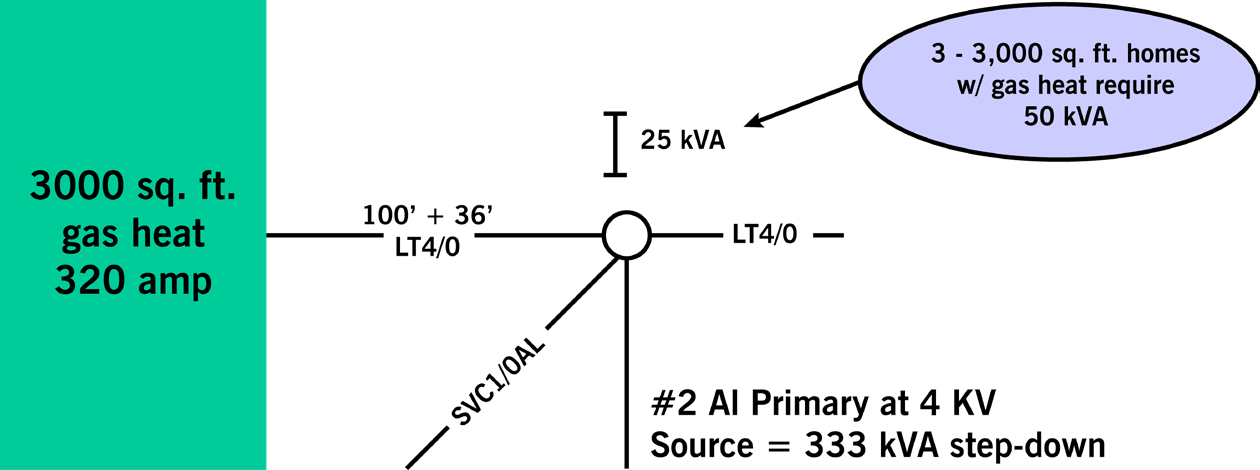
After a 28 kW tankless water heater was installed, (an EEMax tankless water heater model EX280T2T) the customer started complaining about an issue with flicker. The power to the residence was supplied via a 25 kVA transformer with a lateral line from the transformer to the entrance panel with 136 feet of 4/0 wire. The primary line feeding the step-down distribution transformer was 2 AWG aluminum at 4 kV, ultimately fed from a 333 kVA substation transformer (Figure 1). The customer has a 320A service.
A PMI recorder was used to monitor voltage, current, power, and flicker in the investigation. The initial recording showed significant amounts of voltage variation correlated with the TWH operation. The amount of power consumed by the TWH varied depending on the water demand. For low flow rates, the heaters were cycled quickly to reduce the average power; this cycling produces continuously varying voltage levels. For high flow rates, the TWH consumed a very large amount of power, lowering the service voltage. The initial recording revealed these patterns.
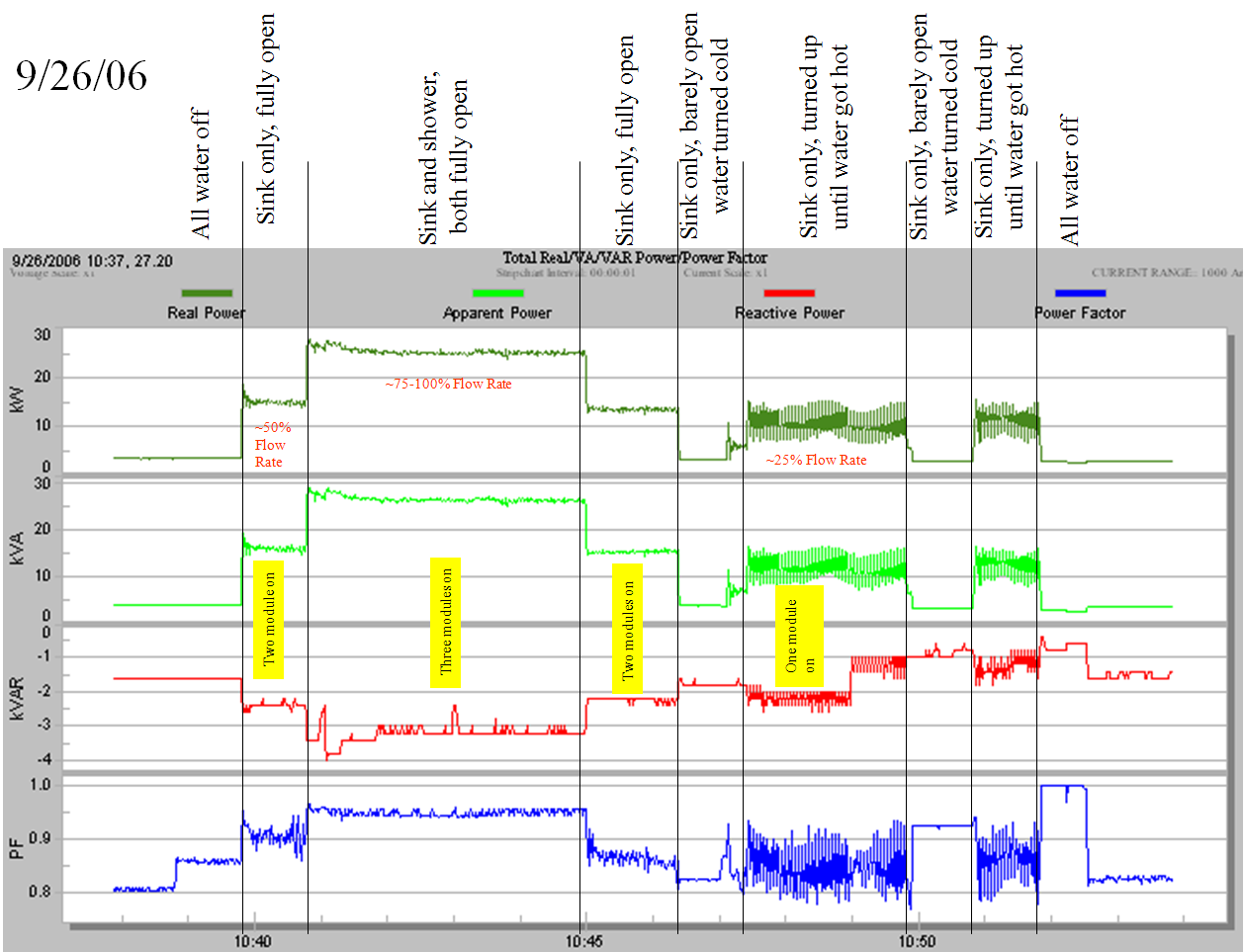
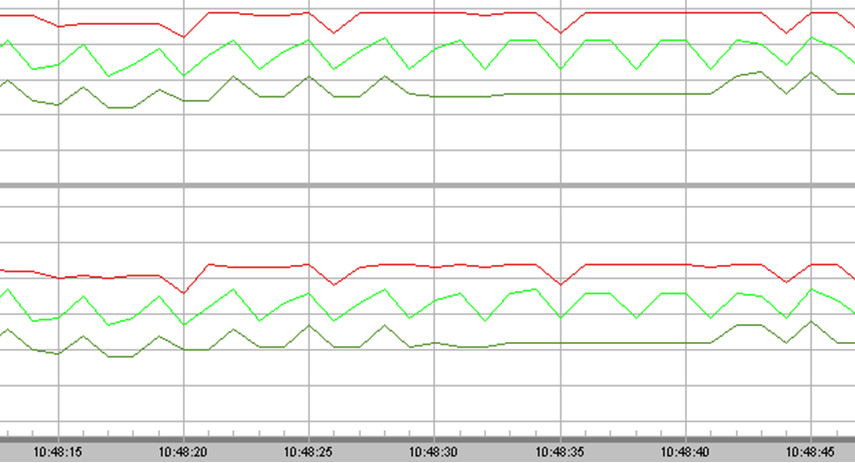
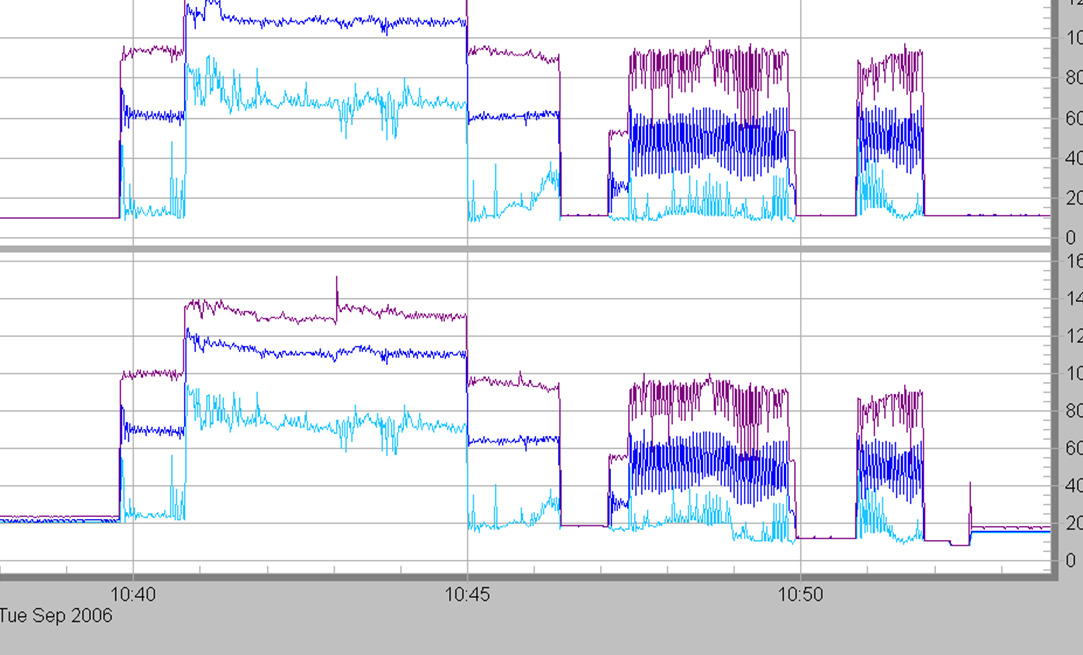
In Figure 2, the power is at a minimum at the start of the graph. “A” on the power measurement shows little power flowing when all water is turned off. The first step, B, shows when just the sink faucet is wide open. This is about 50% of total capacity. The second major step, C, is when the sink and shower are fully opened as the real power reaches the 28 kW level. Then the shower is turned off in D, followed by the sink in E, and power drops to its base level. The next response around 10 kW of draw, in F, is when the sink only is turned up, just until the water gets hot at around 25% flow (Figure 3). In Figure 3, the voltage RMS stripchart is shown during the 25% flow rate. Looking at the spread between the average and minimum values, the voltage variation is around 1%. Since the min is consistently below the average and the max consistently above the average at every interval, it’s clear that the tankless water heater was cycling very quickly and continuously producing flicker. Then in G, the sink’s faucet is barely opened, followed by the sink being turned up for hot water again in H, concluding with everything is turned off again in I. The current drawn during these periods is shown in Figure 4. Not only are the currents high (over 120A), which itself can cause low voltage, but the large current swings in combination will create excessive flicker.
With a typical 25% flow rate the percent voltage flicker, as seen in the spread between the minimum and average voltage, was about 1.00%. Note the continuous separation between the minimum and average voltage readings – indicating persistent voltage variation and thus light flicker, as shown in the graph in Figure 3.
Observations and Recommendations
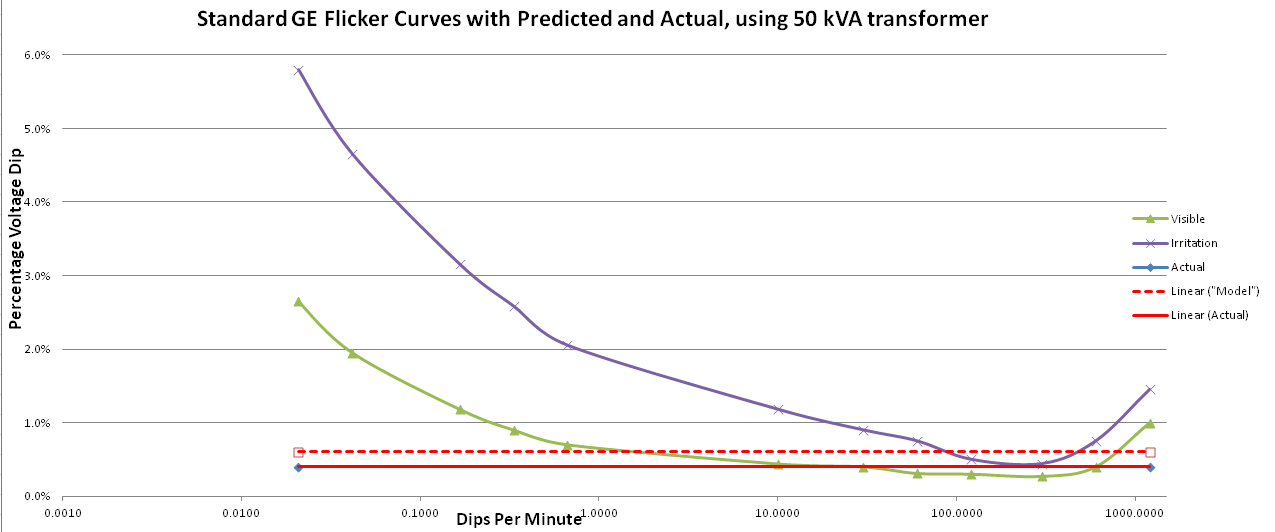
The manufacturer stated in their installation literature that this unit will perform “satisfactorily” if the utility transformer is at least 37.5 kVA in size. An analysis of the present system using distribution modeling software estimated the voltage flicker magnitude at 1.00%. This was confirmed with the actual field data. The existing 25 kVA transformer needed to be replaced with a 50 kVA unit to meet the utility’s standards for loading. System modeling indicated that a 50 kVA transformer would reduce the flicker to around 0.6%, a 40% reduction (Figure 5). In Figure 5, the standard GE flicker curves are shown with a threshold of irritation in purple and visibility in green. The model predicted a reduction to a 0.6% voltage variation level marked by the dotted line in Figure 5. If the customer requested a greater voltage flicker magnitude reduction than provided with the 50 kVA transformer, then additional studies/alternatives would be analyzed with all work to be done at the customer’s expense.
Follow-Up Data
The 25 kVA transformer was replaced with a 50 kVA unit. The customer stated the flicker was still noticeable, yet tolerable. Afterwards, the customer agreed to follow up the test to again confirm the system modeling results. The utility attempted to match the initial testing protocol as closely as possible.
Results and Observations
Replacing the 25 kVA transformer with the 50 kVA transformer made a noticeable and measurable improvement in voltage flicker from about 1% to only 0.4%. This level is marked by the solid red line in Figure 5 and is well below the threshold of irritability. The utility is obligated to maintain a voltage within +/- 5% of nominal, 120 volts, for five-minute intervals for residential customers in urban areas. Tankless water heaters can operate longer than this five-minute interval. The 50 kVA transformer can maintain substantial overloads for brief periods, but the high-side transformer fuse could be the limiting factor with sustained TWH operation combined with other large loads.
Path Forward
Some additions were made to the IOU’s company guidelines concerning customer responsibilities associated with installing a tankless water heater. This particular utility normally designs its services to support a 5500-watt electric water heater. Instantaneous or tankless water heaters exceeding these parameters may cause excessive voltage drop and the utility must now be consulted before these units are installed. The customer may incur charges for corrective actions which the utility may have to take in order to reduce the flicker caused by tankless water heaters.
Due to the increasing popularity of tankless water heaters, planning needs to be done in anticipation of entire residential developments using this technology. It will be necessary in the future to add diversified loads of TWHs to utility loading charts in order to maintain voltages within +/- 5% of nominal 120 volts for five-minute intervals for residential customers in urban areas, and to not exceed the transformer fusing guidelines.
Transformer Sizing Comparison
The following table in Figure 6 shows a comparison of two sets of data from the test, one with the original 25 kVA transformer, and one with the larger 50 kVA transformer.
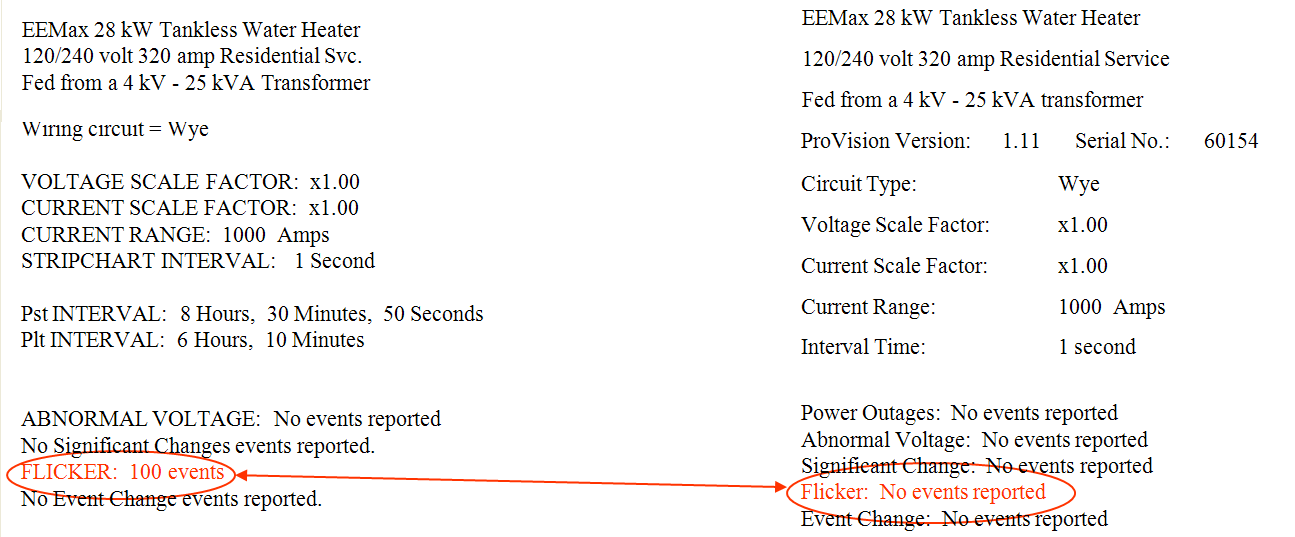
From the previous report in Figure 6, there is a clear improvement in the number of flicker events with the 50 kVA transformer compared to the 25 kVA. The 25 kVA transformer had a flicker report with 100 events triggered in roughly 16 minutes. The 50 kVA transformer had zero flicker events triggered in a 31-minute time span.
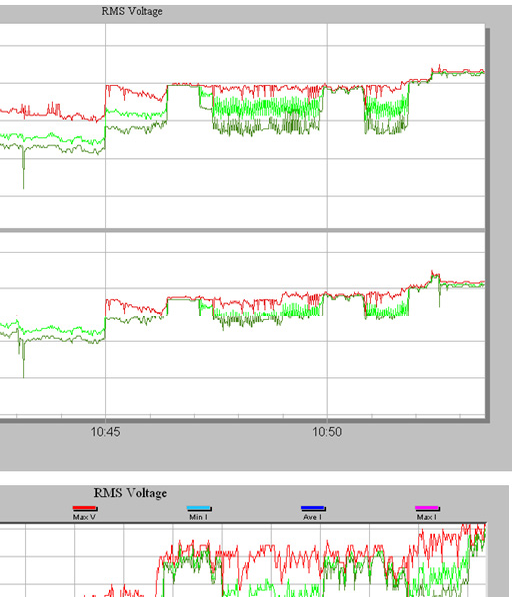
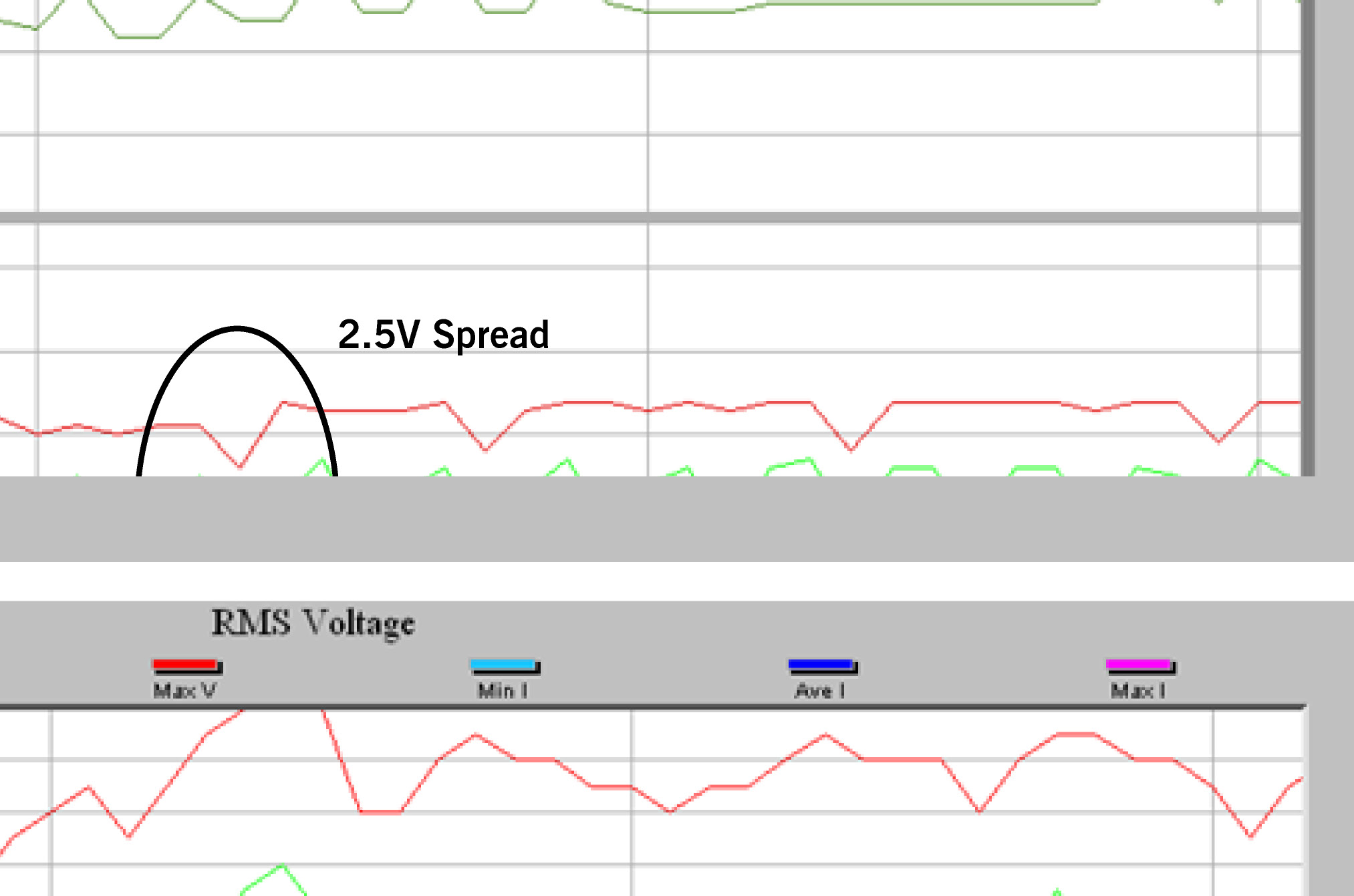
Figure 7 shows a comparison with the small transformer (top graph) and the large transformer (bottom graph) during all phases of the tankless water heater (similar to Figure 2). In Figure 8, a comparison is shown for the 25% flow rate portion. Note that the voltage scale has changed between the top 25 kVA and the bottom 50 kVA. The top scale is two volts per major division versus the 50 kVA showing a one-half volt per major division. The spread between the min and max is 2.5V in the top graph (small transformer), and about 1V in the bottom graph (large transformer). This significant reduction in voltage spread translates directly to lower light flicker.
Conclusion
In this case study, the utility responded to the customer’s flicker complaint after an installation of a tankless water heater and took measurements to verify the severity of the problem. With the measurements made, it was possible to use modeling software to simulate the effect of upsizing the transformer from 25 kVA to 50 kVA. The model predicted that the flicker should be reduced by 40%, which would more than satisfy the minimum power quality requirements. The utility proceeded to replace the 25 kVA distribution transformer with a 50 kVA model along with a follow-up recording. The measurements validated the modeling predictions, and the customer stated that even though the flicker was still noticeable it was much less severe and tolerable. In the future utility planning and customer guidelines must take into account the possibility of a tankless electric water heater and its very high power requirement.