Abstract
All PMI Revolution power quality analyzers go through a thorough and rigorous testing phase to ensure that they operate reliably and effectively. All Revolutions go through multiple tests including: a current accuracy test, a voltage accuracy test, a phase angle and power factor accuracy test, a real power accuracy test, a reactive power accuracy test, and a PST flicker test. VISION units also go through these same testing procedure, and have the same calibration report.
Each Revolution is tested for one hour using a state of the art, custom designed calibration fixture. This fixture contains high accuracy signal generators, meters, and calibration standards. The entire test is computer controlled and automated, so that it can be repeated easily. The tests are designed to verify that the Revolution is recording with very little margin of error. All reported values are traceable back to primary standards. All units sent back for checkout or repair gets retested.
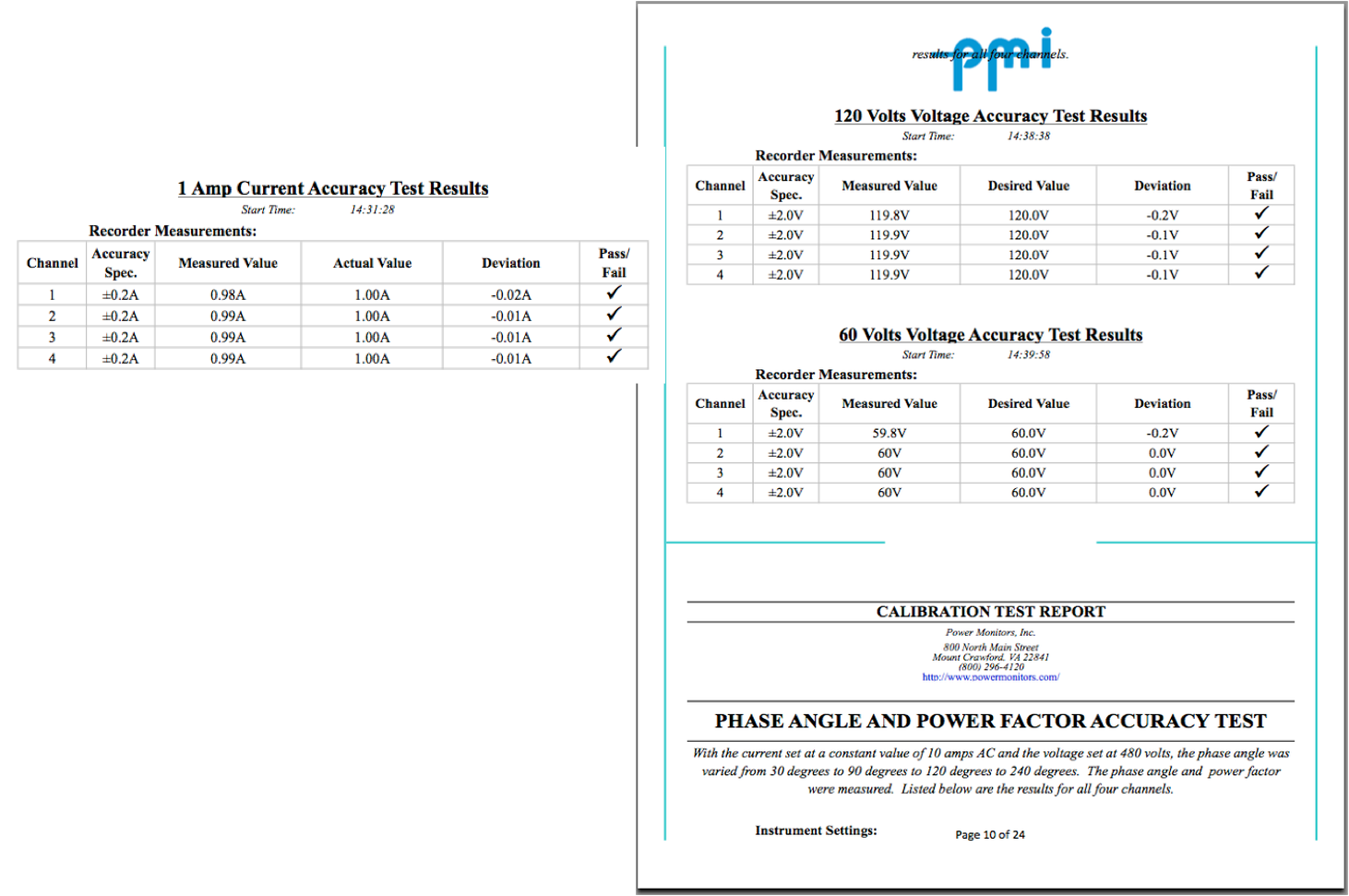
Although the procedures vary from test to test, as well as the parameter being tested, there is only one parameter being tested in each test. As shown in Figure 1, each page of the booklet contains several columns indicating the output value, the value measured by the recorder, the error of the measurement, the accuracy specification of the recorder, the measured error as a percentage of the stated specification, and whether or not the recorder complies with the stated specification.
Summary of Terms in Report
Environmental Information. This includes the temperature, barometric pressure, and humidity of the environment in which the Revolution was calibrated.
Recorder Information. The recorder information includes the internal temperature and the battery voltage of the Revolution.
Instrument Settings. The instrument settings include the settings that were used for the test, other than the parameters being tested.
Start Time. This is the start time of the individual test.
Channel. This is the channel whose results are reported in that row.
Accuracy Spec. This is the value which PMI specifies for the accuracy of the measured parameter for the Revolution.
Measured Value. This is the value measured by the Revolution.
Actual Value. This is the actual value of the parameter being measured.
Deviation. This is the difference between the actual value and the value measured.
Pass/Fail. This indicates whether or not the measurement is within specification.
The booklet starts with information about the tested Revolution and its initial settings. First listed is the date that the tests were performed. Next the start and stop times of the tests, and the total duration of the tests. The recorder model is listed, as well as its serial number. Next listed is the firmware version installed on the unit, and the version of ProVision installed. Lastly the circuit configuration and the recording interval used are listed.
Information Presented Before Test Results
Before the test results are listed, information relevant to the test environment is presented. Relevant information includes the environmental information during the test. This includes the ambient temperature of the room, the barometric pressure, and the humidity.
Also presented is the recorder’s internal temperature and battery voltage.
Tests
Current Accuracy Test. During this test the voltage is set to a constant of 120VAC. Current during the test is varied from one amp to five amps to ten amps for all four channels.
Voltage Accuracy Test. During this test the current is set to a constant of 0 amps AC. The voltage is varied for all four channels from 600 volts to 480 volts to 240 volts to 120 volts to 60 volts to 10 volts to 0 volts. The internal battery’s ability to power the Revolution is tested during the 0 volt trail, as the Revolution is not being supplied enough voltage to operate during the test.
Phase Angle and Power Factor Accuracy Test. During this test the current is set to a constant value of 10 amps AC and the voltage to 480 volts. The phase angle is varied from 30 degrees to 90 degrees to 120 degrees to 240 degrees. During the test both the phase angle and power factor are measured.
Real Power Accuracy Test. During this test the current is set to a constant value of 10 amps AC and the voltage is set to 480 volts for all four channels. The phase angle is set at +30 degrees. During this test the real power is measured.
Apparent Power Accuracy Test. During this test the current is set to a constant value of 10 amps AC, and the voltage at 480 volts for all four channels. The phase angle is set to +30 degrees and the real power is measured.
Reactive Power Accuracy Test. During this test the current is set to a constant value of 10 amps AC, and the voltage at 480 volts for all four channels. The phase angle is set to +30 degrees and the reactive power is measured.
Frequency Accuracy Test. During this test the current is set to a constant of 10 amps AC and the voltage to 120 volts, while the frequency is varied from 48Hz to 50Hz to 52Hz to 54Hz to 56Hz to 60Hz to 62Hz.
PST Flicker Test. During this test the current is set to a constant value of 0 amps AC, while the voltage is set to 120 volts AC for channels 1, 2, and 3. The voltage is then fluctuated by 1.695% at a frequency of 0.05833 hertz creating a PST value of 1.0.
Conclusion
Each Revolution is rigorously tested to ensure that they meet the highest standards for measurement accuracy. Each Revolution is put through multiple tests with Power Monitors, Inc. state-of-the-art calibration fixture to ensure that it measures within an acceptable margin of error.